Micrographia: or some physiological descriptions of minute bodies made by magnifying glasses. With observations and inquiries thereupon / By R. Hooke.
- Robert Hooke
- Date:
- 1665
Licence: Public Domain Mark
Credit: Micrographia: or some physiological descriptions of minute bodies made by magnifying glasses. With observations and inquiries thereupon / By R. Hooke. Source: Wellcome Collection.
291/384 page 191
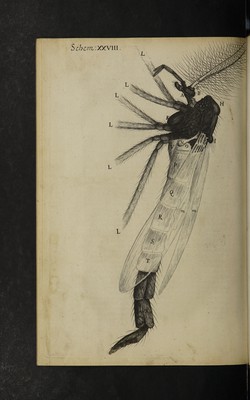
![I?r Eggs muft certainly be very final], which fo final] a creature is a Gnat yields, and therefore: we need not wonder .that we find not the Eggs themfelves, Tome of the younger of them, which I have obferv’d, having not exceeded a tenth part of the bulk they ha ve afterwards come to 5 and next,I have obferved fome of thofe little ones which muft have been gene¬ rated after the Water was inclofed in the Bottle, and therefore moff pro¬ bably from Eggs, whereas thole, creatures have been fuppos'd to be bred of the corruption of the Water, there being not formerly known any probable way how they fl^ould be generated. A fecond is, whether thefe Eggs are immediately dropt into the Water by the Gnats themfelves, or, mediately, are brought down by the falling rain * for it feems not very improbable',but that thole fmall feeds of Gnats may (being, perhaps, of fo light a nature, and having fo great a propor¬ tion of furface to fo ltnall a bulk of body) be eje&ed into the Air, and fo, perhaps, carried for a good while too and fro in it, till by the drops of Rain it be wallf d out of it. A third is, whether multitudes of thofe other little creatures that are found to inhabit the Water for fome time, do not, at certain times, take wing and fly into the Air, others dive and hide themfelves in the Earth, and fo contribute to the increafe both of the one and the other Element. A good while fince the writing of this Defcription, I was prefented by Do&or Peter Ball, an ingenious Member of the Royal Society^with a little Paper of Nuts, which he told me was fenthim from a Brother of his out of the Countrey,from Mamhead in Devonjhire,fome of them were loole, having been, as I fuppole, broken off, others were ftill growing faft on upon the fides of a ftick, which feem’d by the bark, pliablenefs of it, and by certain ftrings that grew out of it, to be fome piece of the root of a Tree 5 they were all of them dry’d, and a little fhrivelfd, others more round, of a brown colour $ their fhape was much like a Figg, but very much fmaller,lome being about the bignefs of a Bay-berry,others,and the biggeft, of a Hazel-Nut. Some of thefe that had no hole in them, I care¬ fully opened with my Knife, and found in them a good large round white Maggot, almoft as bigg as a fmall Pea, which feem’d fhap’d like other Maggots, but fhorter. I could not find them to move, though I ghefs d them to be alive, becaule upon pricking them witha Pinn, there would if fue out a great deal of white mucous matter,which feem’d to be from a vo¬ luntary contraction of their fkin \ their hulk or matrix confifted of three Coats,like the barks of Trees, the outermoft being more rough and Ipon- gie, and the thickeft, the middlemoft more clofe, hard, white, and thin, the innermoft very thin,feeming almoft like the Ikin within an Egg’s fhell. The two outermoft had root in the branch or ftick, but the innermoft had no Item or procels, but was onely a fkin that cover’d the cavity of the Nut. All the Nuts that had no holes eaten in them, I found to con¬ tain thefe Maggots, but all that had holes, I found empty, the Maggots, it (](https://iiif.wellcomecollection.org/image/b30326370_0291.jp2/full/800%2C/0/default.jpg)