Dr. Conquest's outlines of midwifery : intended as a text-book for students, and a book of reference for junior practitioners.
- Conquest, Dr.
- Date:
- 1854
Licence: Public Domain Mark
Credit: Dr. Conquest's outlines of midwifery : intended as a text-book for students, and a book of reference for junior practitioners. Source: Wellcome Collection.
165/370 (page 151)
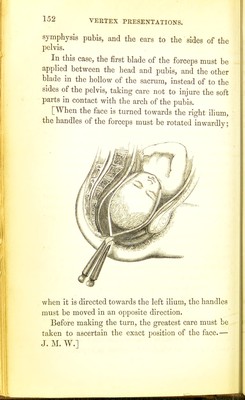
![The best description of forceps, however, is apt to slip, owing to the difficulty of maintaining a firm hold of the head when it is in this position. On this account many practitioners prefer the vectis. — J. M. W.] Considerable time should be given in this position of the head; for it is surely a less evil to allow the woman to endure a little more pain, than to endanger the perineum by a hasty delivery. • ■ 3. When the head has descended into the cavity of the pelvis, the ears are sometimes opposed to the symphysis pubis and hollow of the sacrum, and the occiput and face opposed to the sides of the pelvis. In this case, the long diameter of the head corre- sponds with the shortest diameter of the outlet; con- sequently, the sacro-ischiatic ligaments, the spinous processes of the ischia, and the situation of the shoul- ders at the brim, prevent the advancement of the chUd. Under these circumstances, an attempt should be made to turn the head half-round with the fingers, as suggested in the presentation last under consideration; and if the fingers be inadequate to that quantum of force which may be necessary, the forceps must be substituted to effect the same object. Very often, when this half-turn is made (which should always be so effected as to bring the face into the hollow of the sacrum), the difficulty being over- come, nature will terminate the labour. Should she not, the forceps are to be used as in the first supposed case; or that in which the occiput is opposed to the](https://iiif.wellcomecollection.org/image/b20398840_0165.jp2/full/800%2C/0/default.jpg)