Dr. Conquest's outlines of midwifery : intended as a text-book for students, and a book of reference for junior practitioners.
- Conquest, Dr.
- Date:
- 1854
Licence: Public Domain Mark
Credit: Dr. Conquest's outlines of midwifery : intended as a text-book for students, and a book of reference for junior practitioners. Source: Wellcome Collection.
72/370 (page 58)
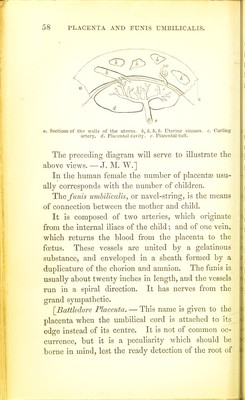
![a. Sections of the walls of the uterus, b, b, b, b. Uterine sinuses, c. Curhng artery, d. Placental cavity, c. Placental tuft. The preceding diagram will serve to illustrate the above views. — J. M. W.] In the human female the number of placentae usu- ally corresponds with the number of children. The funis umbilicalis, or navel-string, is the means of connection between the mother and child. It is composed of two arteries, which originate from the internal iliacs of the child; and of one vein, which returns the blood from the placenta to the foetus. These vessels are united by a gelatinous substance, and enveloped in a sheath formed by a duplicature of the chorion and amnion. The funis is usually about twenty inches in length, and the vessels run in a spiral direction. It has nerves from the grand sympathetic. [Battledore Placenta. — This name is given to the placenta when the umbilical cord is attached to its edo-e instead of its centre. It is not of common oc- currence, but it is a peculiarity which should be borne in mind, lest the ready detection of the root of](https://iiif.wellcomecollection.org/image/b20398840_0072.jp2/full/800%2C/0/default.jpg)