Licence: Public Domain Mark
Credit: The natural history of digestion / by A. Lockhart Gillespie. Source: Wellcome Collection.
Provider: This material has been provided by the Royal College of Physicians of Edinburgh. The original may be consulted at the Royal College of Physicians of Edinburgh.
110/498
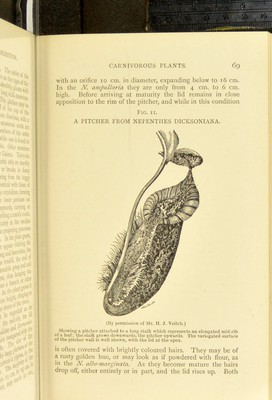
![the pitchers and the lids are invariably of a bright colour, and at a little distance almost exactly simulate flowers. Indeed, they look very like the flowers of the AristolochicR, a genus akin to them, and also to be found in tropical forests. No better description of these plants can be given than that of Kerner in his Natiu’al History of Plants, translated by Oliver:— “ The bright pitchers of Nepenthes, visible from afar, are sought, just as flowers are by insects, and probably by other winged creatures as well; and this occurs all the more because there is a secretion of honey by the epider- mal cells upon the under surface of the lid, and on the rim round the mouth of each pitcher. The swollen and often delicately-fluted rim, in particular, drips and glitters with the sugary juice; and it would be permissible in this connection to speak of a honeyed mouth and sweet lips in the most literal sense of the words. Animals which suck honey from the lips of Nepenthes pitchers wander, as they do so, only too readily upon the interior surface of the orifice. But the inner face is smooth and precipitous, and rendered so sli])pery by a bluish coating of wax that not a few of the alighted guests slip down to the bottom of the pitcher and fall into the liquid there collected. Many of them perish in a short time ; others try to save them- selves by climbing up the internal face of the pitcher, but they alwaj-s slip again on the polished wax-coated zone, and tumble back once more to the bottom. In large pitchers the involute rim of the aperture is in addition armed with sharp teeth, which are pointed downwards and bristle in front of such of the unlucky victims in the pitfall as try to emerge.” The walls of the pitchers may be described as being divided into three zones. The upper one is narrow and close to the rim; as we have already seen, it is studded with epidermal honey- cells, below which are ranged one or more circular rows of spinous processes pointing downwards inside the cavity. The second zone of the internal wall is covered by an exceedingly smooth epithelium which secretes a small quantity of wax. The lower third of the pitcher forms the third zone, which is about half the depth of the second. In it are found thousands of special gland cells which secrete a watery fluid with a very weak acid reaction. The quantity of this liquid may reach many cubic centimetres in some of the larger varieties. It has a slightly acid taste even if obtained from a pitcher into which no insects have fallen, though some say that its reaction is neutral under these circumstances. But as soon as the body of an animal or a piece of meat is dropped in, the fluid is secreted in larger quantities, and with a more distinct acid re- action. 'J'he secretion of the fasting pitcher has no power of igesting proteid substances, unless some acid, organic or](https://iiif.wellcomecollection.org/image/b21941105_0110.jp2/full/800%2C/0/default.jpg)