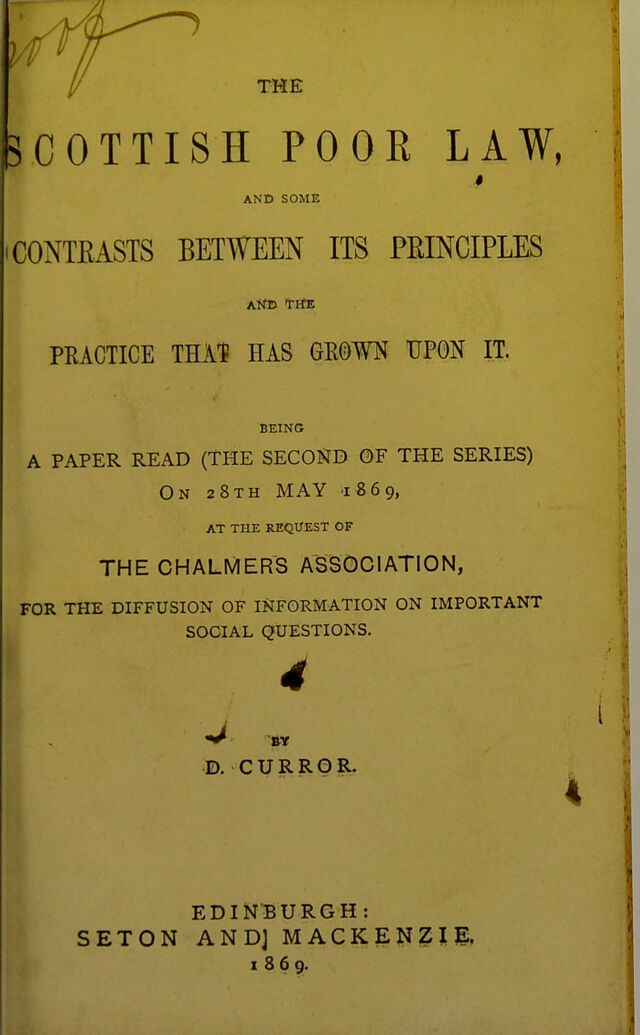
The Scottish Poor Law, and some contrasts between its principles and the practices that have grown upon it : being a paper read ... on 28th May 1869, at the request of the Chalmers Association ... / by D. Curror.
- Date:
- 1869
Licence: Public Domain Mark
Credit: The Scottish Poor Law, and some contrasts between its principles and the practices that have grown upon it : being a paper read ... on 28th May 1869, at the request of the Chalmers Association ... / by D. Curror. Source: Wellcome Collection.
Provider: This material has been provided by the Royal College of Physicians of Edinburgh. The original may be consulted at the Royal College of Physicians of Edinburgh.
12/32 page 10
![contristecl these, and found them in principle, if not identical,' at least twin; brothers, differing more in the clothes they wesr thaniin' the soubwithin them; and now let us contrast both, with some existing practices which have grown out of them, so as to know the kind of fruit our Poor Law System has borne, and thereby test the system itself : A first principle of the apostolic system was, that the impo- tent poor were to share the means and substance of the Chris-, tian brotherhood. Following that precedent, the old Poor Law.: Act provided for the same impotent class out of the means and substance of all the parish. The Amendment Act continued the same principle, if the Parochial Boards chose to exercise the right. But Parochial Boards did not exercise the option, 5ind by die last'Act, 1861, lands and heritages only are now. assessable for the poor-rate. You saw pasted on these walls last week sundry specimens of inequities in the rating of lands and heritages. These are of very minor importance, indeed, to the inequities of the existing principle of rating. The change from meanS' and substance to lands and heritages involves a gross injustice, and is a corrupt departure from principle. Admitting a national Poor Law, all principle and reason lays the burden of the national obligation upon the material wealth of the nation, i.e., its means and substance. But lands and heritages do not represent more than a half of the material wealth of Scotland. That half at present discharges a whole national burden, and the other half goes free. That is not right. Take an example of a class. An ostensible proprietor of 0,000 worth of land, has it burdened with a bond and disposition for ;^8ooo. The return from land is not very great. The nominal proprietor, happen what may, must meet the interest, taxes, and rates applicable to the ;^io,ooo value. But all the risks of income attaches to the last ^2000 of herit- able worth. He runs these risks, and lives upon very short commons indeed. But out of that bare living—an appearance to keep up without the means—probably remembering days of joy when misery is at hand—he pays all the poor-rates; and the real owner of the land—the bondholder—pays ne'er a rap. to maintain the poor. Incomes from manufactures, from stocks, and shares, are all free. A millionaire of Moray Place pays only on his house, and his thousands invested otherwise than; on, land and heritages pay nothing. The poorest house- holder pays on his rent, and his sticks may he rou])ed at the Cross failipg-payraent, and he.and his may be driven to the poor](https://iiif.wellcomecollection.org/image/b21974378_0012.jp2/full/800%2C/0/default.jpg)