The Scottish Poor Law, and some contrasts between its principles and the practices that have grown upon it : being a paper read ... on 28th May 1869, at the request of the Chalmers Association ... / by D. Curror.
- Date:
- 1869
Licence: Public Domain Mark
Credit: The Scottish Poor Law, and some contrasts between its principles and the practices that have grown upon it : being a paper read ... on 28th May 1869, at the request of the Chalmers Association ... / by D. Curror. Source: Wellcome Collection.
Provider: This material has been provided by the Royal College of Physicians of Edinburgh. The original may be consulted at the Royal College of Physicians of Edinburgh.
18/32 page 16
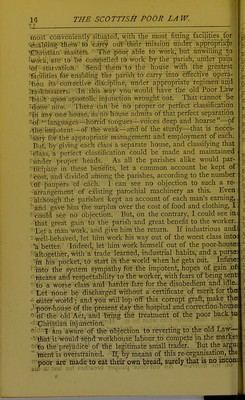
![U : ■ — mosTl^onvemeTT^^ f^LcTlitTes ^for c^ilW^ftf ^liete^«J ''tifcf oiff--%Vir--missibri under approphiife ''8SMlibean^#ai«€ft. ^'^i'l^^fk^ iB& td'-Hvork, but uriwilling'to ■^vf(S^ll;'ar:e''taif'5'e comfiefUed to'work;by the parish, underpaid e(§f-'-%ta,rvation.' 'Send'therri' to the house with the greatest sf^ditotes fdf fenabHri'g tlie parish to carry into_ efifective Opera- ^fijn its- eori-ectlve dlscipirne, under appropriate regimen aprd ?feykmaSters; ' liri ^this have the old Poor Law 9!j4iW;-' upori 'apostdlic' i'hj unction wrought out. That cannot be ^a'6We-'hdw;-' There' tfah be no proper or perfect classification khy one house,'ks'no''house admits of that perfect separation 5^-'Ianguages-^homd tongues—voices deep and hoarse—of .^tM;ii^l|)otent—of the weak—and of the sturdy—that is neces- kkry for the appropriate management and employment of each. But, by giving each class a separate house, and classifying that ^^-kss, a. perfect classification could be made and maintained sflnder proper; heads.: As all the parishes alike would par- ''trci'p'ate in these benefits, let a common account be kept of e^pst, and divided'among the parishes, according to the number- Xbf f>aUpers of each. I can see no objection to such a re-- -■^ari-angeraent of existing parochial macliinery as this. Even; 'although tlie parishes kept an account of each man's earning,, -■^alnd gave him the surplus over the cost of food and clothing, !, sfcduld see no objection. But, on the contrary, I could see ini '^Siat grea:t gain to the parish and great benefit to the worker., ^iiet a man work, and give him the return. If industrious andl 'J%ell-behaved, let him work his way out of the worst class into] i better. Indeed, let him work himself out of the poor-house: t^aitdgether, with a trade learned, industrial habits, and a purse; -ifi his pocket, to start ift tJie world when he gets out Infuse: i'teto' tlie system sympatliy for the impotent, hopes of gain of iHekns and respectability'to the worker, withfears of being sent sfe a worse class and harder fare for the disobedient and idle. e''Eei none be discharged without a certificate of merit for the * o'df^'^^-worM; and yoti will lop off this corrupt graft, make the< 3feey6¥46use of tlie present day the hospital and correction-houSe: Sibf flie' old Act, and bring the treatment of the poor back to. -Jichri^ati ihjuiitiioffif^H ;'C^; ..'.^iC oldri '^^m ^Hvare of flife'6bjfe'ction to reverting to tlie 6M LaW^- -I'tHat it would sehd-workhouse labour to compete in the mafkev s^io tie prejudicfe^ of the legitimatfe small trader. But the argu teent is Overstrained. If, by means of this re-organisation, the r''tibbr are made to eat their own bread, surely that is no incOa](https://iiif.wellcomecollection.org/image/b21974378_0018.jp2/full/800%2C/0/default.jpg)