Licence: In copyright
Credit: Intermediate physics / by W. Watson. Source: Wellcome Collection.
Provider: This material has been provided by UCL Library Services. The original may be consulted at UCL (University College London)
102/588 page 82
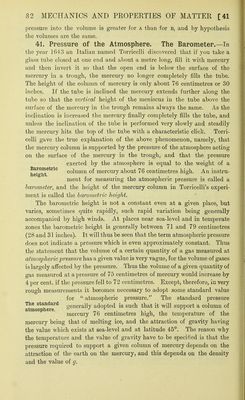
![pressure into the volume is greater for a than for b, and by hypothesis the volumes are the same. 41. Pressure of the Atmosphere. The Barometer.—In the year 1643 an Italian named Torricelli discovered that if you take a glass tube closed at one end and about a metre long, fill it with mercury and then invert it so that the open end is below the surface of the mercury in a trough, the mercury no longer completely fills the tube. The height of the column of mercury is only about 76 centimetres or 30 inches. If the tube is inclined the mercury extends further along the tube so that the vertical height of the meniscus in the tube above the surface of the mercury in the trough remains always the same. As the inclination is increased the mercury finally completely fills the tube, and unless the inclination of the tube is performed very slowly and steadily the mercury hits the top of the tube with a characteristic click. Torri- celli gave the true explanation of the above phenomenon, namely, that the mercury column is supported by the pressure of the atmosphere acting on the surface of the mercury in the trough, and that the pressure exerted by the atmosphere is equal to the weight of a column of mercury about 76 centimetres hio;h. An instru- ment for measuring the atmospheric pressure is called a barometer, and the height of the mercury column in Torricelli's ex]3eri- ment is called the barometric height. The barometric height is not a constant even at a given place, but varies, sometimes quite rapidly, such rapid variation being generally accompanied by high winds. At places near sea-level and in temperate zones the barometric height is generally between 71 and 79 centimetres (28 and 31 inches). It will thus be seen that the term atmospheric pressure does not indicate a pressure which is even approximately constant. Thus the statement that the volume of a certain quantity of a gas measured at atmospheric pressure has a given value is very vague, for the volume of gases is largely affected by the pressure. Thus the volume of a given quantity of gas measured at a pressure of 75 centimetres of mercury would increase by 4 per cent, if the pressure fell to 72 centimetres. Except, therefore, in very rough measurements it becomes necessary to adopt some standard value for atmospheric pressure. The standard pressure The standard creneraliy adopted is such that it will support a column of mercury 76 centimetres high, the temperature of the mercury being that of melting ice, and the attraction of gravity having the value which exists at sea-level and at latitude 45°. The reason M'hy the temperature and the value of gravity have to be specified is that the pressure required to support a given column of mercury depends on the attraction of the earth on the mercury, and this depends on the density and the value of g.](https://iiif.wellcomecollection.org/image/b21641523_0102.jp2/full/800%2C/0/default.jpg)
 No text description is available for this image
 No text description is available for this image
 No text description is available for this image