Licence: Public Domain Mark
Credit: A text-book of pathology / by Alfred Stengel. Source: Wellcome Collection.
Provider: This material has been provided by the Royal College of Physicians of Edinburgh. The original may be consulted at the Royal College of Physicians of Edinburgh.
130/868
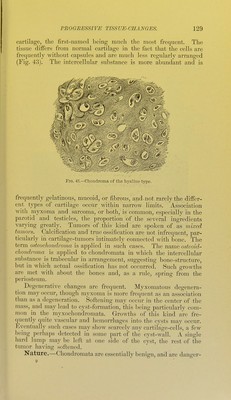
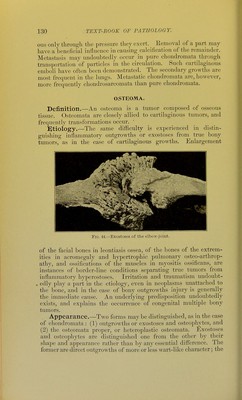
![sent lobular irregularity when they reach considerable size, the lobules being separated by connective tissue. All forms are hard, thougli secondary softening may occur. Fig. 42.—Chondroma of the thumb (Warren). In cases in which association of mucous, sarcomatous, or other soft tissue is present the consistency is correspondingly less. In some cases central softening leads to cystic formation. The liquid in the cyst is more or less turbid and occasionally san- guinolent. Seats.—Ecchondroses and chondromata, for the most part, take their origin from bone, cartilage, or j^eriosteum. In some cases, however, they originate in connective tissue, as that of the tendons, by a process of cartilaginous metaplasia. Cartilage- tumors are met with in some of the glandular organs, notably the parotid gland, testicle, and ovary ; and rarely they occur in the lungs, especially at the root and .springing from the peribronchial cartilages. Ecchondroses are most frequent about the long bones, as those of the extremities, and particularly at the epiphyseal attachments. They are not at all infrequent, and may reach considei'able pi'opor- tions in these situations. Situations of great clinical importance are the interpubic and occipitosphenoidal junctions. In the former situation ecchondroses projecting inward may interfere seriously with labor, and in the latter place cartilaginous outgrowths may ])enetrate the dura and exercise injurious compression on the bi*ain. Allusion has been made to the ecchondroses of the joints in arthritis. Chondromata proper may occur in the neighborhood of bones, in the muscles and tendons near their bony attachments, and in the organs mentioned, but in the last situation are rarely pure, myxoma being the most frequent associate. Structure.—Chondromata resemble hyaline, fibrous, or elastic](https://iiif.wellcomecollection.org/image/b21981668_0130.jp2/full/800%2C/0/default.jpg)