Licence: Public Domain Mark
Credit: A text-book of pathology / by Alfred Stengel. Source: Wellcome Collection.
Provider: This material has been provided by the Royal College of Physicians of Edinburgh. The original may be consulted at the Royal College of Physicians of Edinburgh.
209/868
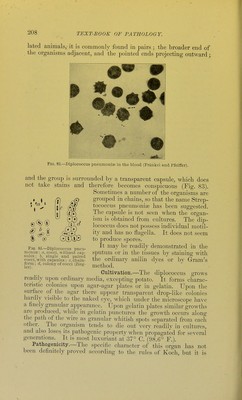
![(staphylococci and others); and the intracellular position is not rarely assumed by a variety of bacteria. The failure to stain by Gram's method and the failure to grow on ordinary media are strong points in favor of the gonococcus. Typical cultures alone settle the diagnosis. Pathogenicity.—It has been demonstrated by direct implanta- tion of pure colonies upon the healthy, urethra that this organism will cause characteristic gonorrhea. Urethritis may, however, be <lue to other organisms; the specific form termed gonorrhea is probably always due to the gonococcus. Secondary lesions, such as salpingitis, oophoritis, arthritis, peritonitis, conjunctivitis, endo- carditis, etc., may also be due to this organism, no other form of bacteria being present. Sometimes, however, complications, such as periurethral abscesses, suppurative adenitis, etc., are due to secondary infectious. Pathologic Anatomy.—The lesions of gonorrhea will be considered elsewhere. Suffice it to say in this place that the organism causes suppurative catarrh of the mucous surfaces with which it comes in contact. There is abundant round-cell infiltra- tion, and the organisms tend to penetrate deeply into tissues. Pathologic Physiology.—Gonorrhea is in most cases a purely local disease. Little is known of its power to produce .soluble toxins. The distant lesions are in all cases, as far as we definitely know, dependent upon deposit of the specific organism. These have been found in the effusions of arthritis and in the vegetations of gonorrheal endocarditis, as well as in the blood in the last named condition. CROUPOUS PNEUMONIA. Definition.—There are a number of forms of inflammation of the pulmonary tissues to which the term pneumonia is appli- cable. The most definite form of disease is that spoken of as croupous, fibrinous, or lobar pneumonia. In its typical form this is a specific and well characterized disease. It is infectious, more or less contagious, and caused by a specific organism. ]^tiology.—The organism most likely the cause of croupous pneumonia is the Diplocoecus pneumonice. This organism is also called the pneumococcus and the pneumobacillus. In reality the last name is most applicable, but has not found general favor. The diplococcus of pneumonia was recognized in the saliva of healthy persons by Sternberg and Pasteur, but its relation to croupous pneumonia was demonstrated by Friinkel, and later by Weichselbaum. The individual organism has a somewhat elon- gated, lanceolate shape, and therefore deserves the name bacillus, though it does not always show this bucilhuy shape distinctly (Fig. 82). In the sputuin and lungs, and in the blood of inocu-](https://iiif.wellcomecollection.org/image/b21981668_0209.jp2/full/800%2C/0/default.jpg)