Licence: Public Domain Mark
Credit: A text-book of pathology / by Alfred Stengel. Source: Wellcome Collection.
Provider: This material has been provided by the Royal College of Physicians of Edinburgh. The original may be consulted at the Royal College of Physicians of Edinburgh.
95/868
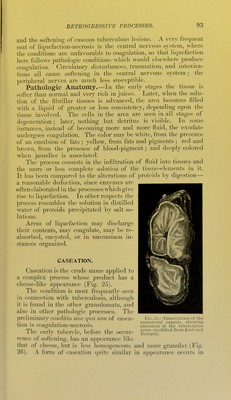
![and the softening of caseous tuberculous lesions. A very frequent seat of liquefaction-necrosis is the central nervous system, where the conditions are unfavorable to coagulation, so that liquefaction here follows pathologic conditions which would elsewhere produce coagulation. Circulatory disturbances, traumatism, and intoxica- tions all cause softening in the central nervous system; the peripheral nerves are much less susceptible. Pathologic Anatomy.—In the early stages the tissue is softer than normal and very rich in juices. Later, when the solu- tion of the fibrillar tissues is advanced, the area becomes filled with a liquid of greater or less consistency, depending upon the tissue involved. The cells in the area are seen in all stages of degeneration; later, nothing but detritus is visible. In some instances, instead of becoming more and more fluid, the exudate undergoes coagulation. The color may be white, from the presence of an emulsion of fats ; yellow, from fats and pigments ; red and brown, from the presence of blood-pigment; and deeply colored when jaundice is associated. The process consists in the infiltration of fluid into tissues and the more or less complete solution of the tissue-elements in it. It has been compared to the alterations of proteids by digestion— a reasonable deduction, since enzymes are often elaborated in the processes which give rise to liquefaction. In other respects the process resembles the solution in distilled water of proteids precipitated by salt so- lutions. Areas of liquefaction may discharge their contents, may coagulate, may be re- absorbed, encysted, or in uncommon in- stances organized. CASEATION. Caseation is the crude name applied to a complex process Avhose product has a cheese-like appearance (Fig. 25). The condition is most frequently seen in connection with tuberculosis, although it is found in the other granulomata, and also in other pathologic processes. The preliminary conditio sine (lua non of casea- vu-,. 'jr).—TubercuiosiN oi the • ' 1 • snpnirenul capsule, showing tlOn IS coagulation-necrosis. cnseiition of the mberculous The early tubercle, before the occur- '>/;;';;«^ojy.difledfromKa.tu,ui rence of softening, has an appearance like that of cheese, but is less homogeneous and more granular (Fig. 26). A form of caseation (piite similar in a])pearance occurs in](https://iiif.wellcomecollection.org/image/b21981668_0095.jp2/full/800%2C/0/default.jpg)