Outbreak of cholera among convicts : an etiological study of the influence of dwelling, food, drinking-water, occupation, age, state of health, and intercourse upon the course of cholera in a community living in precisely the same circumstances / by Max von Petternkofer.
- Pettenkofer Max von, 1818-1901.
- Date:
- 1876
Licence: Public Domain Mark
Credit: Outbreak of cholera among convicts : an etiological study of the influence of dwelling, food, drinking-water, occupation, age, state of health, and intercourse upon the course of cholera in a community living in precisely the same circumstances / by Max von Petternkofer. Source: Wellcome Collection.
Provider: This material has been provided by The Royal College of Surgeons of England. The original may be consulted at The Royal College of Surgeons of England.
19/128 page 13
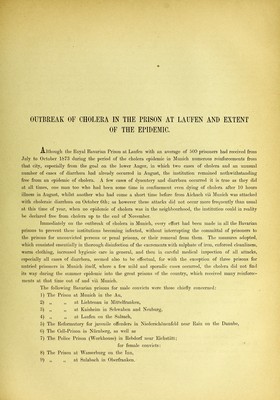
![OUTBREAK OF CHOLERA IN THE PRISON AT LAUFEN AND EXTENT OF THE EPIDEMIC. Although the Royal Bavarian Prison at Laufen with an average of 500 prisoners had received from July to October 1873 during the period of the cholera epidemic in Munich numerous reinforcements from that city, especially from the goal on the lower Anger, in which two cases of cholera and an unusual number of cases of diarrhoea had already occurred in August, the institution remained noth withstanding free from an epidemic of cholera. A few cases of dysentery and diarrhoea occurred it is true as they did at all times, one man too who had been some time in confinement even dying of cholera after 10 hours illness in August, whilst another who had come a short time before from Aichach via Munich was attacked with choleraic diarrhoea on October 6th; as however these attacks did not occur more frequently than usual at this time of year, when no epidemic of cholera was in the neighbourhood, the institution could in reality be declared free from cholera up to the end of November. Immediately on the outbreak of cholera in Munich, every effort had been made in all the Bavarian prisons to prevent these institutions becoming infected, without interrupting the committal of prisoners to the prisons for unconvicted persons or penal prisons, or their removal from them. The measures adopted, which consisted essentially in thorough disinfection of the excrements with sulphate of iron, enforced cleanliness, warm clothing, increased hygienic care in general, and then in careful medical inspection of all attacks, especially all cases of diarrhoea, seemed also to be effectual, for with the exception of three prisons for untried prisoners in Munich itself, where a few mild and sporadic cases occurred, the cholera did not find its way during the summer epidemic into the great prisons of the country, which received many reinforce- ments at that time out of and via Munich. The following Bavarian prisons for male convicts were those chiefly concerned: ]) The Prison at Munich in the An, 2) ,, ,, at Lichtenau in Mittelfranken, 3) „ „ at Kaisheim in Schwaben and Neuburg, 4) „ ,, at Laufen on the Salzach, 5) The Reformatory for juvenile offenders in Niederschonenfeld near Rain on the Danube, 6) The Cell-Prison in Niirnberg, as well as 7) The Police Prison (Workhouse) in Rebdorf near Eichstiitt; for female convicts: 8) The Prison at Wasserburg on the Inn, 9) ,, ,, at Sulzbach in Oberfranken.](https://iiif.wellcomecollection.org/image/b22372647_0021.jp2/full/800%2C/0/default.jpg)



 No text description is available for this image
 No text description is available for this image
 No text description is available for this image