A systematic handbook of volumetric analysis, or, The quantitative estimation of chemical substances by measure, applied to liquids, solids and gases / by Francis Sutton.
- Francis Sutton
- Date:
- 1890
Licence: Public Domain Mark
Credit: A systematic handbook of volumetric analysis, or, The quantitative estimation of chemical substances by measure, applied to liquids, solids and gases / by Francis Sutton. Source: Wellcome Collection.
507/592 page 491
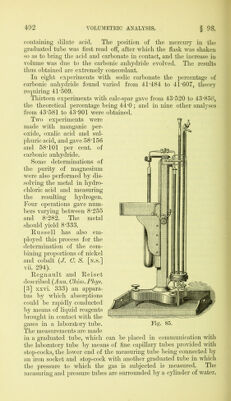
![with the liquid, and thus hasten the absorption. Ten minutes was found to be a sufficient time for the absorption of carbonic anhydride when mixed with air. To remove the liquid reagent, a ball of moistened cotton wool is employed. The ball is made in the following manner:—A piece of steel wire is bent into a loop at one end, and some cotton wool tightly wrapped round it. It is then dipped in water and squeezed with the hand under the liquid until the air is removed. The end of the steel wire is next passed through a piece of glass tube, curved near one end, and the cotton ball drawn against the curved extremity of the tube. The ball, saturated with water, is now depressed in the mercury trough, and, after as much of the water as possible has been squeezed out of it, it is passed below the eudiometer, and, by pushing the wire, the ball is brought to the surface of the mercury in the eudiometer and rapidly absorbs all the liquid reagent, leaving the meniscus clean. The ball is removed with a slight jerk, and gas is thus prevented from adhering to it. It is found that this mode of removing the liquid can be used without fear of altering the volume of the gas in the eudiometer. Carbonic anhydride may be absorbed by a solution of potassic hydrate, and oxygen by means of potassic hydrate and pyrogallic acid. The determination of ethylene is best effected by means of fuming sulphuric acid on a coke ball, water and dilute potassic; hydrate being subsequently introduced and removed by the ball of cotton wool. Doubtless this mode of using the liquid reagents might be employed with advantage in the ordinary process of analysis to diminish the time necessary for the absorption of the gases. By this process of Russell's the calculations are much shortened and facilitated, the volumes read off being comparable among themselves; this will be seen by an example, taken from the original memoir, of the determination of oxygen in air— by potassic hydrate and ptyru-103-5 104*46 gallic acid . . . . j 132T5 104-46 27*69 volumes of oxygen in 132*15 of air. 132*15 : 27*69 : : 100 : 20-953 percentage of oxygen in air. Bussell has also employed his apparatus for the analysis of carbonates (J. C. S. [n.s.] vi. 310). For this purpose he adapted a graduated tube, open at both ends, to a glass flask by means of a thick piece of caoutchouc tube. Into the flask a weighed quantity of a carbonate was placed, together with a vessel Volume in Table corresponding to reading. Volume of air taken . Volume after absorption of 130-3 132-15](https://iiif.wellcomecollection.org/image/b28127006_0509.jp2/full/800%2C/0/default.jpg)