A systematic handbook of volumetric analysis, or, The quantitative estimation of chemical substances by measure, applied to liquids, solids and gases / by Francis Sutton.
- Francis Sutton
- Date:
- 1890
Licence: Public Domain Mark
Credit: A systematic handbook of volumetric analysis, or, The quantitative estimation of chemical substances by measure, applied to liquids, solids and gases / by Francis Sutton. Source: Wellcome Collection.
510/592 page 494
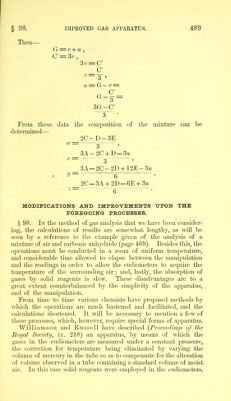
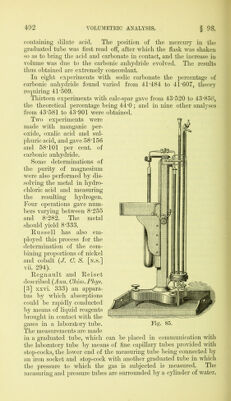
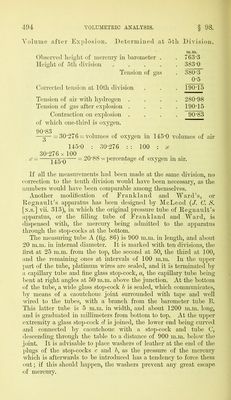
![Volume after Explosion. Determined at 5tli Division. m.m. Observed height of mercury in barometer . . 763*3 Height of 5th division .... . 383*0 Tension of gas . 380*3 0*5 Corrected tension at 10tli division . 190*15 Tension of air with hydrogen . . 280*98 Tension of gas after explosion . . 190*15 Contraction on explosion . . 90*83 of which one-tliird is oxygen. g— — 30*276 = volumes of oxygen in 145*0 volumes of air 145*0 : 30*276 : : 100 : jc 30*276 x 100 x ■— = 20*88 - percentage of oxygen m air. If all the measurements had been made at the same division, no correction to the tenth division would have been necessary, as the numbers would have been comparable among themselves. Another modification of Frank land and Ward’s, or Begnault’s apparatus has been designed by McLeod (J. C. S. [x.s.] vii. 313), in which the original pressure tube of Regnault’s apparatus, or the filling tube of Frank land and Ward, is dispensed with, the mercury being admitted to the apparatus through the stop-cocks at the bottom. The measuring tube A (fig. 86) is 900 m.m. in length, and about 20 m.m. in internal diameter. It is marked with ten divisions, the first at 25 m.m. from the top, the second at 50, the third at 100, and the remaining ones at intervals of 100 m.m. In the upper part of the tube, platinum wires are sealed, and it is terminated by a capillary tube and fine glass stop-cock, a, the capillary tube being bent at right angles at 50 m.m. above the junction. At the bottom of the tube, a wide glass stop-cock b is sealed, which communicates, by means of a caoutchouc joint surrounded with tape and well wired to the tubes, with a branch from the barometer tube B. This latter tube is 5 m.m. in width, and about 1200 m.m. long, and is graduated in millimeters from bottom to top. At the upper extremity a glass stop-cock d is joined, the lower end being curved and connected by caoutchouc with a stop-cock and tube C, descending through the table to a distance of 900 m.m. below the joint. It is advisable to place washers of leather at the end of the plugs of the stop-cocks c and 5, as the pressure of the mercury which is afterwards to be introduced has a tendency to force them out; if this should happen, the washers prevent any great escape of mercury.](https://iiif.wellcomecollection.org/image/b28127006_0512.jp2/full/800%2C/0/default.jpg)