Outlines of physiology in its relations to man / by John Gray McKendrick.
- John Gray McKendrick
- Date:
- 1878
Licence: Public Domain Mark
Credit: Outlines of physiology in its relations to man / by John Gray McKendrick. Source: Wellcome Collection.
Provider: This material has been provided by the Francis A. Countway Library of Medicine, through the Medical Heritage Library. The original may be consulted at the Francis A. Countway Library of Medicine, Harvard Medical School.
73/796 (page 39)
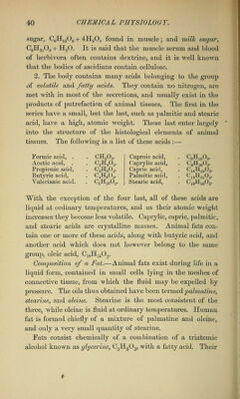
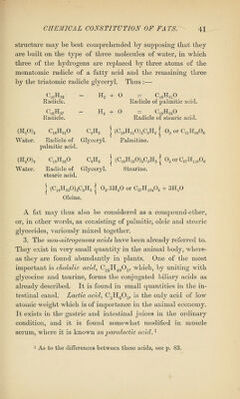
![Here again the compound body is resolved into a nitrogen- ous aud a non-nitrogenous portion. 2. The Non-conjugated Acids.—Certain acids are also met witli in the animal body which are not conjugated, as for example, inosic acid, C^qKiJ^^0-^^, which is found in muscle juice, and the principal acids of urine, namely, uric acid, CgKJ^liP.^, and hippuric acid, CgHgNOy. Closely related to uric acid, there are a series of bodies sometimes met Avith in the animal fluids, most of which, by the addition of one or more molecules of water, may be resolved into a nitro- genous base, urea, and a non-nitrogenous acid. Example:— C,H,N,03 Uric acid. + 4HoO Tartronic acid. 2CH,N.,0 Urea. Alloxan. -1- 2HoO = Cgli.^Og + Mesoxalic acid. CH4N.O Urea. Oxaluric acid. -f- H,0 = CoH.,04 + Oxalic acid. CH^NoO Urea. CgH.NA. AUanturic acid. + H^O = CgH.O:, _ + Oxyglycocholic acid. CH,]sr.,o Urea: Aliantoine. + H,0 ^ C3H,isr,o.3 + AUanturic acid. CH,K,0 Urea: C.HgNgO, Creatine. + HoO = CgH.NOo + Sarcosine. CH,N,0 Urea. It will be observed that aliantoine and creatine split into two nitrogenous compounds. These numerous examples of chemical decompositions are given to show how urea (the principal nitrogenous substance separated by the kidneys) may possibly be produced from more complex nitrogenous substances. 4. Non-nitrogenous Compounds. These consist of carbohydrates, volatile acids, fatty acids and fats, and non-nitrogenous acids. 1. The carbohydrates are glycogen, CgHioOg + SH^O, met with in the liver, blood, and tissues; glucose or graj)e sugar, CgHioOg + 2HoO, found in blood and chyle; inosite, or muscle](https://iiif.wellcomecollection.org/image/b21066905_0073.jp2/full/800%2C/0/default.jpg)