Statistical methods applied to education : a textbook for students of education in the quantitative study of school problems / by Harold O. Rugg.
- Harold Rugg
- Date:
- [1917?]
Licence: In copyright
Credit: Statistical methods applied to education : a textbook for students of education in the quantitative study of school problems / by Harold O. Rugg. Source: Wellcome Collection.
30/444 (page 8)
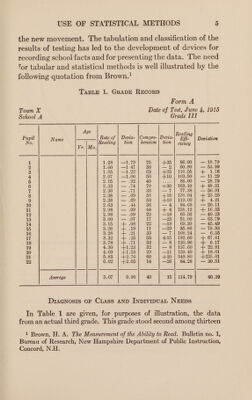
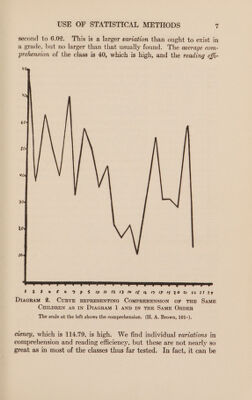
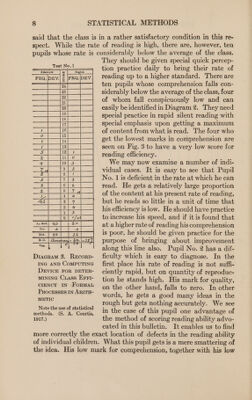
![Test No.1 Anompts pel ev FRQ, 8 PRQDBV. ee ee a Ol ll Se we) Ww] Le] oy rajAl Clo) ole} mew ray — DIS ITQi~f~]O[~ — o & | 1G] ee INS ivy DOSSSgn i M.D. | Ceeahracd = $2 |-557| eg 4-9-6 DiacraM 3. ReEcorpD- ING AND COMPUTING DEVICE FOR DETER- MINING Crass EFrt- CIENCY IN -FoRMAL PRocESSES IN ARITH- METIC Note the use of statistical methods. (S. A. Courtis, 1917.) They should be given special quick percep- tion practice daily to bring their rate of reading up to a higher standard. There are ten pupils whose comprehension falls con- siderably below the average of the class, four of whom fall conspicuously low and can easily be identified in Diagram 2. They need special practice in rapid silent reading with special emphasis upon getting a maximum of content from what is read. The four who get the lowest marks in comprehension are seen on Fig. 3 to have a very low score for reading efficiency. We may now examine a number of indi- vidual cases. It is easy to see that Pupil No. 1 is deficient in the rate at which he can read. He gets a relatively large proportion of the content at his present rate of reading, but he reads so little in a unit of time that his efficiency is low. He should have practice to increase his speed, and if it is found that at a higher rate of reading his comprehension is poor, he should be given practice for the purpose of bringing about improvement along this line also. Pupil No. 2 has a dif- ficulty which is easy to diagnose. In the first place his rate of reading is not suffi- ciently rapid, but on quantity of reproduc- tion he stands high. His mark for quality, on the other hand, falls to zero. In other words, he gets a good many ideas in the rough but gets nothing accurately. We see in the case of this pupil one advantage of the method of scoring reading ability advo- cated in this bulletin. It enables us to find](https://iiif.wellcomecollection.org/image/b32866768_0030.jp2/full/800%2C/0/default.jpg)