Lectures on the operations of surgery : and on diseases and accidents requiring operations / by Robert Liston ; with numerous additions by Thomas D. Mütter.
- Robert Liston
- Date:
- 1846
Licence: Public Domain Mark
Credit: Lectures on the operations of surgery : and on diseases and accidents requiring operations / by Robert Liston ; with numerous additions by Thomas D. Mütter. Source: Wellcome Collection.
Provider: This material has been provided by the National Library of Medicine (U.S.), through the Medical Heritage Library. The original may be consulted at the National Library of Medicine (U.S.)
107/592
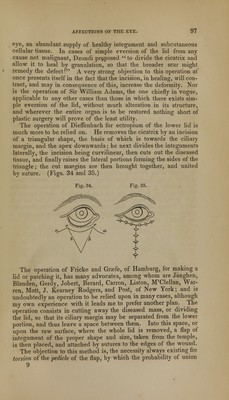
![tissue has been removed, and attached to the sound skin by twisted or interrupted sutures. The surface from which it has been re- moved is next closed, by drawing the edges of the wound together by the twisted suture and straps. A compress is then applied over the nap and secured with a roller, firmly applied, so as to prevent by pressure the oozing of blood, which, in all operations of this kind, is one of the chief obstacles to union by the first intention. The patient is then ordered to be kept quiet, the compress to be saturated with cold water; the head to be maintained in an elevated position, and the diet to be absolute. The advantages of this method, which belongs to plastic opera- tions by inclination of the flap, are, the facility with which it is executed, the little risk of sloughing from the pedicle of the flap being scarcely, if at all, subjected to torsion, and the trifling scar which it leaves. Professor Jaeger, of Berlin, has proposed a plan of operating that may do very well in some cases, which belongs to the class of plastic operations by sliding the flap, (glissement du lambeau,) and is peculiarly adapted to cases of lagophthalmos and ectropium. It consists in first cutting through the everted or shortened lid in its whole thickness by a transverse incision, including its whole breadth; he then cuts out a perpendicular piece, so as to bring the lid to its proper width; he next loosens the integuments of the cheek, if he is operating upon the lower lid, or of the forehead if the upper is the seat of disease, with a double-edged knife carried between the orbicularis muscle and the bone, so that they can be drawn upwards or downwards to a sufficient extent. The wounds are then united by sutures. A method somewhat similar to this has been proposed by T. W. Jones, of England. He includes the cicatrix or contracted portion in two incisions, which unite at an acute angle, so as to form a V, and must extend into sound tissue. He then draws upon the flap, so as to stretch out the cellular tissue beneath it, and when this does not yield readily, he dissects up a portion of the flap; and, by thus sliding the skin, he expects to gain the object in view. This operation might possibly answer in some cases, but I do not recommend it, as we have other means more worthy of confidence, and it could rarely, if ever, be performed where it is necessary to form the entire lid. Professor Horner has recently performed an operation for ectro- pium, which differs a little from the operations mentioned, but be- longs to the class of operations by displacement of the flap. Professor Pancoast has recently reported two cases of blephero- plastic operation, in which he combined the methods of Dieffenbach, Sir William Adams, and Jones, and in both cases his success was complete.—T. D. M.]](https://iiif.wellcomecollection.org/image/b21137286_0107.jp2/full/800%2C/0/default.jpg)
 No text description is available for this image
 No text description is available for this image
 No text description is available for this image