The pulse / by W.H. Broadbent ; illustrated with 59 ophygmographic tracings.
- William Broadbent
- Date:
- [1899?]
Licence: Public Domain Mark
Credit: The pulse / by W.H. Broadbent ; illustrated with 59 ophygmographic tracings. Source: Wellcome Collection.
Provider: This material has been provided by the Francis A. Countway Library of Medicine, through the Medical Heritage Library. The original may be consulted at the Francis A. Countway Library of Medicine, Harvard Medical School.
241/328 (page 229)
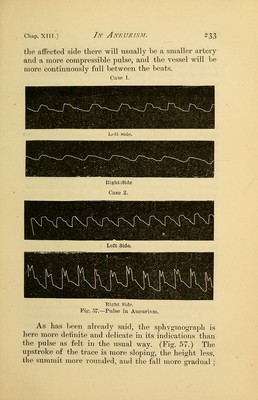
![difference in the two radial pulses, a thoracic aneurism must be so situate as to affect differently the two subclavians. An aneurism at the root of the aorta, or in the ascending aorta, or even in the first part of the arch, need not cause any difference between the pulse on the two sides. Aneurism of the first part of the arch will have this effect when the innominate is directly or indirectly implicated, as will aneurism of the innominate artery itself, and in such cases the chief modification will be in the right pulse. It is, however, in aneurism of the transverse and descending arch that a difference is most frequently felt between the two pulses, that of the left side being affected, and it often constitutors an important, sometimes almost a determining element in the diagnosis. There is a great difference between aneurism of the ascending aorta and of the arch, both as to the effects whicli they produce and as to the indications by means of which they are recognised. I have long been in the habit of calling the former the aneurism of physical signs,'' the latter the aneurism of symptoms. The ascending aorta is freely movable, and does, in fact, move up and down—or, to speak more exactly, down and up—with each beat of the heart; it probably expands and contracts also more than any other part of the vessel. Accordingly, provision exists for its free play; it is not closely attached to surrounding- parts, and is not in close relation with the nearest important structures, the root of the lung and the vena cava superior and the pneumogastric nerve. In this way it comes to ]3ass that an aneurism of the ascending aorta may attain a considerable size before pressure-effects, or, in other words, symptoms, are produced. On the other hand, this part of the aorta is near the' surface of the chest, an expansion of the vessel here very often takes a superficial direction upwards and outwards, and in whatever direction it](https://iiif.wellcomecollection.org/image/b21043668_0241.jp2/full/800%2C/0/default.jpg)