A hand-book of materia medica and therapeutics : with twenty-nine illustrations : being a portion of An analytical compendium of the various branches of medicine / by John Neill and Francis Gurney Smith.
- John Neill
- Date:
- 1852
Licence: Public Domain Mark
Credit: A hand-book of materia medica and therapeutics : with twenty-nine illustrations : being a portion of An analytical compendium of the various branches of medicine / by John Neill and Francis Gurney Smith. Source: Wellcome Collection.
Provider: This material has been provided by the National Library of Medicine (U.S.), through the Medical Heritage Library. The original may be consulted at the National Library of Medicine (U.S.)
82/101
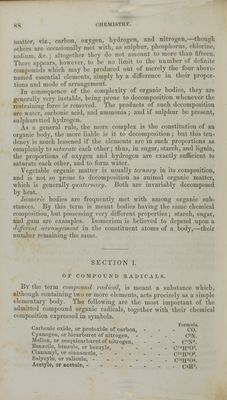
![matter, viz., carbon, oxygen, hydrogen, and nitrogen,—though others aw occasionally mel with, as sulphur, phosphorus, chlorine, dtogether they '1 uot amount to more than fifteen. There appears, however, to be no Limit to the number of definite compounds which may be produced oul of merely the four above- named essentia] elements, simply by a difference in their propor- tions and mode of arrangement. In consequence of the complexity of organic bodies, they are generally verj instable, being prone to decomposition whenever the restraining force is removed. The produots of such decomposition are wain-, carbonic acid, and ammonia; and if sulphur be present, sulphuretted hydrogen. \- B general rule, the more complex is the constitution of an organic body, the more liable is it to decomposition; but this ten- dency is much lessened if the i Lements arc in such proportions as completely to saturate each other; thus, in sugar, starch, and lignin, tho proportions of oxygen and hydrogen are exactly sufficient to saturate each other, and to form water. table organic matter is usually ternary in its composition, and is not so prone to decomposition as animal organic matter, which is generally quaternary. Both are invariably decomposed by heat. Isomeric bodies are frequently mel with among organic sub- stances !>y this term is meant bodies having the same chemical composition, bul possessing verj different properties; starch, sugar, and gum axe examples. Isomerism LB believed to depend upon a different arrangement in the constituent atoms of a body,—their number remaining the same. SECTION I. OF COMPOUND RADICALS. By the term compound radical, is meant a substance which, although containing two or more elements, acts precisely as a simple elementary body. The following are the most important of the admitted compound organic radicals, together with their chemical composition expressed in symbols. r, . Formula. Carbonic oxide, or protoxide of carbon, - - - CO. < yanogen, or bicarburet of nitrogen, - - - C2N. Mellon, or sesquicarbaret of nitrogen, ... C6N*. Benzoile, benzule, or benzyle, - CII402. Cinnamyl, or cinnamule, C'lPO2. Salycyle, or sahcule, CMH*0*. Acety'le, or acetule, OH'.](https://iiif.wellcomecollection.org/image/b21143559_0082.jp2/full/800%2C/0/default.jpg)