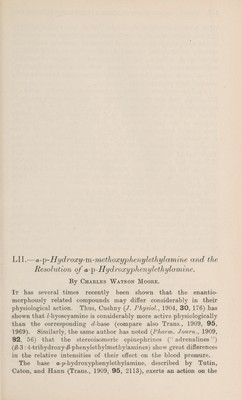
a-p-Hydroxy-m-methoxyphenylethylamine and the resolution of a-p-Hydroxyphenylethylamine / by Charles W. Moore.
- Moore, Charles W.
- Date:
- [1911?]
Licence: In copyright
Credit: a-p-Hydroxy-m-methoxyphenylethylamine and the resolution of a-p-Hydroxyphenylethylamine / by Charles W. Moore. Source: Wellcome Collection.
5/10 page 418
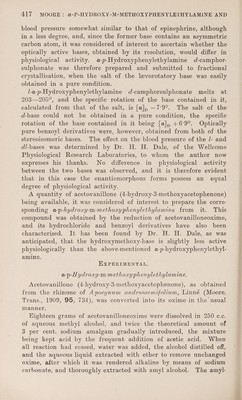
![alcoholic liquids were extracted with successive quantities of dilute hydrochloric acid, and the combined acid liquids concentrated under diminished pressure, when, on cooling, a-p-hydroxy-m-methoxy- 'phenyletliylamine hydrochloride separated in glistening prisms. This salt is readily soluble in water and alcohol, but can be re¬ crystallised from a mixture of alcohol and ethyl acetate. The quantity so obtained amounted to about 8'5 grams: 0-1490 gave 0-2938 C02 and 0-0936 H,0. C = 53-7; H = 7*0. 0-1710 „ 0-1180 AgCl. Cl = 17*0. C9H]3OoN,HC1 requires C==531; H = 69; Cl = 174 per cent. A methoxyl determination by Perkin's modification of the Zeisel method gave the following result: 0-2136 gave 0'2445 Agl. OMe=151. C8HnONCl*OMe requires OMe = 152 per cent. a-p-Hydroxy-m-methoxyphenylethylamine was obtained from its hydrochloride by the action of sodium ethoxide on an alcoholic solution of the salt. Five grams of the hydrochloride were dissolved in about 25 c.c. of warm absolute alcohol, and to the solution 053 gram of sodium, dissolved in 10 c.c. of absolute alcohol, was added. The precipitated sodium chloride was removed by filtration, and the filtrate cooled, when the base separated in glistening prisms, melting at 158°. The quantity so obtained was only 15 grams, and on concentrating the alcoholic mother liquor, only amorphous products were obtained. As only 95 per cent, of the theoretical amount of sodium ethoxide was employed for the liberation of the base, this change can only be attributed to the unstable nature of the substance in solution. A similar phenomenon was observed on recrystallising the base, but the latter, when in the crystalline state, is quite stable: 0-1338 gave 0-3180 C02 and 0'0970 H20. C = 64’8; H = 8*0. 02806 „ 20*6 c.c. N2 at 23° and 755 mm. N = 8*2. C9H1302N requires C = 647; H = 78; N = 84 per cent. A methoxyl determination by Perkin's modification of the Zeisel method gave the following result: 0-2240 gave 0‘3095 Agl. OMe = 18'2. C8H](JON*OMe requires OMe = 185 per cent. The dibenzoyl derivative, prepared by the Schotten-Baumann method, crystallises from alcohol in glistening plates, melting at 178°: 0-1326 gave 0 3574 CO, and 0’0686 H,0. C = 73'5; H = 5 7. C23H21O4N requires C = 736; IT = 56 per cent. a-p-IIydroxy-m-methoxy-N-benzoylphenylethylamine was obtained by heating the dibenzoyl derivative for some hours with a 10 per](https://iiif.wellcomecollection.org/image/b30618216_0005.jp2/full/800%2C/0/default.jpg)