a-p-Hydroxy-m-methoxyphenylethylamine and the resolution of a-p-Hydroxyphenylethylamine / by Charles W. Moore.
- Moore, Charles W.
- Date:
- [1911?]
Licence: In copyright
Credit: a-p-Hydroxy-m-methoxyphenylethylamine and the resolution of a-p-Hydroxyphenylethylamine / by Charles W. Moore. Source: Wellcome Collection.
7/10 page 420
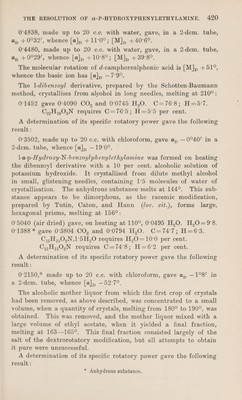
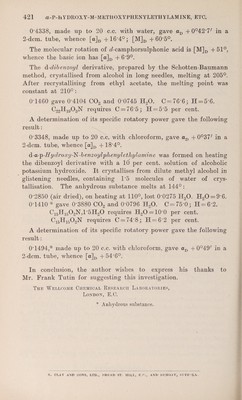
![0 4838, made up to 20 c.c. with water, gave, in a 2-dcm. tube, aD +0°32/, whence [a]D + 11*0°; [M]D + 40*6°. 0'4480, made up to 20 c.c. with water, gave, in a 2-dcm. tube, aD +0°29/, whence [a]D + 10*8°; [M]D +39'8°. The molecular rotation of ^-camphorsulphonic acid is [M]D +51°, whence the basic ion has [a]D — 7'9°. The 1 -dibenzoyl derivative, prepared by the Schotten-Baumann method, crystallises from alcohol in long needles, melting at 210°: 0-1452 gave 0-4090 C02 and 0*0745 H20. C = 76*8; H=5*7. C22H1903N requires C = 76*5; H = 5*5 per cent. A determination of its specific rotatory power gave the following result: 03502, made up to 20 c.c. with chloroform, gave aD — 0°40/ in a 2-dcm. tube, whence [a]D —190°. \-a-p-Hydroxy-'N-benzoylphenylethylamine was formed on heating the dibenzoyl derivative with a 10 per cent, alcoholic solution of potassium hydroxide. It crystallised from dilute methyl alcohol in small, glistening needles, containing 15 molecules of water of crystallisation. The anhydrous substance melts at 144°. This sub¬ stance appears to be dimorphous, as the racemic modification, prepared by Tutin, Caton, and Hann (loc. cit.), forms large, hexagonal prisms, melting at 156°: 05040 (air dried) gave, on heating at 110°, 0*0495 H20. H20 = 9*8. 0-1388* gave 0*3804 C02 and 0*0794 H20. 0 = 747; H = 6*3. Ci5H1-02N,1*5H20 requires H2O = 10*0 per cent. C15H1502N requires C = 74*8; H = 6*2 per cent. A determination of its specific rotatory power gave the following result: 0*2150,* made up to 20 c.c. with chloroform, gave aD —1°8/ in a 2-dcm. tube, whence [a]D —52*7°. The alcoholic mother liquor from which the first crop of crystals had been removed, as above described, was concentrated to a small volume, when a quantity of crystals, melting from 180° to 190°, was obtained. This was removed, and the mother liquor mixed with a large volume of ethyl acetate, when it yielded a final fraction, melting at 163—165°. This final fraction consisted largely of the salt of the dextrorotatory modification, but all attempts to obtain it pure were unsuccessful. A determination of its specific rotatory power gave the following result: Anhydrous substance.](https://iiif.wellcomecollection.org/image/b30618216_0007.jp2/full/800%2C/0/default.jpg)
 No text description is available for this image
 No text description is available for this image
 No text description is available for this image