Practical hydropathy : including plans of baths and remarks on diet, clothing, and habits of life / by John Smedley.
- Smedley, John.
- Date:
- 1861
Licence: Public Domain Mark
Credit: Practical hydropathy : including plans of baths and remarks on diet, clothing, and habits of life / by John Smedley. Source: Wellcome Collection.
473/530 (page 465)
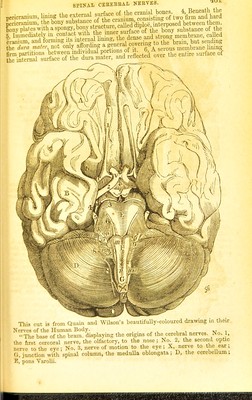
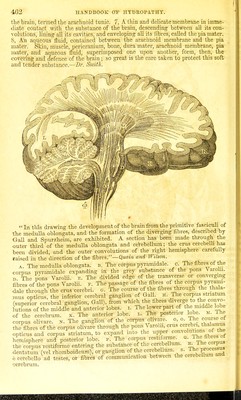
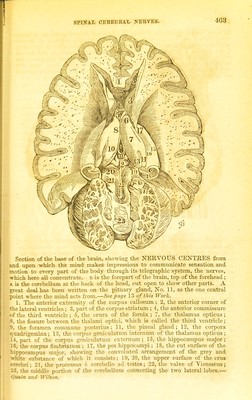
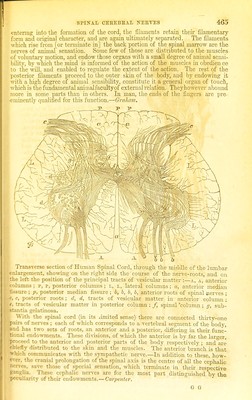
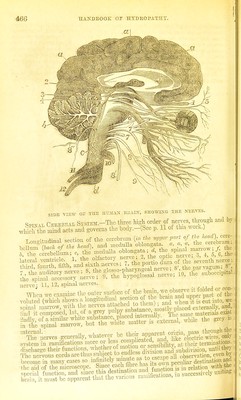
![entering into the formation of the cord; the filaments retain their filamentary form and original character, and are again ultimately separated. The filaments which rise from [or terminate in] the back portion of the spinal marrow are the nerves of animal sensation. Some few of those are distributed to the muscles of voluntary motion, and endow those organs with a small degree of animal sensi- bility, by which the mind is informed of the action of the muscles in obedien ce to the will, and enabled to regulate the extent of the action. The rest of the posterior filaments proceed to the outer skin of the body, and by endowing it with a high degree of animal sensibility, constitute it a general organ of touch, which is the fundamental animalfacultyof external relation. They however abound more in some parts than in others. In man, the ends of the fingers are pre- -eminently qualified for this function.—Graham, Transverse section of Human Spinal Cord, through, the middle of the lumbar enlargement, showing on the right side the course of the nerve-roots, and on the left the position of the principal tracts of vesicular matter :—a, a, anterior columns ; p, p, posterior columns ; l, l, lateral columns; a, anterior median fissure ; p, posterior median fissure ; b, b, b, b, anterior roots of spinal nerves ; ■c, c, posterior roots; d, d, tracts of vesicular matter in anterior column ; e, tracts of vesicular matter in posterior column ; /, spinal 'column ; g, sub- stantia gelatinosa. With the spinal cord (in its limited sense) there are connected thirty-one pairs of nerves ; each of which corresponds to a vertebral segment of the body, and has two sets of roots, an anterior and a posterior, differing in their func- tional endowments. These divisions, of which the anterior is by far the larer ■proceed to the anterior and posterior parts of the body respectively ; and are chiefly distributed to the skin and the muscles. The anterior branch is that ■which communicates with the sympathetic nerve.—In addition to these, how- ever, the cranial prolongation of the spinal axis is the centre of all the cephalic nerves, save those of special sensation, which terminate in their respective ganglia. These cephalic nerves are for the most part distinguished by the •peculiarity of their endowments.—Carpenter. G Q](https://iiif.wellcomecollection.org/image/b20398700_0473.jp2/full/800%2C/0/default.jpg)