A history of classical Greek literature / by J.P. Mahaffy.
- John Pentland Mahaffy
- Date:
- 1910
Licence: In copyright
Credit: A history of classical Greek literature / by J.P. Mahaffy. Source: Wellcome Collection.
25/240 page 9
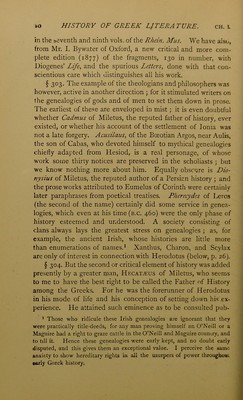
![I speak of obscurity the word may, of course, be taken in differ- ent senses. First, there is the obscurity of allusions not clear to the reader ; and Pindar is full of this, but of this only, as he was one of the ordinary crowd in philosophy, and was not capable of any thoughts in themselves profound. Secondly, there is the obscurity of a crabbed or affected style. In /Flschylus, on the contrary, we have not only the first kind of obscurity—the allusions to mysteries—but we have obscure thoughts, difficult to express and unintelligible to the most advanced Greeks ; for we have the evidence of Aristophanes, which I here believe, that A'ischylus thought even the Athenians no judges of poetry, and would not accommodate his writing to their comprehension. It has not, perhaps, been sufficiently remarked how im- portant was the example of Heracleitus, and how easy it is to lead the fashion in obscure writing. We must remember that Heracleitus was really a quaint and original thinker, and a remarkable innovator, not only in thought, but in style ; for he \vrote a rythmical, picturesque prose, at a time when prose was in its infancy. His fragments are far more poetical in the higher sense than the verses of Xenophanes, and for this very reason he may have scorned the shackles of metre, and set down unchanged the utterances of his teeming mind. This accounts for the remark of the rhetor Demetrius,' who says that the frequent asyndeta were the greatest cause of his obscurity. Each thought was thrown out by itself, and the reader must find its logical connection with the rest for himself.^ In addition to Zeller’s exhaustive chapter on Heracleitus,’ I may recommend the various brilliant essays of J. Bernays, reaching from 1848 to 1869 ; some separately published, others ' § 192. * Specimens of Heracleitus’ style are the following : ^/xireSov ovSeu, i\\d Kui is KVKtwva irduTO, ffvveiXioPTai. iffrl Tuvrh repif/is aTtp\f/lr], yvu(rls iyvuairi, p.iya p.iKp6v, &vu Kdru -n-fpixtopfovra Kal dfiei^dixeya iv tov alavos TaiSty. aldiv irais iari na'i^up TTfffffevwv a’vvSia<pfp6/xeyos. tA Si irdura Kfpavyds. ov Skus Sia<f>fp6fitvoy Iwury dfioXoytfi • traXly- rpo^os appoylr] Siffirtp t6^ov koI \6pr]s. • /’Ail. d. Criech. i, 566-677.](https://iiif.wellcomecollection.org/image/b24867032_0025.jp2/full/800%2C/0/default.jpg)



 No text description is available for this image
 No text description is available for this image
 No text description is available for this image