Calendar for the year 1896-97 / University of Durham College of Medicine.
- University of Durham. College of Medicine
- Date:
- 1896
Licence: Public Domain Mark
Credit: Calendar for the year 1896-97 / University of Durham College of Medicine. Source: Wellcome Collection.
114/178
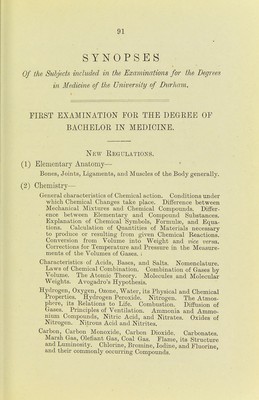
![Siilpliur, Sulphuretted Hydrogen and Sulphides, Sulphur Oxides, Sulphuric Acid and Sulphates, Sulphurous Acid and Sulphites. Phosphorus, Arsenic, and Antimony, and their compounds with Oxygen and with Hydrogen. Phosphoric Acid and Phosphates, Arsenious Acid and Arseniates, Arsenic Acid and Arseniates. The detection of Phosphorus, Arsenic, and Antimony. Boron, Boracic Acid and Borates. General properties of the more common Metals and their Compounds. The preparation and properties of such as are used in Medicine. Differences between Organic and Inorganic Compounds, and Organic and Organised Bodies. Methods of determining the composition of Organic Compounds. Explanation of the terms Homologue, Isomerism, Polymerism, Metamerism. Cyanogen, Hydrocyanic Acid, Cyanic Acid and Urea, Uric Acid. General Characteristics of Hydro-carbons, Alcohols, Ethers, Ethereal Salts, Amines, Aldehydes, Acids, Ketones, Amides. Methyl and Ethyl Alcohols, their more important deriva- tives. Acetic Acid and its derivatives. Glycol. Lactic Acid and its homologues. Oxalic Acid and its homologues. Malic and Tartaric Acids. Glycerine. Fats. Saponification. Allyl Compounds. Car- bohydrates. Fermentation. Benzene, Phenol, Benzoic Acid, Salicylic Acid. Glucosides. Principal Vegetable Acids. The Alkaloids, Nicotine, Conine, Morphine, Strychnine, Brucine, Quinine, Cinchonine. Chemical constituents of Vegetable and Animal Organisms. (3) Practical Chemistry— The Examination will consist in the Qualitative Analysis of solutions or powders, containing not more than one acid or one base, also the preparation of simple compounds, ihe bases contained in these may be any one of those f ollowmg, and may be combined with any of the commoner acids :— Potassium, Sodium [Ammonium]. Calcium, Barium, Strontium, Magnesium, Iron, Manganese, Aluminium, Zinc, Chromium, Cappei-, Mercury, Lead, Bismuth, Tin, Arsenic, Antimony, and Silver. The Candidate will be expected to be familiar with the methods of detecting the following substances ^Uiea, Uric Acid, Grape Sugar, Morphine, Strychnme, Brucme, Cinchonine, Quinine.](https://iiif.wellcomecollection.org/image/b21780894_0114.jp2/full/800%2C/0/default.jpg)



 No text description is available for this image
 No text description is available for this image
 No text description is available for this image