Volume 1
A system of surgery / by Charles B. Ball [and others] ; edited by Frederick Treves.
- Date:
- 1896-1898
Licence: Public Domain Mark
Credit: A system of surgery / by Charles B. Ball [and others] ; edited by Frederick Treves. Source: Wellcome Collection.
Provider: This material has been provided by King’s College London. The original may be consulted at King’s College London.
1155/1206 (page 1113)
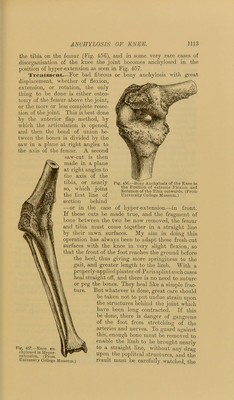
![Fig. 456.—Bony Anchylosis of the Knee in the Position of extreme Flexion and Rotation of the Tihia outwards. (From University College Museum.) the tibia on the femur (Fig. 450), and in some very rai-e cases of disorganisation of the knee the joint becomes ancliylosed in the position of hy]>er-extension as seen in Fig. 457. I'reafmeiif.—For bad fibrous or bony anchylosis vvith great displacement, whetlier of flexion, extension, or rotation, the only thing to be done is either osteo- tomy of the femur above the joint, or the more or less complete resec- tion of the joint. This is best done by the anterior flap method, by which the articulation is opened, and then the bond of union be- tAveen the bones is divided by the saw in a plane at right angles to the axis of the femur. A second saw-cut is then made in a plane at right angles to the axis of the tibia, or nearly so, which joins the first line of section behind —or in the case of hyper-extension—in front. If these cuts be made true, and the fragment of bone between the two be now removed, the femur and tibia must come together in a straight line by their sawn surfaces. My aim in doing this operation has always been to adapt these fresh-cut surfaces with the knee in very slight flexion, so that the front of the foot reaches the ground before the heel, thus giving more springiness to the gait, and greater length to the limb. With a properly-applied plaster-of-Paris splint such cases heal straight off, and there is no need to suture or peg the bones. They heal like a simple frac- ture. But whatever is done, great cai’e should be taken not to put undue strain upon the structures behind the joint which have been long contracted. If this be done, there is danger of gangrene of the foot from stretching of the arteries and nerves. To guard against this, enough bone must be removed to enable the limb to be brought nearly to a straight lino, without any drag upon the popliteal structures, and the result must be carefully watched, the Fig. 457.—Knee an- ohylosed in Hyper- extension. (From University College Mnsonni.)](https://iiif.wellcomecollection.org/image/b21303691_0001_1155.jp2/full/800%2C/0/default.jpg)