Volume 1
A system of surgery / by Charles B. Ball [and others] ; edited by Frederick Treves.
- Date:
- 1896-1898
Licence: Public Domain Mark
Credit: A system of surgery / by Charles B. Ball [and others] ; edited by Frederick Treves. Source: Wellcome Collection.
Provider: This material has been provided by King’s College London. The original may be consulted at King’s College London.
53/1206 (page 9)
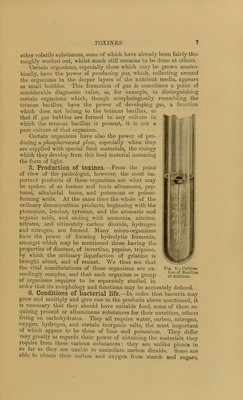
![those which, though usually living outside the body, are capable under certain conditions of taking up their lodging in an animal host and of there, usually, giving rise to definite pathogenic conditions. A saprophytic organism is one which is capable of growing on dead organic matter, i.e. outside the animal body. The terms obligate and facultative are applied to saprophytes in very much the same way as they are applied to parasites, obligate saprophytes . being unable to exist as parasitic organisms, and the facultative saprophyte being a parasitic organism which can continue its growth and multiplication on dead organic matter’—anthrax tetanus and malignant oedema bacilli may all, uirder certain conditions, become facultative parasites and alternately facultative saprophytes. It is importairt for the surgeon to remember that most organisms are saprophytic, and that even those that now exei’t a pathogenic influence are apparently derived from a saprophytic stock. Indeed, the con- ditions favourable to the growth of saprophytic organ- isms are so widespread and the part they play in the process of putrefaction and conversion of dead material for the use of plants is so definite, whilst the agencies inimical to the vitality of the pathogenic organisms are so numerous and effective, that the keeping down of the number of disease-producing germs should be a comparatively easy matter. The obligate parasites are confined to certain regions where the conditions are such that they can be passed on directly from indi- I'lipiyj vidual to individual, but the facultative parasites, which are able to assume a saprophytic existence— take the anthrax bacillus, for instance, which can flourish on the refuse of a farmyard—are much more • dangerous organisms. In the same way those organ- isms which, through the formation of .spores, are capable of continuing their species under unfavourable condi- tions are more difficult to get rid of than the more • ] 1 .,1 1 , . ° . . , non of Bucillus easily killed non-spore-bearing micro-organisms, such as of Tetanus. the cholera bacillus. 7. Temperature conditions.—The majority of the pathogenic micro-organisms develop most readily and luxuriantly at the tem- perature of the human body. Some will grow at the temperature of the room—15° or 16° C., but any temperature below 30° C. or above 42° C. usually leads to a diminution of their virulence or of their vital activity. It is scarcely necessary to consider the tempera- tures (outside the limits) at which organisms retain their vitality or are killed off; but speaking generally, it may be stated that most bacteria cease to grow at a temperature of 5° to 10°0. on the one hand and above 45° to 50° 0. on the other, thougli certain species have been found which arc capable of exhibiting vegetative and functional activity even beyond the limit (65° to 70° C.).](https://iiif.wellcomecollection.org/image/b21303691_0001_0053.jp2/full/800%2C/0/default.jpg)