Surgical diagnosis; a manual for students and practitioners / by Albert A. Berg ... illustrated with 215 engravings and 21 plates.
- Albert A. Berg
- Date:
- 1905
Licence: Public Domain Mark
Credit: Surgical diagnosis; a manual for students and practitioners / by Albert A. Berg ... illustrated with 215 engravings and 21 plates. Source: Wellcome Collection.
Provider: This material has been provided by the Augustus C. Long Health Sciences Library at Columbia University and Columbia University Libraries/Information Services, through the Medical Heritage Library. The original may be consulted at the the Augustus C. Long Health Sciences Library at Columbia University and Columbia University.
68/594 (page 62)
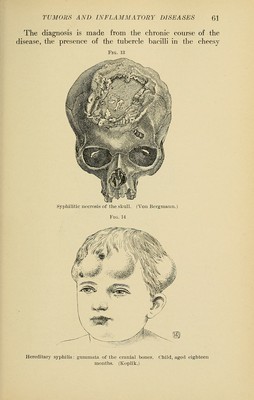
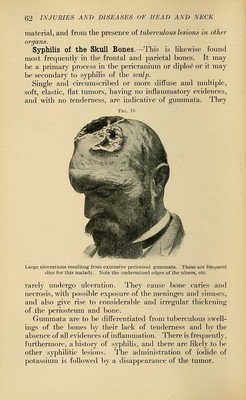
![material, and from the presence of tuberculous lesions in other organs. Syphilis of the Skull Bones.—This is likewise found most frequently in the frontal and parietal bones. It may be a primary process in the pericranium or diploe or it may be secondary to syphilis of the scalp. Single and circumscribed or more diffuse and multiple, soft, elastic, flat tumors, having no inflammatory evidences, and with no tenderness, are indicative of gummata. They Fig. 15 ]>arge ulcerations resulting from extensive periosteal gummata. These are frequent sites for this malady. Note the undermined edges of the ulcers, etc. rarely undergo ulceration. They cause bone caries and necrosis, with possible exposure of the meninges and sinuses, and also give rise to considerable and irregular thickening of the periosteum and bone. Gummata are to be differentiated from tuberculous swell- ings of the bones by their lack of tenderness and by the absence of all evidences of inflammation. There is frequently, furthermore, a history of syphilis, and there are likely to be other syphilitic lesions. The administration of iodide of potassium is followed by a disappearance of the tumor.](https://iiif.wellcomecollection.org/image/b21228589_0068.jp2/full/800%2C/0/default.jpg)