An essay on the wear and tear of human life : and the real remedy for this complaint / by G.T. Hayden.
- Hayden, G. T. (George Thomas), 1798-1857
- Date:
- 1846
Licence: Public Domain Mark
Credit: An essay on the wear and tear of human life : and the real remedy for this complaint / by G.T. Hayden. Source: Wellcome Collection.
Provider: This material has been provided by The Royal College of Surgeons of England. The original may be consulted at The Royal College of Surgeons of England.
154/160
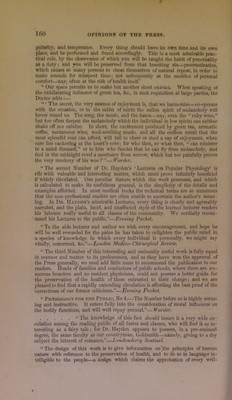
![I.i8 calls them, of authors tliat have written upon the discovery of the vita] princi- ple.”— Warder. ‘‘ If we can judgotf the forthcoming work by the Numbers now before us, we should say it will prove a useful addition to our iwpular literature. In asserting a physiological doctrine, Dr. Hayden nivariably illustrates it by some anecdote at once amusing and instructive, thus conve3’ing information in the most pleas- ing form, and that most calculated to leave an impression on the reader. It is hardly necessarj' to add, that we strongly recommend the perusal of ‘ Physi- ology for the Public ’ to such of our readers ns are not content to remain be- hind their age in tlie knowledge of those physical sciences wliich are calculated to fit them for that better and more rational enjoyment, which an acquaintance with the laws that regulate our functional existence would pohit out.” Free- man's Journal. “ This is the first of a series of publications, to be issued monthly, on Popular Physiology, ‘ comprising jjlnin f)rinciplcs and rules for the preservation of the functions of Iwth body and mind in a state of health.’ The work will not extend kej’ond twelve Parts. The subject is one which concerns everj’ human being; yet there is scarcely any which is so little known to the great mass of mankind, so little has been done by competent writers to treat it in a really popular manner. The members of the Faculty appear to have been anxious to keep their craft a myster}', or else they have imparted the knowledge they jwssess in such a form, as that none but the initiated—those who intended to adopt it as a profession— could derive any material benefit from their instructions. Through the medium of the Press, indeed, several valuable suggestions on this, as well as every other sub- ject, have in modem times found their way to the public, and these have not been without their gooil etfect; but the information thus communicated has consisted oul}’ of a few general rules for the preservation of the corporeal and mental facul- ties in a healtliy state. There has been no attempt that we are aware of to treat the subject fully and systematically, or to free it from tho.se technicalities which make it a scaled book to the vast majority of readers. The work of Surgeon Hayden seems likely to go far towards filling up this desideratum, and to prove what its author designs it to be, ‘a truly popular treatise upon the physiology of man.’ The style is of that simple and familiar kind which at once wins the at- tention and adapts itself to the capacity of every reader. I>;t it not be supposed that we wish every man to become his own doctor. Far from it. Wo agree with the writer of this treatise in thinking that physiology should be studied b^' tlie public more with a view to the prevention than the cure of disease. The complicated mechanism of the human frame, and tlie intimate, j-et subtle relation tliat subsists between mind and body, require the highest skill to rectify any de- rangement of the system ; and here the aid of the professional man is necessary. But there are many of ‘ the thousand ills ’ that we now fall into, which might bo avoided by an acquaintance with the principles of the science. One of the most prominent illustrations of the value of this knowledge is referred to by Dr. Hayden in the ’Introduction.’”—Londonderry Sentinel. “ It is an aphorism which cannot be too often repeated, that the surest enemy to quackery is he who, by opening the flood-gates of knowledge, diffuses that stream of information which, irrigating the dry and biu-ren soil of popular mind, imparts to it that susceptibility to cultivation and productiveness which, by its inward -workings, shall make its latent .seed to spring up, and bear so rich a har- vest as shall scare from its presence the intestine craving after -n-onders and miracles.”—Old England. “ When a man can, by the evidence of his own senses, ascertain that ho possesses a piece of intricate machineiy, he is ever anxious to preserve it in perfect repair, and should any derangement occur in its working, he not only does not venture to meddle with it himself, but he is very cautious in his selection of an artificer to whose hands he may intrust it. If it be a chronometer, he is enabled, on mere](https://iiif.wellcomecollection.org/image/b22334609_0156.jp2/full/800%2C/0/default.jpg)