Volume 1
Taylor's principles and practice of medical jurisprudence / [Alfred Swaine Taylor].
- Alfred Swaine Taylor
- Date:
- 1920
Licence: Public Domain Mark
Credit: Taylor's principles and practice of medical jurisprudence / [Alfred Swaine Taylor]. Source: Wellcome Collection.
878/962 (page 860)
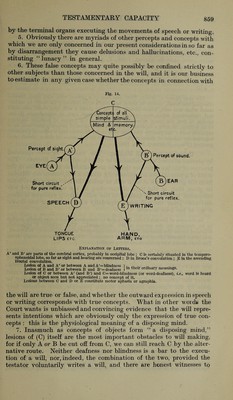
![prove that the written or spoken (dictated) will correctly represents the wishes of the testator. 8. Lesions between C and D or E may in like manner be over¬ come by alternate routes, but if the testator can neither speak nor write (vide case in Lancet, 1896, 2, p. 1702), other means must be found for estimating whether a will correctly represents the testator’s intentions, of which a very ingenious example was given in the medical journals a few years ago, which constitutes the third form of making a will. The case Moore v. Moore, 1900, was that of a person who was, from disease affecting the brain, unable to write, and could with difficulty be made to under¬ stand what was said, but evidently wished to make a will, and could also read and understand what was written. The medical man in attendance [I am unable to find the exact reference, Ed.] caused the names of possible legatees to be written, each on a separate card, and the articles of property also each on a separate card ; the patient was then able to put a name and a piece of property together by means of these cards. Probate in the sense of these terms was granted {Times, February 13th, 1900). C. Delusions and Will Making.—The validity of wills executed by persons affected with delusions is often a subject of dispute. The practice of the law indicates that the mere existence of a delusion in the mind of a person does not necessarily vitiate a will, unless the delusion form the groundwork of such will, or unless the most decisive evidence be given that, at the time of executing it, the testator’s mind was influenced by it in the making of the will. Strong evidence is often derivable from the will itself, especially when a testator has drawn it up of his own accord. In the case of Barton (July, 1840), the Ecclesiastical Court was chiefly guided in its decision by the nature of the instrument. The testator, it appeared, laboured under the delusion that he could dispose of his own property to himself, and make himself his own legatee and executor. This he had accordingly done. The instrument was pronounced to be invalid. « But a will may be manifestly unjust to the surviving relatives of a testator, and it may display some of the extraordinary opinions of the individual; yet it will not necessarily be void, unless the testa¬ mentary dispositions clearly indicate that they have been formed under the influence of a delusion. Some injustice may possibly be done by the rigorous adoption of this principle, since delusion may certainly enter into a man’s act, whether civil or criminal and it may not be always in our power to discover it; but after all, this is per¬ haps the most equitable mode of construing the last wishes of the dead. The elaborate summing up of Gorell Barnes, J., in the case of Roe v. Nix and others, contains many of the chief points to be considered in estimating the testamentary capacity of a lunatic suffering from delu¬ sions (The Times Law Rep., December 10th, 1892). The great point at issue in the case, that of the Duchess of Manchester, was purely of a medical nature : namely, whether the delusions or wanderings under which the Duchess laboured during her illness were the rooted delusions of insanity—fixed mental derangement, or only the temporary delusion of delirium, the result of the disease under which she was labouring. In granting a new trial,](https://iiif.wellcomecollection.org/image/b31359796_0001_0878.jp2/full/800%2C/0/default.jpg)