The chemical synthesis of vital products and the interrelations between organic compounds : Vol. 1 / by Raphael Meldola.
- Meldola Raphael, 1849-1915.
- Date:
- 1904
Licence: In copyright
Credit: The chemical synthesis of vital products and the interrelations between organic compounds : Vol. 1 / by Raphael Meldola. Source: Wellcome Collection.
Provider: This material has been provided by the Royal College of Physicians of Edinburgh. The original may be consulted at the Royal College of Physicians of Edinburgh.
36/368 page 16
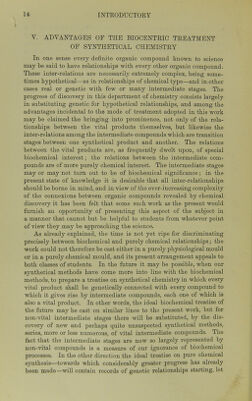
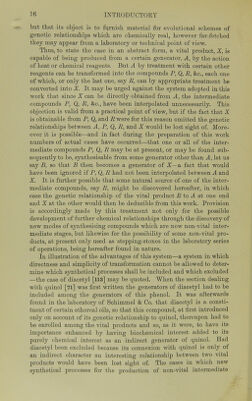
![but that its object is to furnish material for evolutional schemes of genetic relationships which are chemically real, however far-fetched they may appear from a laboratory or technical point of view. Thus, to state the case in an abstract form, a vital j)roduct, X, is capable of being produced from a certain generator, A, by the action of heat or chemical reagents. But A by treatment with certain other reagents can be transformed into the compounds P, Q, R, &c., each one of which, or only the last one, say R, can by appropriate treatment be converted into X. It may be urged against the system adopted in this work that since X can be directly obtained from A, the intermediate compounds P, Q, R, &c., have been interpolated unnecessarily. This objection is valid from a practical point of view, but if the fact that X is obtainable from P, Q, and R were for this reason omitted the genetic relationships between A, P, Q, R, and X would be lost sight of. More- over it is possible—and in fact during the preparation of this work numbers of actual cases have occurred—that one or all of the inter- mediate compounds P, Q, R may be at present, or may be found sub- sequently to be, synthesisable from some generator other than A, let us say B, so that B then becomes a generator of X—a fact that would have been ignored if P, Q, R had not been interpolated between A and X. It is further possible that some natural source of one of the inter- mediate compounds, say R, might be discovered hereafter, in which case the genetic relationship of the vital product P to M at one end and X at the other would then be deducible from this work. Provision is accordingly made by this treatment not only for the possible development of further chemical relationships through the discovery of new modes of synthesising compounds which are now non-vital inter- mediate stages, but likewise for the possibility of some non-vital pro- ducts, at present only used as stepping-stones in the laboratory series of operations, being hereafter found in nature. In illustration of the advantages of this system—a system in which directness and simplicity of transformation cannot be allowed to deter- mine which synthetical processes shall be included and which excluded —the case of diacetyl [H3] may be quoted. When the section dealing with quinol [7l] was first written the generators of diacetyl had to be included among the generators of this phenol. It was afterwards found in the laboratory of Schimmel & Co. that diacetyl is a consti- tuent of certain ethereal oils, so that this compound, at first introduced only on account of its genetic relationship to quinol, thereupon had to be enrolled among the vital products and so, as it were, to have its importance enhanced by having biochemical interest added to its purely chemical interest as an indirect generator of quinol. Had diacetyl been excluded because its connexion with quinol is only of an indirect character an interesting relationship between two vital products would have been lost sight of. The cases in which new synthetical processes for the production of non-vital intermediate](https://iiif.wellcomecollection.org/image/b2169848x_0036.jp2/full/800%2C/0/default.jpg)



 No text description is available for this image
 No text description is available for this image
 No text description is available for this image