[Report 1949] / Medical Officer of Health, River Blyth Port Health Authority.
- River Blythe Port Health Authority
- Date:
- 1949
Licence: Attribution-NonCommercial 4.0 International (CC BY-NC 4.0)
Credit: [Report 1949] / Medical Officer of Health, River Blyth Port Health Authority. Source: Wellcome Collection.
16/28 (page 10)
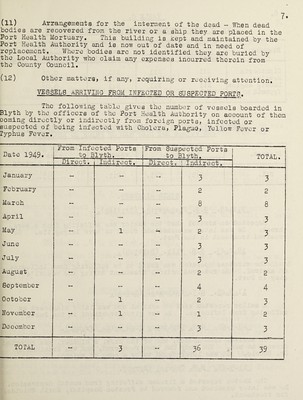
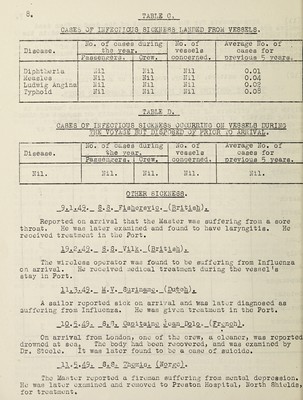
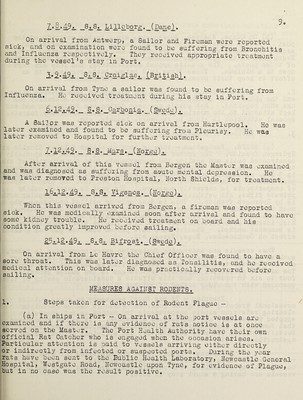
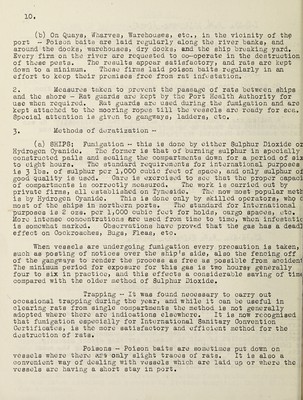
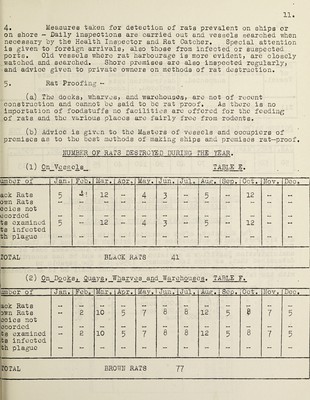
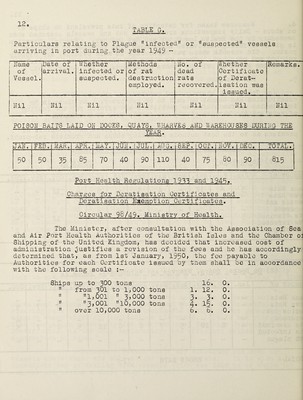
![(b) On Quays, Wharves, Warehouses, etc., in the vicinity of the port - Poison baits are laid regularly along the river banks, and around the docks, warehouses, dry docks, and the ship breaking yard. Every firm on the river are requested to co-operate in the destruction of these pests. The results appear satisfactory, and rats are kept down to a minimum. These firms laid poison baits regularly in an effort to keep their premises free from rat infestation. 2. Measures taken to prevent the passage of rats between ships and the shore - Rat guards are kept by the Port Health Authority for use when required* Rat guards are used during the fumigation and are kept attached to the mooring ropes till the vessels are ready for sea. Special attention is given to gangways, ladders, etc. 3. Methods of deratization - (a) SHIPS: Fumigation - this is done by either Sulphur Dioxide or Hydrogen Cyanide. The former is that of burning sulphur in specially constructed pails and sealing the compartments down for a period of six to eight hours. The standard requirements for international purposes is 3 lbs* of sulphur per 1,000 cubic feet of space, and only sulphur ol good quality is used. Care is exercised to see that the proper capaci of compartments is correctly measured. The work is carried out by private firms, all established on Tyneside. The now most popular mett. is by Hydrogen Cyanide. This is done only by skilled operators, who c most of the ships in northern ports. The standard for International purposes is 2 ozs. per 1,000 cubic feet for holds, cargo spaces, etc. More intense concentrations are used from time to time, when infestatic is somewhat marked. Observations have proved that the gas has a dead] effect on Cockroaches, Bugs, Fleas, etc. When vessels are undergoing fumigation every precaution is taken,: such as posting of notices over the ship's side, also the fencing off of the gangways to render the process as free as possible from accidenl The minimum period for exposure for this gas is two hours?: generally four to six in practice, and this effects a considerable saving of tirru compared with the older method of Sulphur Dioxide. Trapping - It was found necessary to carry out occasional trapping during the year, and while it can be useful in clearing rats from single compartments the method is not generally adopted where there are indications elsewhere. It is now recognised that fumigation especially for International Sanitary Convention Certificates, is the more satisfactory and efficient method for the destruction of rats. Poisons - Poison baits are sometimes put down on vessels where there ass :only slight traces of rats. It is also a convenient way of dealing with vessels which are laid up or where the vessels are having a short stay in port.](https://iiif.wellcomecollection.org/image/b30037438_0016.jp2/full/800%2C/0/default.jpg)