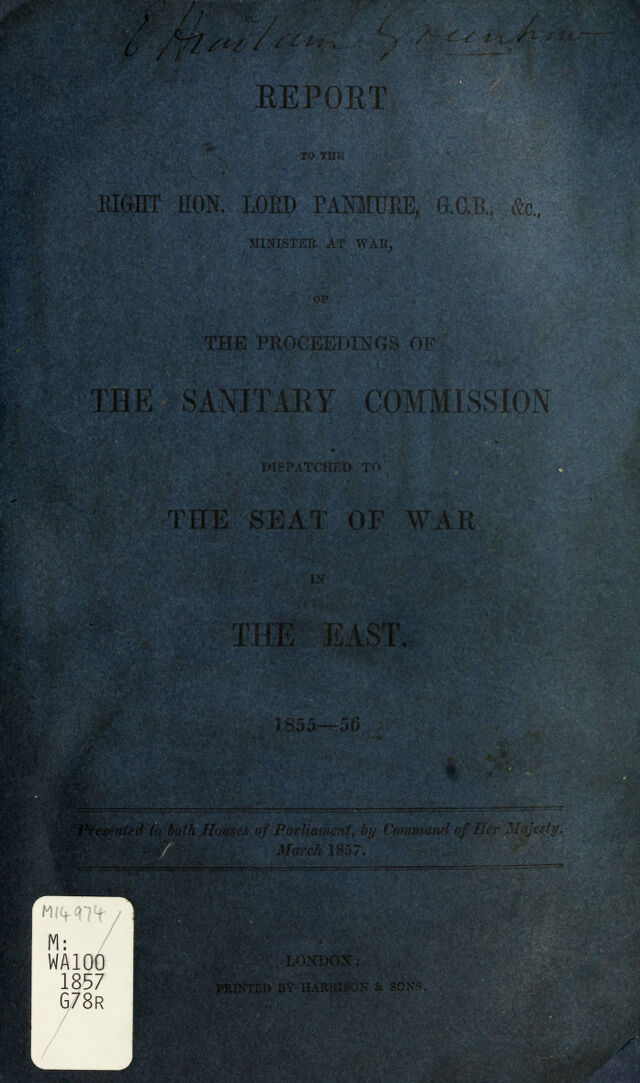
Report to the Right Hon. Lord Panmure, G. C. B., &c., Minister at War, of the proceedings of the Sanitary Commission dispatched to the Seat of War in the East, 1855-56.
- Great Britain. Sanitary Commission Dispatched to the Army in the East (1855-1856)
- Date:
- [1857?]
Licence: Public Domain Mark
Credit: Report to the Right Hon. Lord Panmure, G. C. B., &c., Minister at War, of the proceedings of the Sanitary Commission dispatched to the Seat of War in the East, 1855-56. Source: Wellcome Collection.
16/360
![Proceedings of the Commissioners—continued . 64 to 148 Sanitary Condition of the Camps near Bal alt lava . . 106 to 119 Position of the Camps. The Marine Heights 10? Medical topography; hard, dry, and well drained, but exposed to rapid changes of atmosphere, hioh winds, and sea fogs; generally the ground had been well prepared for the erection of the tents and huts, and they were in good sanitary condition, except as regards ventilation, which was deficient. The Camp of the 79th Highlanders . . 109 Sites of upper huts badly prepared ; earth heaped up against their sides, drainage insufficient, ventilation bad ; lower huts were in a very unhealthy position, ground wet, and earth in contact with sides for two or three feet in height. Report of Sir Colin Campbell that fever had been very prevalent in these huts; statistics of the disease; wetness of the subsoil caused the floor to be very damp, and the huts were overcrowded; removal of the men from the lower huts, recommended by the Commissioners, carried out by Lord Raglan; consequent abatement of fever ; subsequent history of the huts; occupied by the 31st Foot, cholera and diarrhoea became prevalent; afterwards occupied by the Artillery, with a like result; and were then pulled down, when the ground was found exuding water at every pore, p. 109. The Camp of the Royal Artillery in the hollow 113 Was not well situated for health. Much water was found here, and a good deal of manure left about. The Guards1 Camp 114 Situation not very good, means of drainage ample; the damp clay ravines near were not wholesome. Much at- tention had been paid to the preparation and improvement of the camping ground, but earth was heaped up against the walls, and the ventilation was bad. The Land Transport Camp . . . 115 The topographical position, in April ] 855, was one of the worst in the whole occupation; the ground was covered with filth, manure, and offal; numerous fever cases. This camp was afterwards moved.](https://iiif.wellcomecollection.org/image/b20405480_0016.jp2/full/800%2C/0/default.jpg)


 No text description is available for this image
 No text description is available for this image
 No text description is available for this image