The synthesis of some new dimethyltetrahydroquinolines / by Arthur James Ewins and Harold King.
- Ewins, Arthur James.
- Date:
- 1913
Licence: In copyright
Credit: The synthesis of some new dimethyltetrahydroquinolines / by Arthur James Ewins and Harold King. Source: Wellcome Collection.
Provider: This material has been provided by The Royal College of Surgeons of England. The original may be consulted at The Royal College of Surgeons of England.
12/14 (page 111)
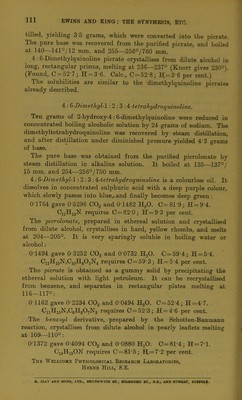
![tilled, yielding 3 5 grams, which were converted into the picrate. The pure base was recovered from the purified picrate, and boiled at 140—141°/12 mm. and 255—256°/760 mm. 4:6-Dimethylquinoline picrate crystallises from dilute alcohol in long, rectangular prisms, melting at 236—237° (Knorr gives 230°). (Found, C = 52'7; H = 3‘6. Calc., C = 52'8; HJ = 3’6 per cent.) The solubilities are similar to the dimethylquinoline picrates already described. 4 : G-Dimethyl-\ : 2 : 3 : A-tetrahydroquinoline. Ten grams of 2-hydroxy-4:6-dimethylquinoline were reduced in concentrated boiling alcoholic solution by 24 grams of sodium. The dimethyltetrahydroquinoline was recovered by steam distillation, and after distillation under diminished pressure yielded 4'3 grams of base. The pure base was obtained from the purified picrolonate by steam distillation in alkaline solution. It boiled at 135—137°/ 15 mm. and 254—256°/750 mm. 4 : Q-Dimethyl-1 : 2 : 3 : 4^tetrahydroquinoline is a colourless oil. It dissolves in concentrated sulphuric acid with a deep purple colour, which slowly passes into blue, and finally becomes deep green: 0-1764 gave 0'5296 C02 and 0T482 H20. C=81'9; H = 9'4. CnH15N requires C = 82-0; H = 9’3 per cent. The 'picrolonate, prepared in ethereal solution and crystallised from dilute alcohol, crystallises in hard, yellow rhombs, and melts at 204—205°. It is very sparingly soluble in boiling water or alcohol : 0T494 gave 0'3252 C02 and 0‘0732 H20. C=59'4; H = 5'4. CnH15N,Ci0H8O6N4 requires C = 59‘3; H = 5'4 per cent. The picrate is obtained as a gummy solid by precipitating the ethereal solution with light petroleum. It can be recrystallised from benzene, and separates in rectangular plates melting at 116—117°: 0’1162 gave 0-2234 C02 and 0’0494 H20. C=52’4; H = 4’7. CnH16N,C6H307N3 requires C = 52’3; H = 4’6 per cent. The benzoyl derivative, prepared by the Schotten-Baumann reaction, crystallises from dilute alcohol in pearly leaflets melting at 109—110°: 0-1372 gave 0’4094 COa and 0'0880 H20. C=81'4; H=7*l. G'j8H]0ON requires C = 8T5; II=7'2 per cent. The Wellcome Physiological Research Laboratories, Herne Hill, S.E. B. GIjAY AND SONS, LTD., BRUNSWICK ST., STAMTORD ST., S.K., AND BUNQAT, SCITOU.](https://iiif.wellcomecollection.org/image/b22439158_0012.jp2/full/800%2C/0/default.jpg)