Licence: Public Domain Mark
Credit: A monograph on mental unsoundness / By Francis Wharton. Source: Wellcome Collection.
Provider: This material has been provided by the Harvey Cushing/John Hay Whitney Medical Library at Yale University, through the Medical Heritage Library. The original may be consulted at the Harvey Cushing/John Hay Whitney Medical Library at Yale University.
72/244 page 62
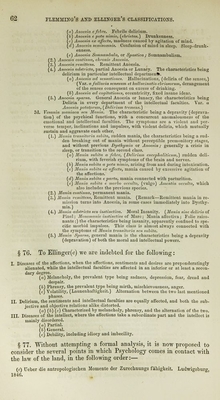
![(«) Anoesia c febre. Febrile delirium. lb) Anoeaia e potu nimio, [ebrietas.) Drunkenness. (c) Anoeaia ex affectu, madness caused by agitation of mind. \d) Anoeaia semisomnis. Confusion of mind in sleep. Sleep-drunk- enness. [e) Anoeaia Somnambula, or Spastica; Somnambulism. (2.) Anoeaia continua, chronic Anoesia. (3.) Anoesia remittens. Remittent Anoesia. (4.) Anoesia adatricta, partial Anoesia or Lunacy. The characteristics being delirium in particular intellectual departments. [a) Anoeaia ad sensatwnes. Hallucinations, (dcliria of the senses,) ( Var. afallacia sensuum et hallucinatio ebriosorum, derangement of the senses consequent on excess of drinking. [b) Anoeaia ad corjitationcs, eccentricity, fixed insane ideas. (5.) Anoesia sparsa. General Anoesia or lunacy, the characteristics being Deliria in every department of the intellectual faculties. Var. a Anoesia potatorum, [Delirium tremens.) 3d. Vesania inaniaca seu Mania. The characteristic being a depravity (deprava- tion) of the psychical functions, with a concurrent anomalousness of the emotional and intellectual faculties. The symptoms are a violent and per- verse temper, inclinations and impulses, with violent deliria, which mutually sustain and aggravate each other. (1.) Mania transitoria subita, sudden mania, the characteristics being a sud- den breaking out of mania without perceptible premonitory stages, and without previous Dysthymia or Anoesia; generally a crisis in sleep, or transition to the second class. («) Mania subita a febre, [Delirium encepHaliticum}) sudden deli- rium, with feverish symptoms of the brain and nerves. (b) Mania subita a potu nimio, arising from and during intoxication. (c) Mania subita ex affectu, mania caused by excessive agitation of the affections. (d) Mania subita e par tit, mania connected with parturition. (e) Mania subita e tnorbo occulto, (vulgo) Amentia occulta, which also includes the previous species. (2.) Mania continua, permanent mania. (3.) Mania remittens, Remittent mania. (Remark—Remittent mania in re- mission turns into Anoesia, in some cases immediately into Dysthy- mia.) (4) Mania adatricta seu instinctica. Moral Insanity. [Mania sine delirio of Pin el; Monomanie instinctive of Marc; Mania aii'ectiva; Folie raiso- nante;) the characteristics being insanity, apparently confined to spe- cific morbid impulses. This class is almost always connected with the symptoms of Mania transitoria seu subita. (5.) Mania Sparsa, general mania is the characteristics being a depravity (depravation) of both the moral and intellectual powers. § 76. To Ellinger(c) we are indebted for the following: I. Diseases of the affections, when the affections, sentiments and desires are preponderatingly alienated, while the intellectual faculties are affected in an inferior or at least a secon- dary degree. (a) Melancholy, the prevalent type being sadness, depression, fear, dread and despair. (b) Phrensy, the prevalent type being mirth, mischievousness, anger. (c) Volatility, (Launenhaftigkcit.) Alternation between the two last mentioned phases. II. Delirium, the sentiments and intellectual faculties aro equally affected, and both the sub- jective and objective relations alike distorted. [a] [b) [e) Characterized by melancholy, phrensy, and the alternation of the two. III. Diseases of the intellect, where the affections take a subordinate part and the intellect is mainly disordered. (a) Partial. (b) General. (c) Debility, including idiocy and imbecility. § 77. Without attempting a formal analysis, it is now proposed to consider the several points in which Psychology conies in contact with the law of the land, in the following order:— (c) Ueber die antropologischen Momente der Zurechiiungs fahigkeit. Ludwigsburg, 1846.](https://iiif.wellcomecollection.org/image/b20999240_0072.jp2/full/800%2C/0/default.jpg)



 No text description is available for this image
 No text description is available for this image
 No text description is available for this image