Dictionary of the active principles of plants: alkaloids : bitter principles; glucosides; their sources, nature, and chemical characteristics / with tabular summary, classification of reactions, and full botanical and general indexes. By Charles E. Sohn.
- Sohn, Charles E.
- Date:
- 1894
Licence: Public Domain Mark
Credit: Dictionary of the active principles of plants: alkaloids : bitter principles; glucosides; their sources, nature, and chemical characteristics / with tabular summary, classification of reactions, and full botanical and general indexes. By Charles E. Sohn. Source: Wellcome Collection.
Provider: This material has been provided by The University of Leeds Library. The original may be consulted at The University of Leeds Library.
13/210
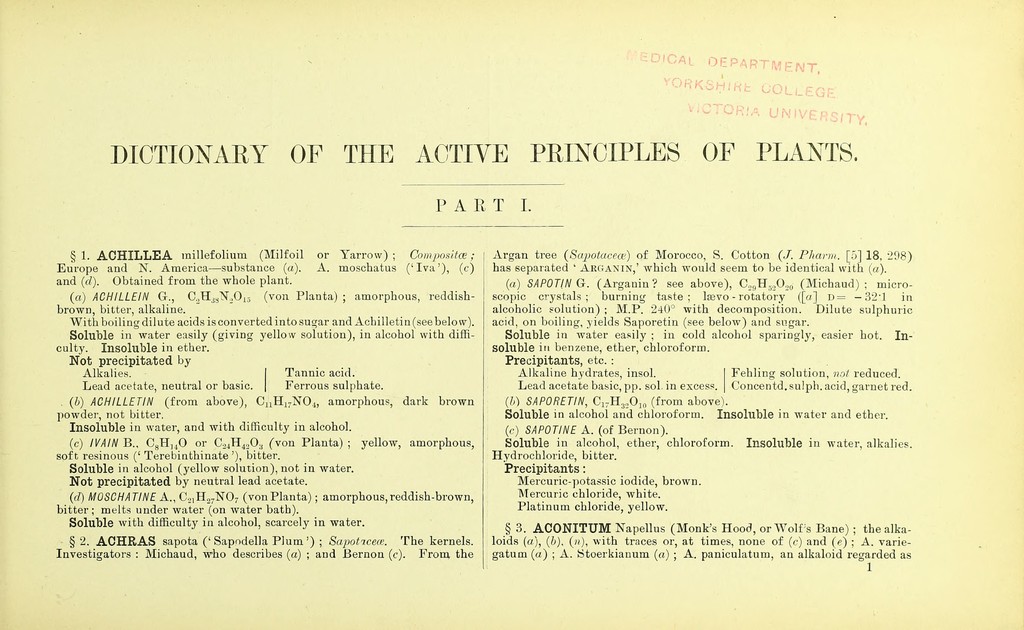
![\ - SDiCAi DEPARTMENT, ^CTORiA UNIVERS/TV, DICTIONARY OF THE ACTIVE PRINCIPLES OF PLANTS. PART I. §1. ACHILLEA millefolium (Milfoil or Yarrow); Compositce; Europe and N. America—substance (a). A. moschatus ('Iva'), (c) and (d). Obtained from the whole plant. («) ACH1LLEIN G., C2H38N2013 (von Planta) ; amorphous, reddish- brown, bitter, alkaline. With boiling dilute acids is converted into sugar and Achilletin (see belo w). Soluble in water easily (giving yellow solution), in alcohol with diffi- culty. Insoluble in ether. Not precipitated by Alkalies. | Tannic acid. Lead acetate, neutral or basic. | Ferrous sulphate. . (b) ACHILLETIN (from above), CUH17N04, amorphous, dark brown powder, not bitter. Insoluble in water, and with difficulty in alcohol. (c) IVAIN B., C8H]40 or C24H4o03 fvon Planta) ; yellow, amorphous, soft resinous (' Terebinthinate '), bitter. Soluble in alcohol (yellow solution), not in water. Not precipitated by neutral lead acetate. (d) MOSCHATINE A., C21H27N07 (vonPlanta); amorphous,reddish-brown, bitter; melts under water (on water bath). Soluble with difficulty in alcohol, scarcely in water. §2. ACHRAS sapota ('Sapodella Plum') ; Sapoticew. The kernels. Investigators : Michaud, who describes (a) ; and Bernon (c). From the Argan tree (Sapotacece) of Morocco, S. Cotton (.7. Pharm. [5] 18, 298) has separated ' Arganin,' which would seem to be identical with (a). (a) SAPOTIN G. (Arganin? see above), C2,,H-.,Oo0 (Michaud); micro- scopic crystals; burning taste; lsevo - rotatory ([«] d= — 32:1 in alcoholic solution) ; M.P. 240° with decomposition. Dilute sulphuric acid, on boiling, yields Saporetin (see below) and sugar. Soluble in water easily ; in cold alcohol sparingly, easier hot. In- soluble in benzene, ether, chloroform. Precipitants, etc.: Alkaline hydrates, insol. I Fehling solution, not reduced. Lead acetate basic, pp. sol. in excess. | Concentd. sulph. acid, garnet red. (//) SAPORETIN, C17H32O10 (from above). Soluble in alcohol and chloroform. Insoluble in water and ether, (c) SAPOTINE A. (of Bernon). Soluble in alcohol, ether, chloroform. Insoluble in water, alkalies. Hydrochloride, bitter. Precipitants: Mercuric-potassic iodide, brown. Mercuric chloride, white. Platinum chloride, yellow. § 3. ACONITUM Napellus (Monk's Hood, or Wolf 's Bane); the alka- loids (a), (b), (n), with traces or, at times, none of (c) and (e) ; A. varie- gatum (a) ; A. kitoerkianum («) ; A. paniculatum, an alkaloid regarded as](https://iiif.wellcomecollection.org/image/b21503023_0013.jp2/full/800%2C/0/default.jpg)