Dictionary of the active principles of plants: alkaloids : bitter principles; glucosides; their sources, nature, and chemical characteristics / with tabular summary, classification of reactions, and full botanical and general indexes. By Charles E. Sohn.
- Sohn, Charles E.
- Date:
- 1894
Licence: Public Domain Mark
Credit: Dictionary of the active principles of plants: alkaloids : bitter principles; glucosides; their sources, nature, and chemical characteristics / with tabular summary, classification of reactions, and full botanical and general indexes. By Charles E. Sohn. Source: Wellcome Collection.
Provider: This material has been provided by The University of Leeds Library. The original may be consulted at The University of Leeds Library.
16/210 page 4
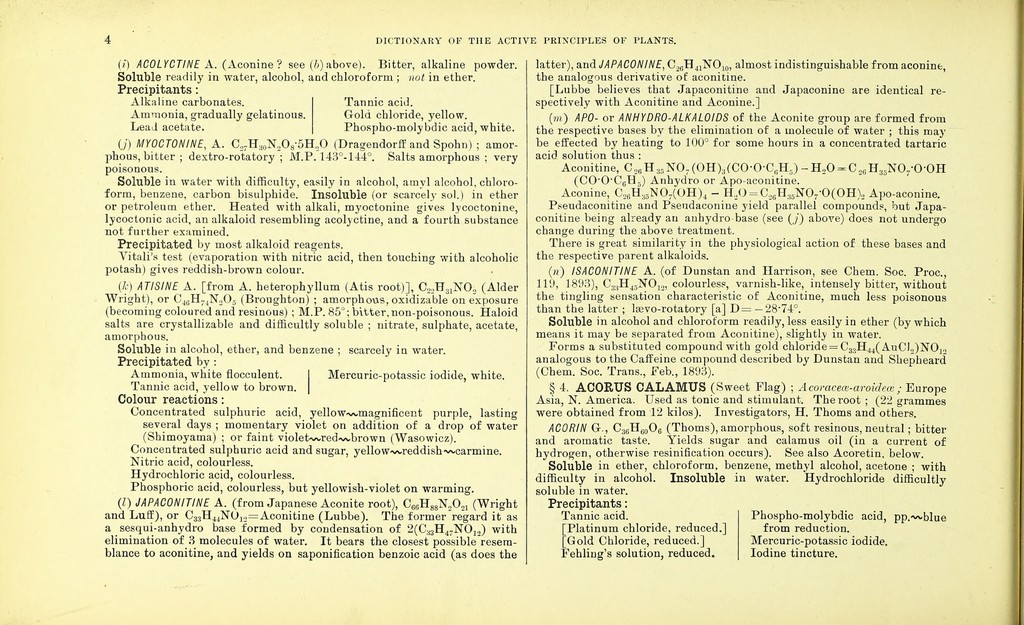
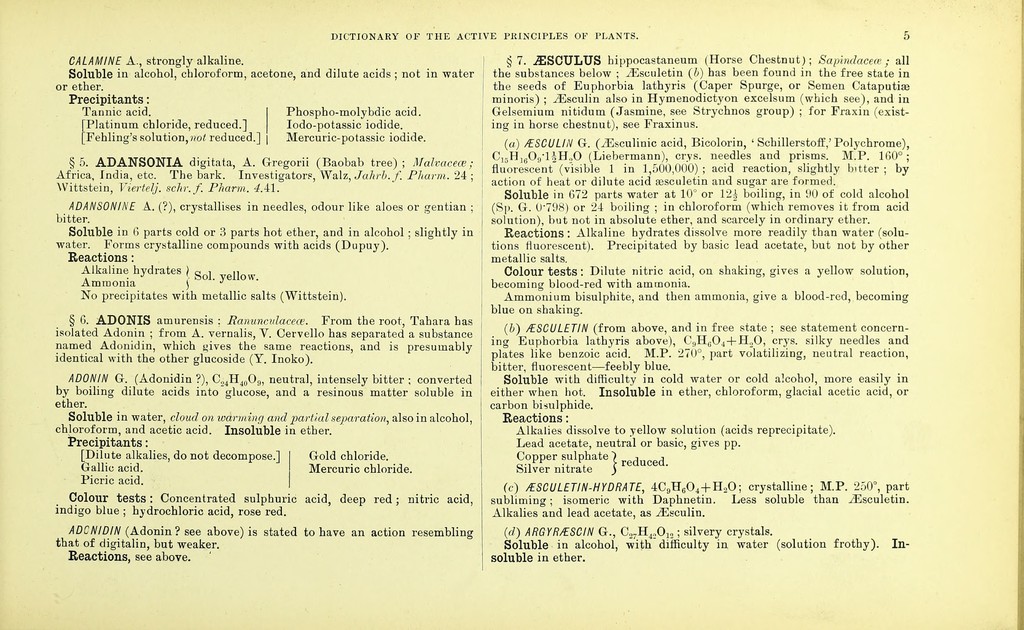
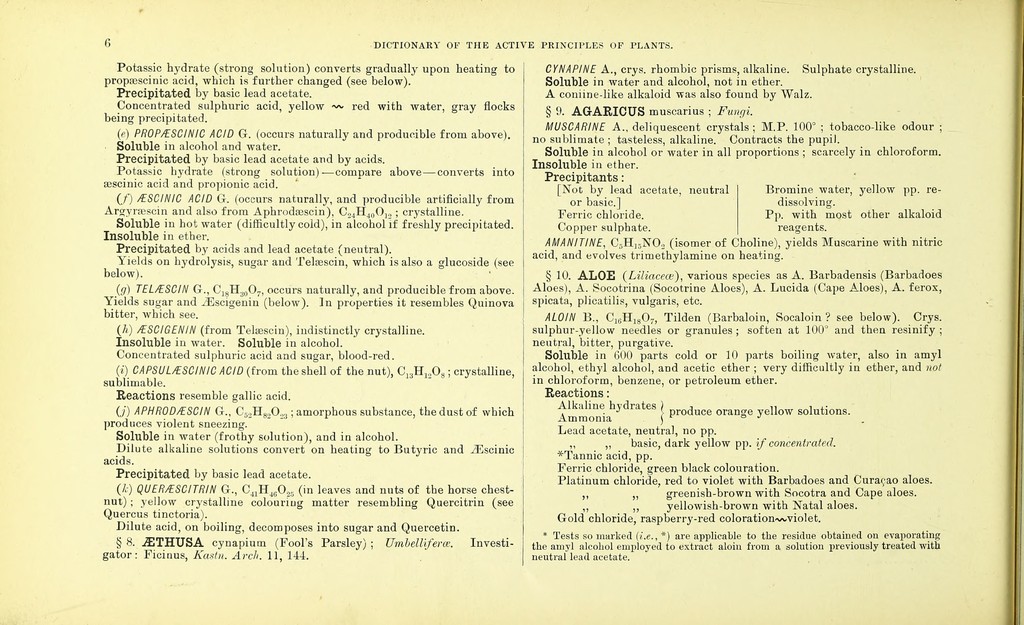
![(i) ACOLYCTINE A. (Aconine ? see (b) above). Bitter, alkaline powder. Soluble readily in water, alcobol, and chloroform ; not in ether. Precipitants: Alkaline carbonates. Tannic acid. Ammonia, gradually gelatinous. Gold chloride, yellow. Lead acetate. Phospho-molybdic acid, white. (./) MYOCTONINE, A. a7Ha0N2O8-5H.2O (Dragendorff and Spohn) ; amor- phous, bitter ; dextro-rotatory; M.P. 143°-144°. Salts amorphous ; very poisonous. Soluble in water with difficulty, easily in alcohol, amyl alcohol, chloro- form, benzene, carbon bisulphide. Insoluble (or scarcely sol.) in ether or petroleum ether. Heated with alkali, myoctonine gives lycoctonine, lycoctonic acid, an alkaloid resembling acolyctine, and a fourth substance not further examined. Precipitated by most alkaloid reagents. Vitali's test (evaporation with nitric acid, then touching with alcoholic potash) gives reddish-brown colour. (k) ATISINE A. [from A. heterophyllum (Atis root)], C2,H31NO„ (Alder Wright), or C46H74N205 (Broughton) ; amorphous, oxidizable on exposure (becoming coloured and resinous) ; M.P. 85°; bitter, non-poisonous. Haloid salts are crystallizable and difficultly soluble ; nitrate, sulphate, acetate, amorphous. Soluble in alcohol, ether, and benzene ; scarcely in water. Precipitated by: Ammonia, white flocculent. I Mercuric-potassic iodide, white. Tannic acid, yellow to brown. | Colour reactions: Concentrated sulphuric acid, yellow~vmagnificent purple, lasting several days ; momentary violet on addition of a drop of water (Shimoyama) ; or faint violet<wred~vbrown (Wasowicz). Concentrated sulphuric acid and sugar, yellow-^reddish-wcarmine. Nitric acid, colourless. Hydrochloric acid, colourless. Phosphoric acid, colourless, but yellowish-violet on warming. (I) JAPACONITINE A. (from Japanese Aconite root), C66H88No0ol (Wright and Luff), or C33H44N012=Aconitine (Lubbe). The former regard it as a sesqui-anhydro base formed by condensation of 2(C33H47N012) with elimination of 3 molecules of water. It bears the closest possible'resem- blance to aconitine, and yields on saponification benzoic acid (as does the latter), and JAPACONINE, C2(!H41NOI0, almost indistinguishable from aconine, the analogous derivative of aconitine. [Lubbe believes that Japaconitine and Japaconine are identical re- spectively with Aconitine and Aconine.] (w) APO- or AN HYDRO-ALKALOIDS of the Aconite group are formed from the respective bases by the elimination of a molecule of water ; this may be effected by heating to 100° for some hours in a concentrated tartaric acid solution thus : Aconitine, CMHMN07(OH)3(CO-0-C6H3)-H20 = C26H35NO/OOH (CO-0C6H5) Anhydro or Apo-aconitine. Aconine, C26H35N07(OH)4 - H20 = C26H86NQ/0(OH)2 Apo-aconine. Pseudaconitine and Pseudaconine yield parallel compounds, but Japa- conitine being already an auhydro base (see (,/) above) does not undergo change during the above treatment. There is great similarity in the physiological action of these bases and the respective parent alkaloids. (») ISACONITINE A. (of Dunstan and Harrison, see Chem. Soc. Proa, 119, 1893), C3:jH45NOj.2, colourless, varnish-like, intensely bitter, without the tingling sensation characteristic of Aconitine, much less poisonous than the latter ; Isevo-rotatory [a] D= — 28-74°. Soluble in alcohol and chloroform readily, less easily in ether (by which means it may be separated from Aconitine), slightly in water. Forms a substituted compound with gold chloride = C3,H44( AuCl.^NO-,., analogous to the Caffeine compound described by Dunstan and Shepheard (Chem. Soc. Trans., Feb., 1893). § 4. ACORUS CALAMUS (Sweet Flag) ; Acoracece-aroidece'■; Europe Asia, N. America. Used as tonic and stimulant. The root ; (22 grammes were obtained from 12 kilos). Investigators, H. Thorns and others. ACORIN Gr., C36H60O8 (Thorns), amorphous, soft resinous, neutral; bitter and aromatic taste. Yields sugar and calamus oil (in a current of hydrogen, otherwise resinification occurs). See also Acoretin, below. Soluble in ether, chloroform, benzene, methyl alcohol, acetone ; with difficulty in alcohol. Insoluble in water. Hydrochloride difficultly soluble in water. Precipitants: Tannic acid. Phospho-molybdic acid, pp.~vblue [Platinum chloride, reduced.] from reduction. [Gold Chloride, reduced.] Mercuric-potassic iodide. Fehling's solution, reduced. Iodine tincture.](https://iiif.wellcomecollection.org/image/b21503023_0016.jp2/full/800%2C/0/default.jpg)