Dictionary of the active principles of plants: alkaloids : bitter principles; glucosides; their sources, nature, and chemical characteristics / with tabular summary, classification of reactions, and full botanical and general indexes. By Charles E. Sohn.
- Sohn, Charles E.
- Date:
- 1894
Licence: Public Domain Mark
Credit: Dictionary of the active principles of plants: alkaloids : bitter principles; glucosides; their sources, nature, and chemical characteristics / with tabular summary, classification of reactions, and full botanical and general indexes. By Charles E. Sohn. Source: Wellcome Collection.
Provider: This material has been provided by The University of Leeds Library. The original may be consulted at The University of Leeds Library.
205/210 page 193
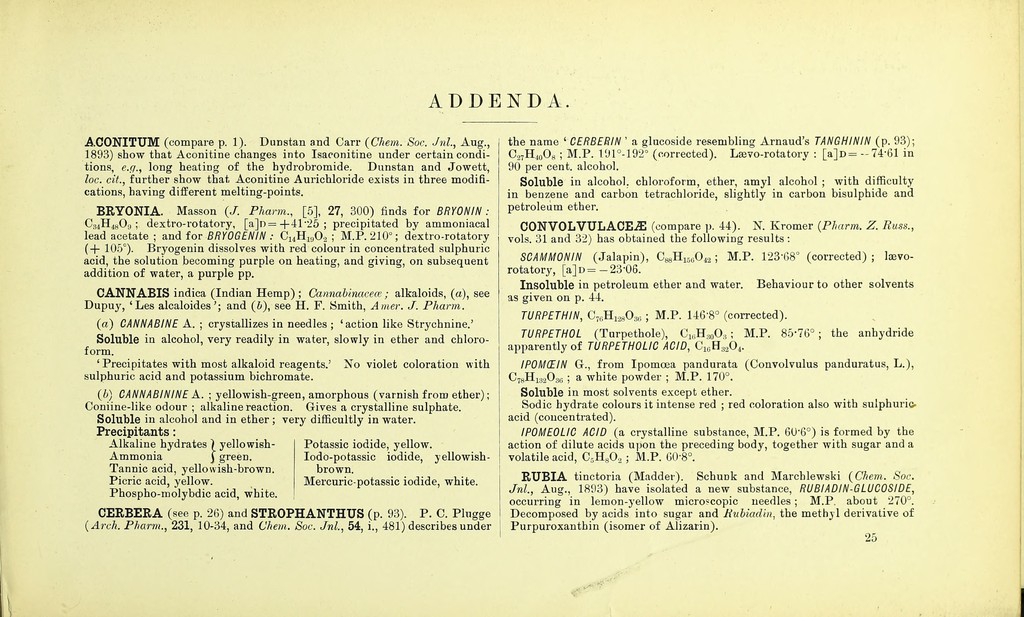
![ADD ACONITUM (compare p. 1). Dunstan and Can- (Chem. Soc. Jnl., Aug., 1893) show that Aconitine changes into Isaconitine under certain condi- tions, e.g., long heating of the hydrobromide. Dunstan and Jowett, loc. cit., further show that Aconitine Aurichloride exists in three modifi- cations, having different melting-points. BRYONIA. Masson (J. Pharm., [5], 27, 300) finds for BRYONIN : C34H4803 ; dextro-rotatory, [a]n=+41-25; precipitated by ammoniacal lead acetate ; and for BRYOGENIN : CuH1H02 ; M.P. 210°; dextro-rotatory (+ 105°). Bryogenin dissolves with red colour in concentrated sulphuric acid, the solution becoming purple on heating, and giving, on subsequent addition of water, a purple pp. CANNABIS indica (Indian Hemp) ; Cannabinacem ; alkaloids, (a), see Dupuy, 'Les alcaloides'; and (&), see H. F. Smith, Amer. J. Pharm. (a) CANNABINE A. ; crystallizes in needles ; 'action like Strychnine.' Soluble in alcohol, very readily in water, slowly in ether and chloro- form. ' Precipitates with most alkaloid reagents.' No violet coloration with sulphuric acid and potassium bichromate. (6) CANNABININE A. ; yellowish-green, amorphous (varnish from ether); Coniine-like odour ; alkaline reaction. Gives a crystalline sulphate. Soluble in alcohol and in ether ; very difficultly in water. Precipitants: Alkaline hydrates \ yellowish- Ammonia } green. Tannic acid, yellowish-brown. Picric acid, yellow. Phospho-molybdic acid, white. Potassic iodide, yellow. Iodo-potassic iodide, yellowish- brown. Mercuric-potassic iodide, white. CERBERA (see p. 26) and STROPHANTHUS (p. 93). P. C. Plugge {Arch. Pharm., 231, 10-34, and Chem. Soc. Jnl., 54, i., 481) describes under N D A. the name ' CERBERIN ' a glucoside resembling Arnaud's TANGHININ (p. 93); C.27H40O„; M.P. 191°-192° (corrected). Laevo-rotatory : [a]D= -74-61 in 90 per cent, alcohol. Soluble in alcohol, chloroform, ether, amyl alcohol ; with difficulty in benzene and carbon tetrachloride, slightly in carbon bisulphide and petroleum ether. CONVOLVULACE^E (compare p. 44). N. Kromer {Pharm. Z. Russ., vols. 31 and 32) has obtained the following results : SCAMM0NIN (Jalapin), C^H^O^; M.P. 123-68° (corrected) ; laevo- rotatory, [a] d=—23'06. Insoluble in petroleum ether and water. Behaviour to other solvents as given on p. 44. TURPETHIN, C76H128086 ; M.P. 146-8° (corrected). TURPETH0L (Turpethole), C16H30O3 ; M.P. 85-76° ; the anhydride apparently of TURPETH0LI0 ACID, C1GH3204. IP0MCEIN G., from Ipomcea pandurata (Convolvulus panduratus, L.), C78H132036 ; a white powder ; M.P. 170°. Soluble in most solvents except ether. Sodic hydrate colours it intense red ; red coloration also with sulphuric- acid (concentrated). IP0ME0LIC ACID (a crystalline substance, M.P. 60-6°) is formed by the action of dilute acids upon the preceding body, together with sugar and a volatile acid, C5H802 ; M.P. 60-8°. RUBIA tinctoria (Madder). SchuDk and Marchlewski (Chem. Soc. Jnl., Aug., 1893) have isolated a new substance, RUBIADIN-GLUCOSIDE, occurring in lemon-yellow microscopic needles; M.P. about 270°. Decomposed by acids into sugar and Eubiadin, the methyl derivative of Purpuroxanthin (isomer of Alizarin). 25](https://iiif.wellcomecollection.org/image/b21503023_0205.jp2/full/800%2C/0/default.jpg)