Dictionary of the active principles of plants: alkaloids : bitter principles; glucosides; their sources, nature, and chemical characteristics / with tabular summary, classification of reactions, and full botanical and general indexes. By Charles E. Sohn.
- Sohn, Charles E.
- Date:
- 1894
Licence: Public Domain Mark
Credit: Dictionary of the active principles of plants: alkaloids : bitter principles; glucosides; their sources, nature, and chemical characteristics / with tabular summary, classification of reactions, and full botanical and general indexes. By Charles E. Sohn. Source: Wellcome Collection.
Provider: This material has been provided by The University of Leeds Library. The original may be consulted at The University of Leeds Library.
22/210 page 10
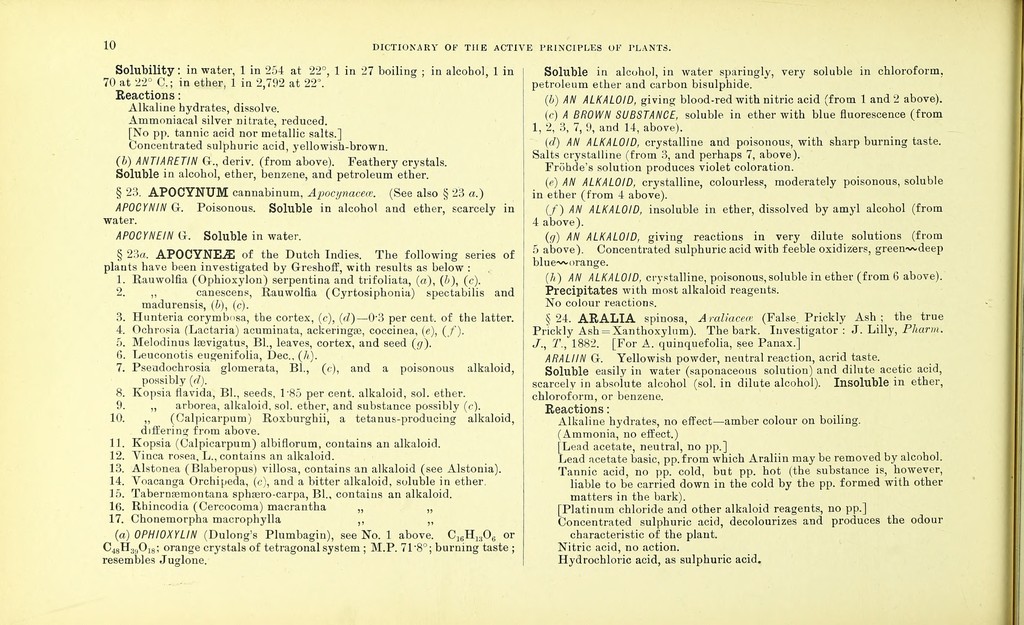
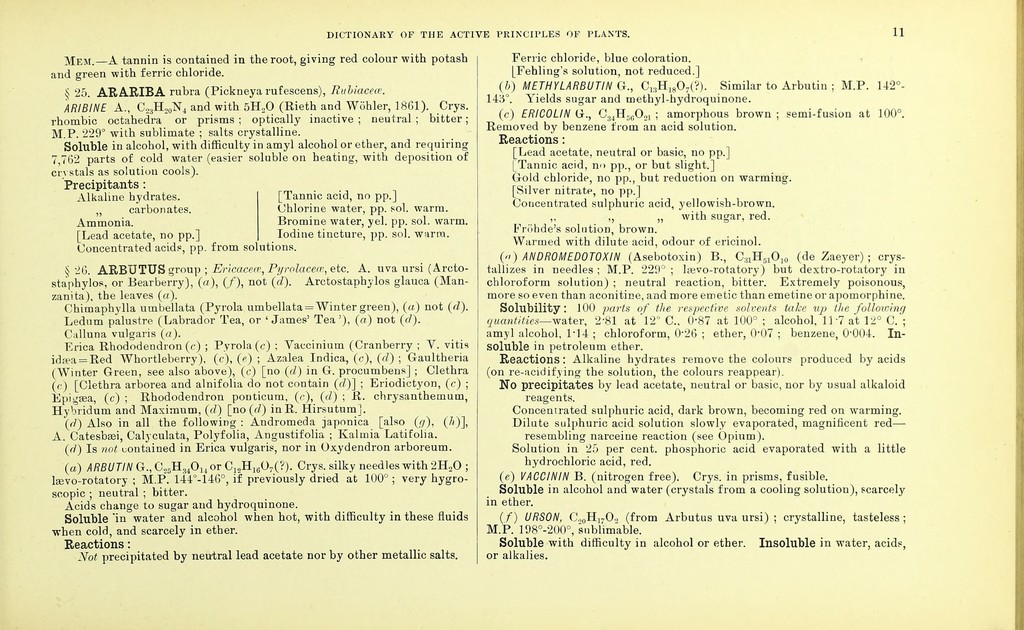
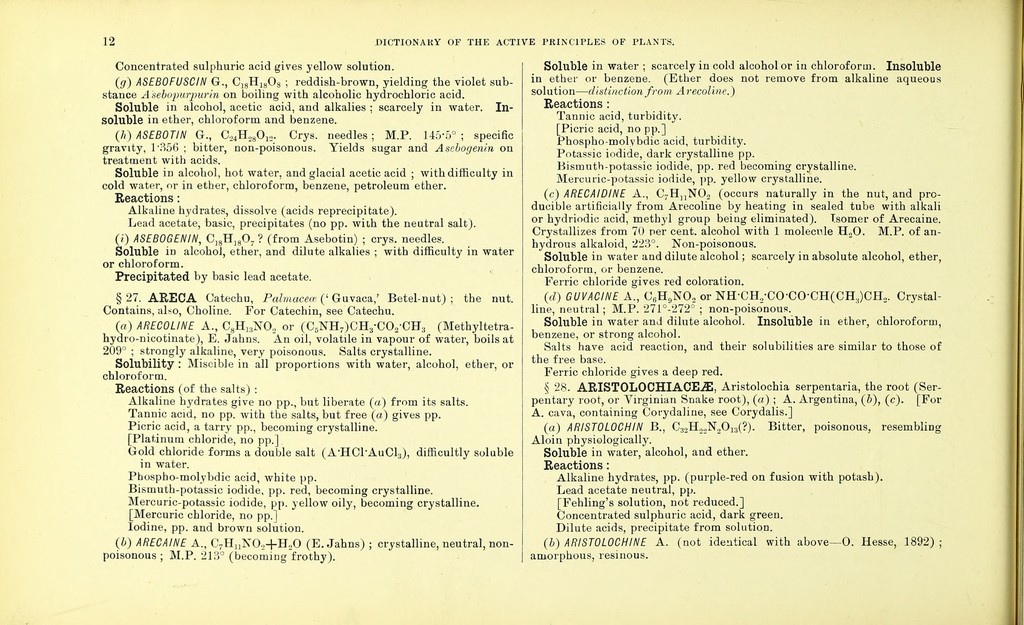
![Solubility: in water, 1 in 254 at 22°, 1 in 27 boiling ; in alcohol, 1 in 70 at 22° C; in ether, 1 in 2,792 at 22°. Reactions: Alkaline hydrates, dissolve. Ammoniacal silver nitrate, reduced. [No pp. tannic acid nor metallic salts.] Concentrated sulphuric acid, yellowish-brown. (b) ANT IA RET IN G., deriv. (from above). Feathery crystals. Soluble in alcohol, ether, benzene, and petroleum ether. § 23. APOCYNUM cannabinum, Apocynacece. (See also § 23 a.) APOCYNIN G. Poisonous. Soluble in alcohol and ether, scarcely in water. APOCYNEIN G. Soluble in water. § 23a. APOCYNE-ffi of the Dutch Indies. The following series of plants have been investigated by Greshoff, with results as below : 1. Rauwolfia (Opbioxylon) serpentina and trifoliata, (a), (b), (c). 2. ,, canescens, Rauwolfia (Cyrtosiphonia) spectabilis and madurensis, (b), (c). 3. Hunteria corymbnsa, the cortex, (c), (d)—03 per cent, of the latter. 4. Ochrosia (Lactaria) acuminata, ackeringre, coccinea, (e), ( /'). 5. Melodinus laevigatus, Bl., leaves, cortex, and seed (g), 6. Leuconotis eugenifolia, Dec, (/*.). 7. Pseadochrosia glomerata, Bl., (c), and a poisonous alkaloid, possibly (d). 8. Kopsia flavida, Bl., seeds, 1 '85 per cent, alkaloid, sol. ether. 9. ,, arborea, alkaloid, sol. ether, and substance possibly (c). 10. ,, (Calpicarpum) Roxburghii, a tetanus-producing alkaloid, differing from above. 11. Kopsia (Calpicarpum) albiflorum, contains an alkaloid. 12. Yinca rosea, L., contains an alkaloid. 13. Alstonea (Blaberopus) villosa, contains an alkaloid (see Alstonia). 14. Voacanga Orchipeda, (c), and a bitter alkaloid, soluble in ether. 15. Tabernasmontana sphasro-carpa, Bl., contains an alkaloid. 16. Rbincodia (Cercocoma) macrantha „ „ 17. Chonemorpha macrophylla ,, ,, (a) 0PHI0XYLIN (Dulong's Plumbagin), see No. 1 above. C16H1:j06 or C48FL,,0]8; orange crystals of tetragonal system ; M.P. 71*8°; burning taste ; resembles Juglone. Soluble in alcohol, in water sparingly, very soluble in chloroform, petroleum ether and carbon bisulphide. (b) AN ALKALOID, giving blood-red witb nitric acid (from 1 and 2 above). (c) A BROWN SUBSTANCE, soluble in ether with blue fluorescence (from 1, 2, 3, 7, 9, and 14, above). (d) AN ALKALOID, crystalline and poisonous, witb sharp burning taste. Salts crystalline (from 3, and perhaps 7, above). Frohde's solution produces violet coloration. (p) AN ALKALOID, crystalline, colourless, moderately poisonous, soluble in ether (from 4 above). (/) AN ALKALOID, insoluble in ether, dissolved by amyl alcohol (from 4 above). (g) AN ALKALOID, giving reactions in very dilute solutions (from 5 above). Concentrated sulphuric acid witb feeble oxidizers, green-wdeep blue-^orange. (/*) AN ALKALOID, crystalline, poisonous, soluble in ether (from 6 above). Precipitates with most alkaloid reagents. No colour reactions. § 24. ARALIA spinosa, Araliacece (False. Prickly Ash; the true Prickly Ash = Xanthoxylnm). The bark. Investigator: J. Lilly, Pharm. J., T., 1882. [For A. quinquefolia, see Panax.] ARALIIN G. Yellowish powder, neutral reaction, acrid taste. Soluble easily in water (saponaceous solution) and dilute acetic acid, scarcely in absolute alcohol (sol. in dilute alcohol). Insoluble in ether, chloroform, or benzene. Reactions: Alkaline hydrates, no effect—amber colour on boiling. (Ammonia, no effect.) [Lead acetate, neutral, no pp.] Lead acetate basic, pp.from which Araliin may be removed by alcohol. Tannic acid, no pp. cold, but pp. hot (the substance is, however, liable to be carried down in the cold by the pp. formed with other matters in the bark). [Platinum chloride and other alkaloid reagents, no pp.] Concentrated sulphuric acid, decolourizes and produces the odour characteristic of the plant. Nitric acid, no action. Hydrochloric acid, as sulphuric acid.](https://iiif.wellcomecollection.org/image/b21503023_0022.jp2/full/800%2C/0/default.jpg)