Dictionary of the active principles of plants: alkaloids : bitter principles; glucosides; their sources, nature, and chemical characteristics / with tabular summary, classification of reactions, and full botanical and general indexes. By Charles E. Sohn.
- Sohn, Charles E.
- Date:
- 1894
Licence: Public Domain Mark
Credit: Dictionary of the active principles of plants: alkaloids : bitter principles; glucosides; their sources, nature, and chemical characteristics / with tabular summary, classification of reactions, and full botanical and general indexes. By Charles E. Sohn. Source: Wellcome Collection.
Provider: This material has been provided by The University of Leeds Library. The original may be consulted at The University of Leeds Library.
24/210 page 12
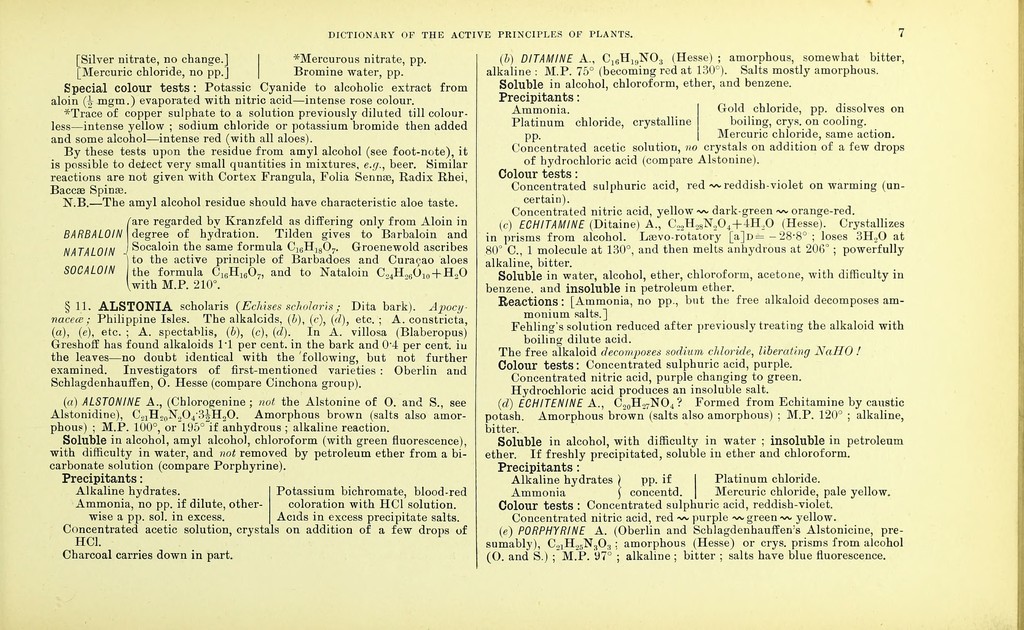
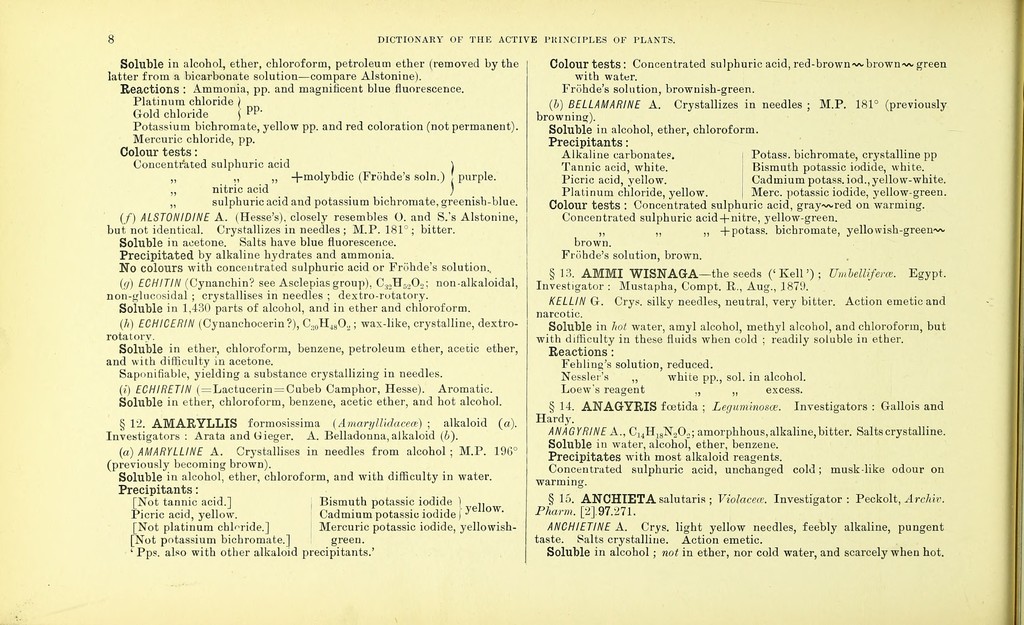
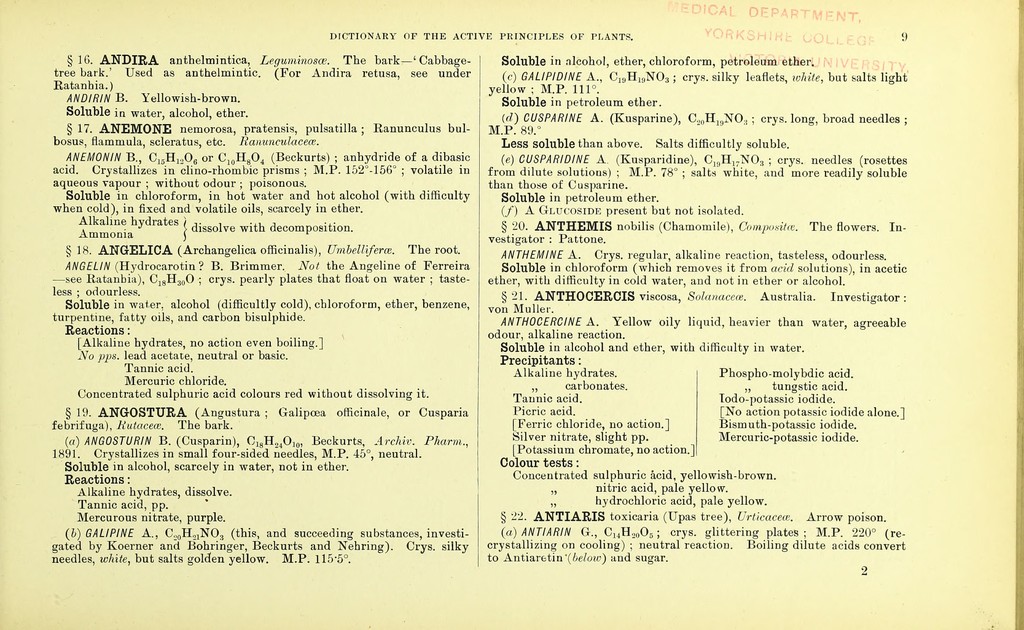
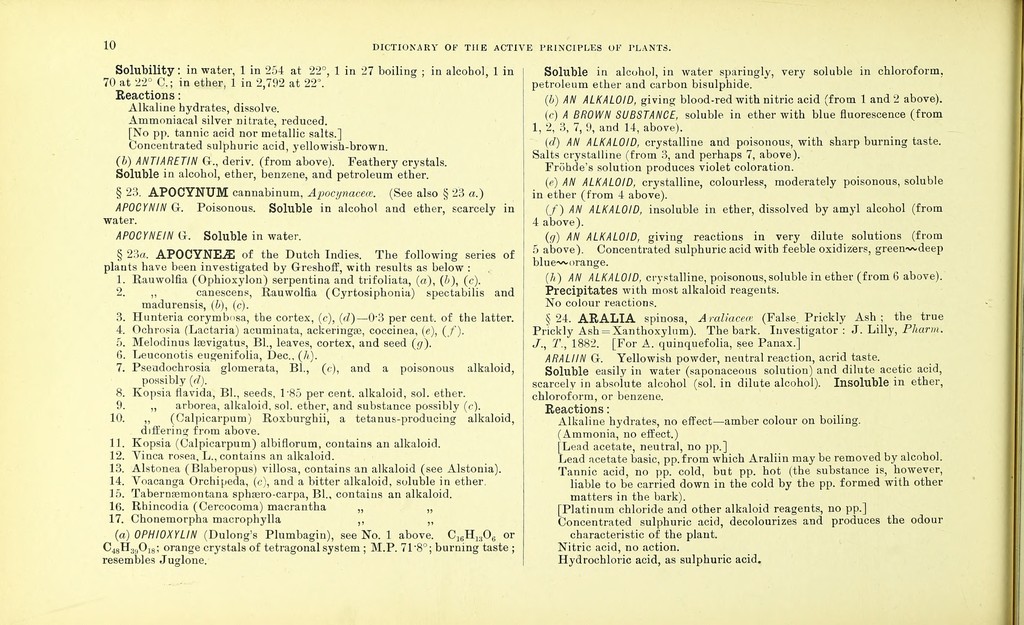
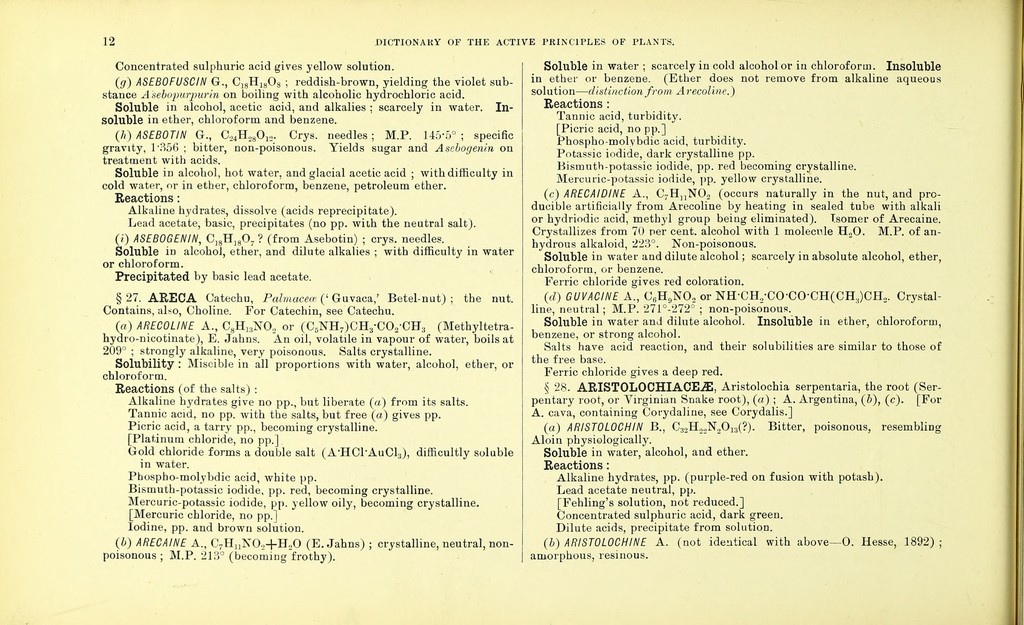
![Concentrated sulphuric acid gives yellow solution. (g) ASEBOFUSCIN G., C18H1803 ; reddish-brown, yielding the violet sub- stance A'sebopurpurin on boiling with alcoholic hydrochloric acid. Soluble in alcohol, acetic acid, and alkalies ; scarcely in water. In- soluble in ether, chloroform and benzene. (h) ASEBOTIN G., G,4H28012. Crys. needles; M.P. 145-5° ; specific gravity, 1\356 ; bitter, non-poisonous. Yields sugar and Asabogenin on treatment with acids. Soluble in alcohol, hot water, and glacial acetic acid ; with difficulty in cold water, or in ether, chloroform, benzene, petroleum ether. Eeactions: Alkaline hydrates, dissolve (acids reprecipitate). Lead acetate, basic, precipitates (no pp. with the neutral salt). (i) ASEBOGENIN, C]8H]807 ? (from Asebotin) ; crys. needles. Soluble in alcohol, ether, and dilute alkalies ; with difficulty in water or chloroform. Precipitated by basic lead acetate. § 27. ARECA Catechu, Palmacece (' Guvaca,' Betel-nut) ; the nut. Contains, also, Choline. For Catechin, see Catechu. («) ARECOLINE A., C8H1:iN02 or (C5NH7)CH3-C02-CH;J (Methyltetra- hydi o-nicotinate), E. Jahns. An oil, volatile in vapour of water, boils at 209° ; strongly alkaline, very poisonous. Salts crystalline. Solubility : Miscible in all proportions with water, alcohol, ether, or chloroform. Reactions (of the salts) : Alkaline hydrates give no pp., but liberate (a) from its salts. Tannic acid, no pp. with the salts, but free (a) gives pp. Picric acid, a tarry pp., becoming crystalline. [Platinum chloride, no pp.] Gold chloride forms a double salt (A'HClAuCL,), difficultly soluble in water. Phospho-molybdic acid, white pp. Bismuth-potassic iodide, pp. red, becoming crystalline. Mercuric-potassic iodide, pp. yellow oily, becoming crystalline. [Mercuric chloride, no pp.] Iodine, pp. and brown solution. (b) ARECAINE A., C7HnNO,+H20 (E. Jahns) ; crystalline, neutral, non- poisonous ; M.P. 213° (becoming frothy). Soluble in water ; scarcely in cold alcohol or in chloroform. Insoluble in ether or benzene. (Ether does not remove from alkaline aqueous solution—distinction from Arecoline.) Reactions : Tannic acid, turbidity. [Picric acid, no pp.] Phospho-molybdic acid, turbidity. Potassic iodide, dark crystalline pp. Bismuth-potassic iodide, pp. red becoming crystalline. Mercuric-potassic iodide, pp. yellow crystalline. (c) ARECAIDINE A., C7HnN02 (occurs naturally in the nut, and pro- ducible artificially from Arecoline by heating in sealed tube with alkali or hydriodic acid, methyl group being eliminated). Isomer of Arecaine. Crystallizes from 70 per cent, alcohol with 1 molecule H.,0. M.P. of an- hydrous alkaloid, 223°. Non-poisonous. Soluble in water and dilute alcohol; scarcely in absolute alcohol, ether, chloroform, or benzene. Ferric chloride gives red coloration. (d) GUVACINE A., C6H9N02 or NH-CH2-COCO-CH(CH;i)CH2. Crystal- line, neutral; M.P. 271°-272° ; non-poisonous. Soluble in water and dilute alcohol. Insoluble in ether, chloroform, benzene, or strong alcohol. Salts have acid reaction, and their solubilities are similar to those of the free base. Ferric chloride gives a deep red. § 28. ARISTOLOCHIACE-ffi, Aristolochia serpentaria, the root (Ser- pentary root, or Virginian Snake root), («) ; A. Argentina, (b), (c). [For A. cava, containing Corydaline, see Corydalis.] (a) ARISTOLOCHIN B., Ci2H22N20i3(?). Bitter, poisonous, resembling Aloin physiologically. Soluble in water, alcohol, and ether. Reactions: Alkaline hydrates, pp. (purple-red on fusion with potash). Lead acetate neutral, pp. [Fehling's solution, not reduced.] Concentrated sulphuric acid, dark green. Dilute acids, precipitate from solution. (b) ARIST0L0CHINE A. (not identical with above—0. Hesse, 1892) ; amorphous, resinous.](https://iiif.wellcomecollection.org/image/b21503023_0024.jp2/full/800%2C/0/default.jpg)