Dictionary of the active principles of plants: alkaloids : bitter principles; glucosides; their sources, nature, and chemical characteristics / with tabular summary, classification of reactions, and full botanical and general indexes. By Charles E. Sohn.
- Sohn, Charles E.
- Date:
- 1894
Licence: Public Domain Mark
Credit: Dictionary of the active principles of plants: alkaloids : bitter principles; glucosides; their sources, nature, and chemical characteristics / with tabular summary, classification of reactions, and full botanical and general indexes. By Charles E. Sohn. Source: Wellcome Collection.
Provider: This material has been provided by The University of Leeds Library. The original may be consulted at The University of Leeds Library.
30/210 page 18
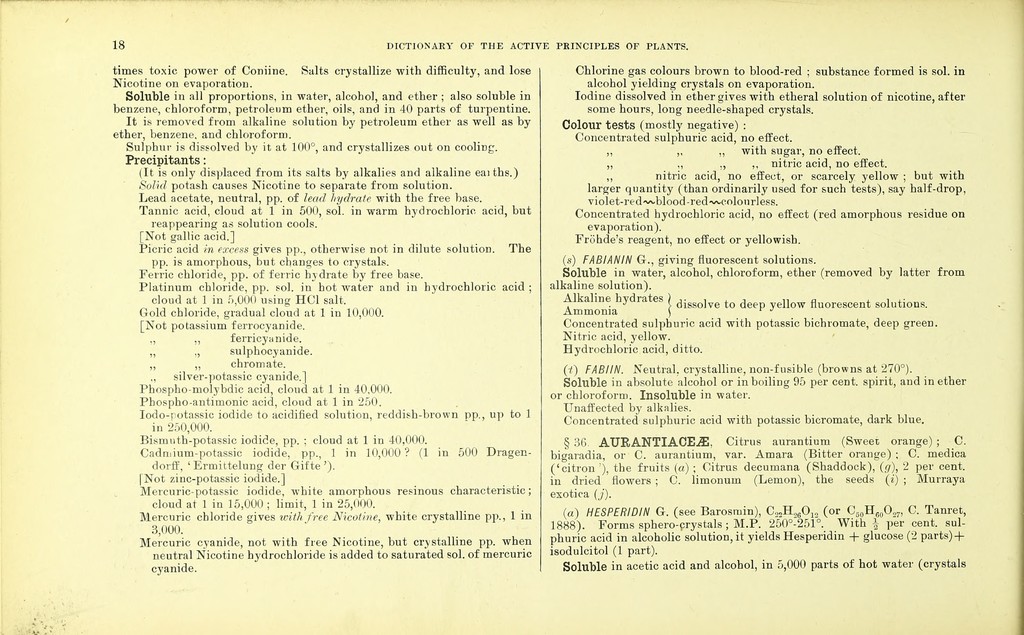
![times toxic power of Coniine. Salts crystallize with difficulty, and lose Nicotine on evaporation. Soluble in all proportions, in water, alcohol, and ether ; also soluble in benzene, chloroform, petroleum ether, oils, and in 40 parts of turpentine. It is removed from alkaline solution by petroleum ether as well as by ether, benzene, and chloroform. Sulphur is dissolved by it at 100°, and crystallizes out on cooling. Precipitants: (It is only displaced from its salts by alkalies and alkaline eaiths.) Solid potash causes Nicotine to separate from solution. Lead acetate, neutral, pp. of lead hydrate with the free base. Tannic acid, cloud at 1 in 500, sol. in warm hydrochloric acid, but reappearing as solution cools. [Not gallic acid.] Picric acid in excess gives pp., otherwise not in dilute solution. The pp. is amorphous, but changes to crystals. Ferric chloride, pp. of ferric hydrate by free base. Platinum chloride, pp. sol. in hot water and in hydrochloric acid ; cloud at 1 in 5,000 using HC1 salt. Gold chloride, gradual cloud at 1 in 10,000. [Not potassium ferrocyanide. ,, ,, ferricyanide. ,, „ sulphocyanide. „ ,, chromate. silver-potassic cyanide.] Phospho-molybdic acid, cloud at 1 in 40,000. Phospho-antimonic acid, cloud at 1 in 250. Iodo-potassic iodide to acidified solution, reddish-brown pp., up to 1 in 250,000. Bismnth-potassic iodide, pp. ; cloud at 1 in 40,000. Cadmium-potassic iodide, pp., 1 in 10,000 ? (1 in 500 Dragen- dorff, 1 Ermittelung der Gifte'). [Not zinc-potassic iodide.] Mercuric-potassic iodide, white amorphous resinous characteristic; cloud at 1 in 15,000 ; limit, 1 in 25,000. Mercuric chloride gives with free Nicotine, white crystalline pp., 1 in 3,000. Mercuric cyanide, not with free Nicotine, but crystalline pp. when neutral Nicotine hydrochloride is added to saturated sol. of mercuric cyanide. Chlorine gas colours brown to blood-red ; substance formed is sol. in alcohol yielding crystals on evaporation. Iodine dissolved in ether gives with etheral solution of nicotine, after some hours, long needle-shaped crystals. Colour tests (mostly negative) : Concentrated sulphuric acid, no effect. ,, ,, ,, with sugar, no effect. ,, ,, ,, nitric acid, no effect. ,, nitric acid, no effect, or scarcely yellow ; but with larger quantity (than ordinarily used for such tests), say half-drop, violet-red-wblood-red-vxcolonrless. Concentrated hydrochloric acid, no effect (red amorphous residue on evaporation). Frohde's reagent, no effect or yellowish. (s) FABIANIN G., giving fluorescent solutions. Soluble in water, alcohol, chloroform, ether (removed by latter from alkaline solution). Alkaline hydrates ) ^jgso]ve ^0 deep yellow fluorescent solutions. Ammonia ) r J Concentrated sulphuric acid with potassic bichromate, deep green. Nitric acid, yellow. Hydrochloric acid, ditto. (t) FABIIN. Neutral, crystalline, non-fusible (browns at 270°). Soluble in absolute alcohol or in boiling 95 per cent, spirit, and in ether or chloroform. Insoluble in water. Unaffected by alkalies. Concentrated sulphuric acid with potassic bicromate, dark blue. § 36. AURANTIACE-S, Citrus aurantium (Sweet orange) ; C. bigaradia, or C. aurantium, var. Amara (Bitter orange) ; C. medica ('citron'), the fruits (a) ; Citrus decumana (Shaddock), (g), 2 per cent, in dried flowers ; C. limonuin (Lemon), the seeds (i) ; Murraya exotica (j). (a) HESPERIDIN G. (see Barosmin), C22H26012 (or CS0H60O27, C. Tanret, 1888). Forms sphero-crystals ; M.P. 250°-251°. With \ per cent, sul- phuric acid in alcoholic solution, it yields Hesperidin + glucose (2 parts) + isodulcitol (1 part). Soluble in acetic acid and alcohol, in 5,000 parts of hot water (crystals](https://iiif.wellcomecollection.org/image/b21503023_0030.jp2/full/800%2C/0/default.jpg)