Dictionary of the active principles of plants: alkaloids : bitter principles; glucosides; their sources, nature, and chemical characteristics / with tabular summary, classification of reactions, and full botanical and general indexes. By Charles E. Sohn.
- Sohn, Charles E.
- Date:
- 1894
Licence: Public Domain Mark
Credit: Dictionary of the active principles of plants: alkaloids : bitter principles; glucosides; their sources, nature, and chemical characteristics / with tabular summary, classification of reactions, and full botanical and general indexes. By Charles E. Sohn. Source: Wellcome Collection.
Provider: This material has been provided by The University of Leeds Library. The original may be consulted at The University of Leeds Library.
33/210 page 21
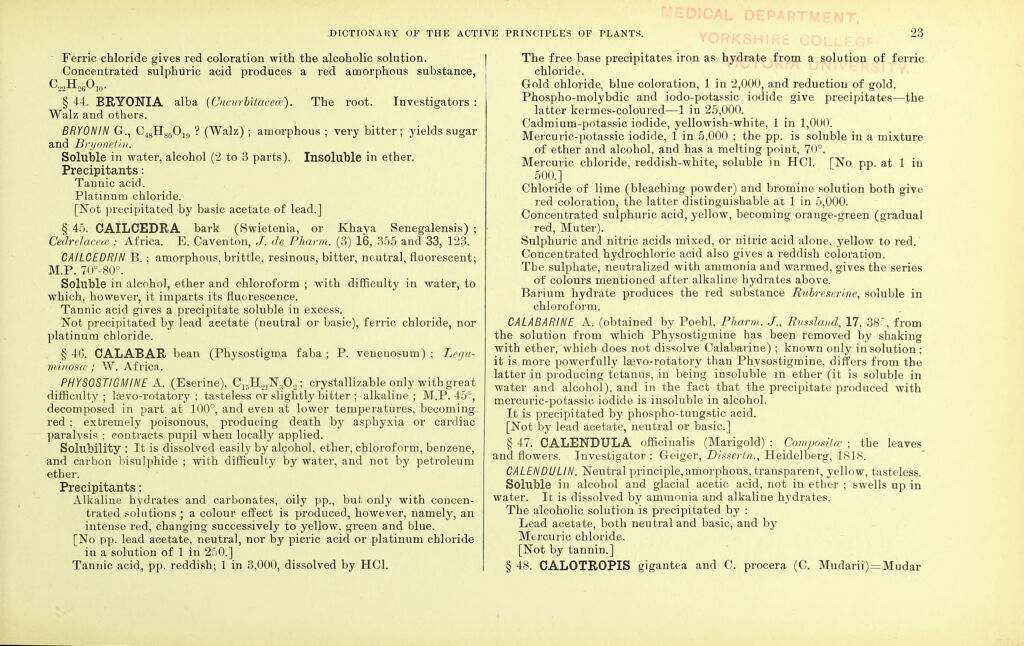
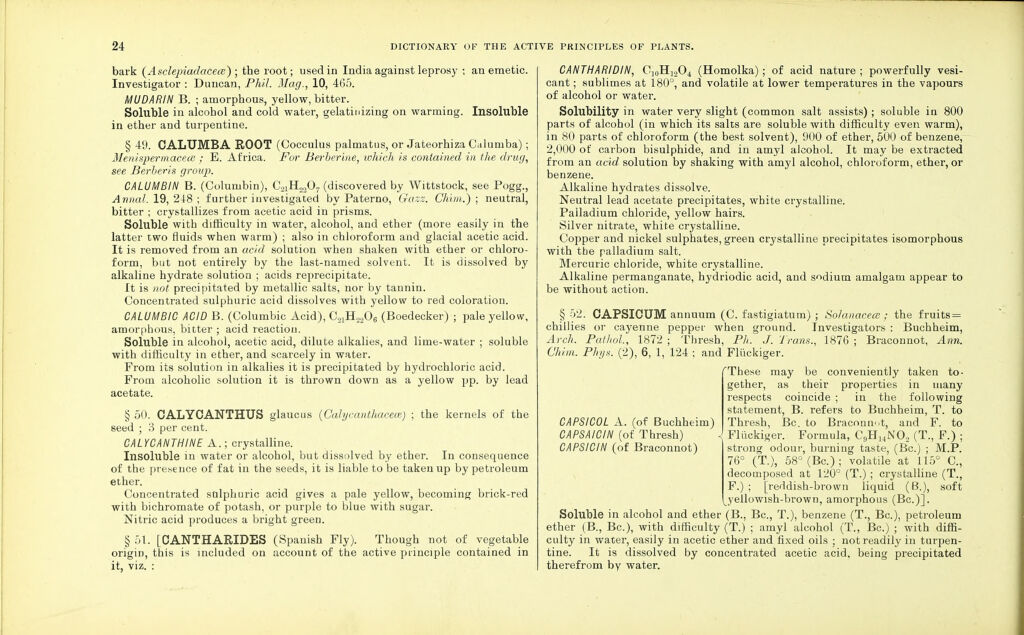
![Hydrastis Canadensis, the 'Golden Seal' (the alkaloids (a),(/),(<?), including 4 per cent, of Berberine) ; Cocculus palmatus, ' Columbo root' (see also Calumba); Xanthoxylum Clava Herculis, Podophyllum peltatum (see also Podophyllum), etc. [For Artarine resembling Berberine, see Xanthoxylon.] (a) BERBERINE A. (Xanthopicrit), C,nH17N04, and with 5H„0 ; crystal- lizes in yellow prisms or needles ; M.P. 120° C. (Fleitman), or browns at 110° and blackens at 160° (Perkiu) ; faint quinone odour on warming ; neutral to litmus ; bitter ; feebly toxic to man, poisonous to dogs and other animals. Medicinal dose, 2 to 5 grains. Solubility : It dissolves in 300 parts of cold water, in alcohol, in benzene with difficulty. Insoluble in ether and petroleum ether ; chloro- form removes traces from acid solution. Boiling alkalies convert to a resinous substance, and ammonia dissolves to a reddish-brown solution. The salts (excepting acetate aud pyrophosphate) are difficultly soluble. Precipitants, etc. : Tannic acid, cloud at 1 in .3,000, increased by hydrochloric acid and dissolved on warming. Picric acid, pp. amorphous, becoming crystalline at 1 in 3,000. Platinum chloride. Gold chloride, immediate orange pp. at 1 in 3,000; part soluble in cold HC1. Ferro-cyanide potassium, yellow. Potassio-argentic cyanide, amorphous at 1 in 6,000. Potassium bichromate, amorphous. Iodo-potassic iodide, kermes colour (or green plates in warm alcoholic solution. Bismutho-potassic iodide, orange-red. Cadmium-potassic iodide, complete precipitation. Zinc-potassic iodide, amorphous at 1 in 6,000. Mayer's reagent (mercuric-potassic iodide). Mercuric chloride, amorphous, insoluble in HC1 even warm. Bromine water, a yellow pp. Iodine, green crystals if excess of iodine be avoided. Tincture of iodine, yellowish-brown crystalline pp. Colour Reactions : Chlorine water, poured gently on to surface of Beberine solution, gives a red ring distinguishable even at 1 in 250,000. Concentrated sulphuric acid, yellow (olive-green, Muter). Oxidizers, such as manganese dioxide, when added to the sulphuric acid solution, give colours resembling those with strychnine. Potassic nitrate, added after 10 to 15 hours solution in sulphuric acid, changes the olive-green solution to dark brown or orange. Nitric acid, brown. Concentrated hydrochloric acid, insoluble. Friihde's reagent, brownish-green, becoming gradually lighter. (b) 0XYACANTHINE A. (Vinetine, from Vinetier, the French name for Berberis vu)g. ; not the Oxyacanthine from Crataegus oxyacanthus), C18H1HNO;!. or CjyH^NO^ (Riidel) ; crystalline; dextro-rotatory [a]D=+131'6 for chloroform solution; M.P. of the dried ammonia pp. = 138°-150°, or the crystals from alcohol 208°-214° ; alkaline reaction ; bitter. Solubility : Water dissolves it with difficulty ; alcohol, 30 parts cold, 4 boiling ; soluble in ether (which removes it from alkaline solution), slightly in petroleum ether ; miscible with chloroform in all proportions. Precipitants: Alkaline hydrates and ammonia, soluble in excess. [Not by neutral or basic lead acetate.] Tannic acid, white. Hicric acid, yellow. [No pp. ferric chloride.] Platinum chloride, yellow, soluble in hydrochloric acid. Gold chloride. Silver nitrate, white. [Not by copper sulphate.] Phospho-molybdic acid, yellowish-white. Mercuric chloi'ide. Bromine solution. Iodine, reddish-brown. Tartar emetic. Stannous chloride. [No pp. mercurous nitrate.] Colour Reactions : Concentrated sulphuric acid, reddish-brown (colourless to yellow—O. Hesse). Nitric acid, brownish-yellow, becoming resinous with formation of oxalic acid. Per-iodic acid, reduced.](https://iiif.wellcomecollection.org/image/b21503023_0033.jp2/full/800%2C/0/default.jpg)