Dictionary of the active principles of plants: alkaloids : bitter principles; glucosides; their sources, nature, and chemical characteristics / with tabular summary, classification of reactions, and full botanical and general indexes. By Charles E. Sohn.
- Sohn, Charles E.
- Date:
- 1894
Licence: Public Domain Mark
Credit: Dictionary of the active principles of plants: alkaloids : bitter principles; glucosides; their sources, nature, and chemical characteristics / with tabular summary, classification of reactions, and full botanical and general indexes. By Charles E. Sohn. Source: Wellcome Collection.
Provider: This material has been provided by The University of Leeds Library. The original may be consulted at The University of Leeds Library.
34/210 page 22
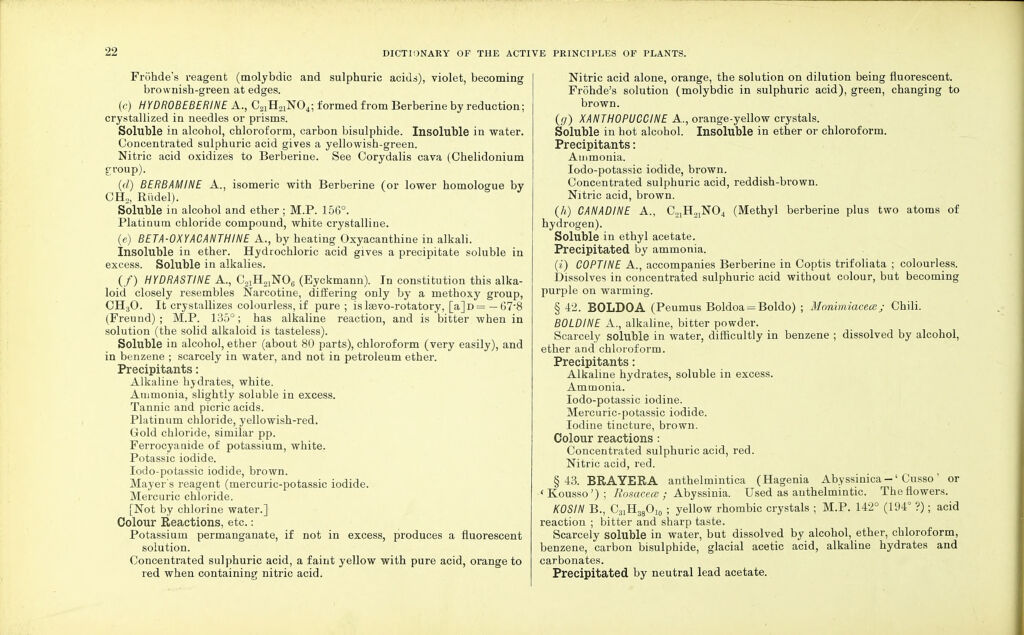
![Frohde's reagent (molybdic and sulphuric acids), violet, becoming brownish-green at edges. (c) HYDROBEBERINE A., C2iH21N04; formed from Berberine by reduction; crystallized in needles or prisms. Soluble in alcohol, chloroform, carbon bisulphide. Insoluble in water. Concentrated sulphuric acid gives a yellowish-green. Nitric acid oxidizes to Berberine. See Corydalis cava (Chelidonium group). (d) BERBAMINE A., isomeric with Berberine (or lower homologue by CH2, Riidel). Soluble in alcohol and ether ; M.P. 156°. Platinum chloride compound, white crystalline. (e) BETA-OXYACANTHINE A., by heating Oxyacanthine in alkali. Insoluble in ether. Hydrochloric acid gives a precipitate soluble in excess. Soluble in alkalies. (/) HYDRASTINE A., 021H21NO6 (Eyckmann). In constitution this alka- loid closely resembles Narcotine, differing only by a methoxy group, CHjO. It crystallizes colourless, if pure; is laevo-rotatory, [a]D= — 67-8 (Freund) ; M.P. 135°; has alkaline reaction, and is bitter when in solution (the solid alkaloid is tasteless). Soluble in alcohol, ether (about 80 parts), chloroform (very easily), and in benzene ; scarcely in water, and not in petroleum ether. Precipitants: Alkaline hydrates, white. Ammonia, slightly soluble in excess. Tannic and picric acids. Platinum chloride, yellowish-red. Gold chloride, similar pp. Ferrocyanide of potassium, white. Potassic iodide. Iodo-potassic iodide, brown. Mayer's reagent (mercuric-potassic iodide. Mercuric chloride. [Not by chlorine water.] Colour Reactions, etc.: Potassium permanganate, if not in excess, produces a fluorescent solution. Concentrated sulphuric acid, a faint yellow with pure acid, orange to red when containing nitric acid. Nitric acid alone, orange, the solution on dilution being fluorescent. Frohde's solution (molybdic in sulphuric acid), green, changing to brown. (g) XANTHOPUCCINE A., orange-yellow crystals. Soluble in hot alcohol. Insoluble in ether or chloroform. Precipitants: Ammonia. Iodo-potassic iodide, brown. Concentrated sulphuric acid, reddish-brown. Nitric acid, brown. (Ji) CANADINE A., C21H21N04 (Methyl berberine plus two atoms of hydrogen). Soluble in ethyl acetate. Precipitated by ammonia. (i) COPTINE A., accompanies Berberine in Coptis trifoliata ; colourless. Dissolves in concentrated sulphuric acid without colour, but becoming purple on warming. § 42. BOLDOA (Peumus Boldoa = Boldo) ; Monimiacemj Chili. BOLDINE A., alkaline, bitter powder. Scarcely soluble in water, difficultly in benzene ; dissolved by alcohol, ether and chloroform. Precipitants: Alkaline hydrates, soluble in excess. Ammonia. Iodo-potassic iodine. Mercuric-potassic iodide. Iodine tincture, brown. Colour reactions : Concentrated sulphuric acid, red. Nitric acid, red. §43. BRAYERA anthelmintica (Hagenia Abyssinica -' Cusso ' or < Kousso') ; Rosacea; ; Abyssinia. Used as anthelmintic. The flowers. KOSIN B., C31H38Oi0 ; yellow rhombic crystals ; M.P. 142° (194° ?); acid reaction ; bitter and sharp taste. Scarcely soluble in water, but dissolved by alcohol, ether, chloroform, benzene, carbon bisulphide, glacial acetic acid, alkaline hydrates and carbonates. Precipitated by neutral lead acetate.](https://iiif.wellcomecollection.org/image/b21503023_0034.jp2/full/800%2C/0/default.jpg)