Dictionary of the active principles of plants: alkaloids : bitter principles; glucosides; their sources, nature, and chemical characteristics / with tabular summary, classification of reactions, and full botanical and general indexes. By Charles E. Sohn.
- Sohn, Charles E.
- Date:
- 1894
Licence: Public Domain Mark
Credit: Dictionary of the active principles of plants: alkaloids : bitter principles; glucosides; their sources, nature, and chemical characteristics / with tabular summary, classification of reactions, and full botanical and general indexes. By Charles E. Sohn. Source: Wellcome Collection.
Provider: This material has been provided by The University of Leeds Library. The original may be consulted at The University of Leeds Library.
35/210 page 23
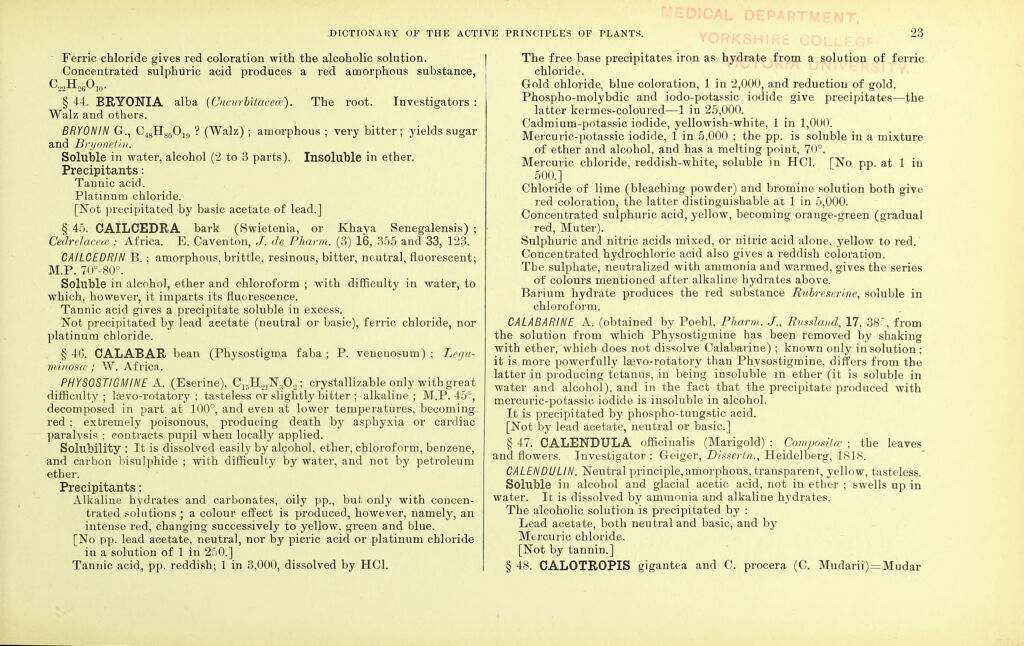
![Ferric chloride gives red coloration with the alcoholic solution. Concentrated sulphuric acid produces a red amorphous substance, CLH26O10. § 44. BRYONIA alba (Cucurbitacece). The root. Investigators : Walz and others. BRYONIN G., C48H80O19 ? (Walz) ; amorphous ; very bitter ; yields sugar and Bryonetin. Soluble in water, alcohol (2 to 3 parts). Insoluble in ether. Precipitants: Tannic acid. Platinum chloride. [Not precipitated by basic acetate of lead.] § 45. OAILCEDRA bark (Swietenia, or Khaya Senegalensis) ; Cedrelacece ; Africa. E. Caventon, J. de Pharm. (3) 16, 355 and 33, 123. CAILCEDRIN B.; amorphous, brittle, resinous, bitter, neutral, fluorescent; M.P. 70°-80°. Soluble in alcohol, ether and chloroform ; with difficulty in water, to which, however, it imparts its fluorescence. Tannic acid gives a precipitate soluble in excess. Not precipitated by lead acetate (neutral or basic), ferric chloride, nor platinum chloride. § 4G. CALABAR bean (Physostigma faba ; P. venenosum) ; Legu- minosa; W. Africa. PHYSOSTIGMINE A. (Eserine), C15H21N.}02; crystallizable only with great difficulty; lasvo-rotatory ; tasteless or slightly bitter ; alkaline; M.P. 45°, decomposed in part at 100°, and even at lower temperatures, becoming red ; extremely poisonous, producing death by asphyxia or cardiac paralysis ; contracts pupil when locally applied. Solubility : It is dissolved easily by alcohol, ether, chloroform, benzene, and carbon bisulphide ; with difficulty by water, and not by petroleum ether. Precipitants: Alkaline hydrates and carbonates, oily pp., but only with concen- trated solutions ; a colour effect is produced, however, namely, an intense red, changing successively to yellow, green and blue. [No pp. lead acetate, neutral, nor by picric acid or platinum chloride in a solution of 1 in 250.] Tannic acid, pp. reddish; 1 in 3,000, dissolved by HC1. '!-OJCAL DEPAR1 The free base precipitates iron as hydrate from a solution of ferric chloride. Gold chloride, blue coloration, 1 in 2,000, and reduction of gold. Phospho-molybdic and iodo-potassic iodide give precipitates—the latter kermes-coloured—1 in 25,000. Cadmium-potassic iodide, yellowish-white, 1 in 1,000. Mercuric-potassic iodide, 1 in 5,000 ; the pp. is soluble in a mixture of ether and alcohol, and has a melting point, 70°. Mercuric chloride, reddish-white, soluble in HC1. [No pp. at 1 in 500.] Chloride of lime (bleaching powder) and bromine solution both give red coloration, the latter distinguishable at 1 in 5,000. Concentrated sulphuric acid, yellow, becoming orange-green (gradual red, Muter). Sulphuric and nitric acids mixed, or nitric acid alone, yellow to red. Concentrated hydrochloric acid also gives a reddish coloration. The sulphate, neutralized with ammonia and warmed, gives the series of colours mentioned after alkaline hydrates above. Barium hydrate produces the red substance Rubreser'me, soluble in chloroform. CALABARINE A. (obtained by Poehl, Pharm. J., Russland, 17, 38, from the solution from which Physostigmine has been removed by shaking with ether, which does not dissolve Calabarine) ; known only in solution ; it is more powerfully lsevo-rotatory than Physostigmine, differs from the latter in producing tetanus, in being insoluble in ether (it is soluble in water and alcohol), and in the fact that the precipitate produced with mercuric-potassic iodide is insoluble in alcohol. It is precipitated by phospho-tungstic acid. [Not by lead acetate, neutral or basic] § 47. CALENDULA officinalis (Marigold) ; Composite ; the leaves and flowers. Investigator : Geiger, Disscrtn., Heidelberg, 1818. CALENDULIN. Neutral principle, amorphous, transparent, yellow, tasteless. Soluble in alcohol and glacial acetic acid, not in ether ; swells up in water. It is dissolved by ammonia and alkaline hydrates. The alcoholic solution is precipitated by : Lead acetate, both neutral and basic, and by Mercuric chloride. [Not by tannin.] § 48. CALOTROPIS gigantea and C. procera (C. Mudarii) = Mudar](https://iiif.wellcomecollection.org/image/b21503023_0035.jp2/full/800%2C/0/default.jpg)