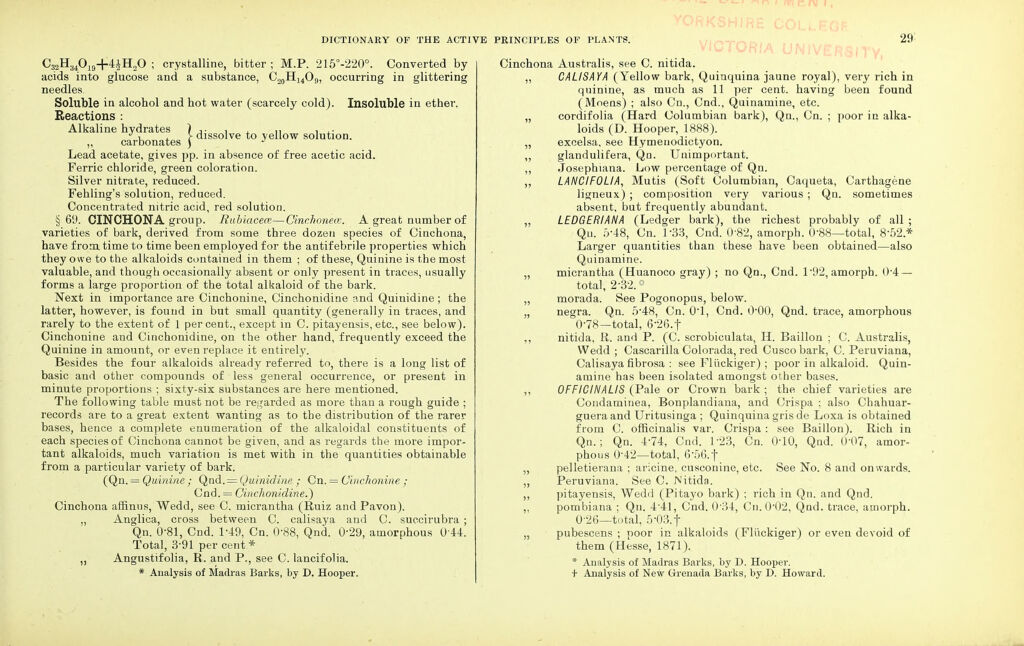
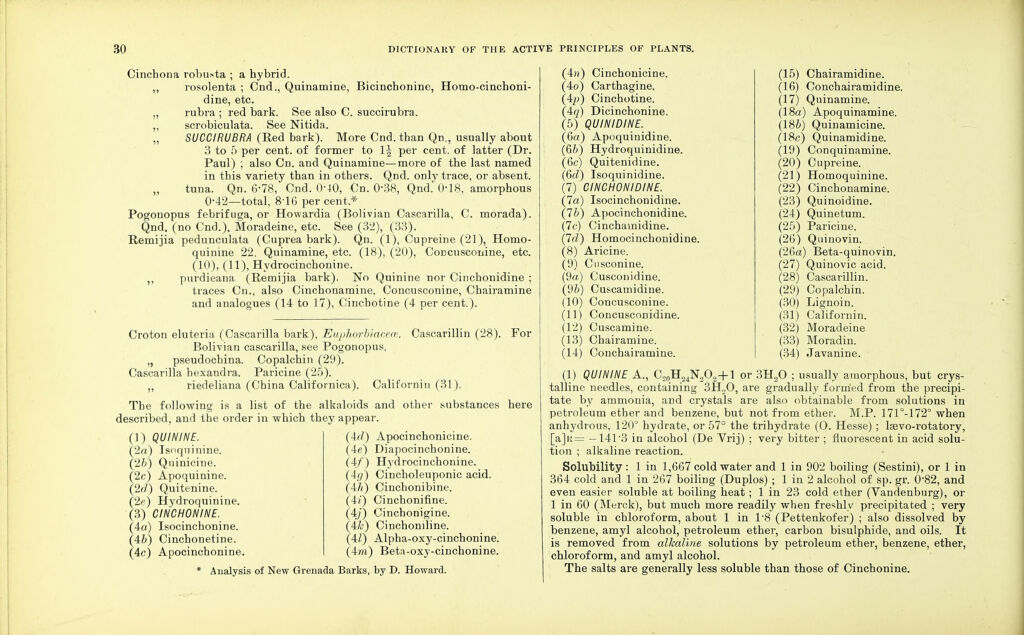
Dictionary of the active principles of plants: alkaloids : bitter principles; glucosides; their sources, nature, and chemical characteristics / with tabular summary, classification of reactions, and full botanical and general indexes. By Charles E. Sohn.
- Sohn, Charles E.
- Date:
- 1894
Licence: Public Domain Mark
Credit: Dictionary of the active principles of plants: alkaloids : bitter principles; glucosides; their sources, nature, and chemical characteristics / with tabular summary, classification of reactions, and full botanical and general indexes. By Charles E. Sohn. Source: Wellcome Collection.
Provider: This material has been provided by The University of Leeds Library. The original may be consulted at The University of Leeds Library.
37/210 page 25
![Capsicia (Be.) is Soluble in alkaline hydrates. [Not in carbonates.] Ammonia converts to soapy mass. Barium and calcium salts give pps. in concentrated alcoholic solutions. It is not precipitated by basic acetate of lead, tannic acid, gold chloride, or silver nitrate (with strong alcoholic solution, the latter does give a pp). Ferric chloride, no change cold, red pp. on warming (T.). Concentrated sulphuric acid gives with Capsicol (B.) a colourless solution becoming successively red, purple and black on warming. Nitric acid, red (becoming yellow with alkalies). Pungency is destroyed by oxidizers. § 53. CARAPA Guianensis (C. Tulucunna) ; Meliacexe; S. America ; the bark. CARAP/N B ('doubtful,' E. Carentou) ; composition, C 55-04, H 6 54, O 38'42 per cent. ; amorphous, resinous. Soluble in water (not easily), alcohol, ether and chloroform. No decided colours with concentrated acids, etc. TULUCUHHIN B.; pale yellow, amorphous ; acid reaction ; very bitter. Soluble in 150 parts of cold water, in alcohol and chloroform ; not in ether. Concentrated sulphuric acid dissolves brown, changing to blue ; or, if a few drf ps of water be added immediately after the acid, a splendid blue is at once obtained. Hydrochloric, phosphoric, warm citric oxalic, or tartaric acid each pro- duces the same colour. Nitric and acetic acids do not. § 54. CAROBA LEAVES (Jacaranda procera, or Cybistax anti- syphilitica) ; Bignoniacece; Brazil. The substance Carobin below ; and Sparattosperma leucantha leaves (same botanical order), Sparatto- spermin. Investigator : Peckolt. Ph. J. Trans,, 1882, and Ze.lt. oest. Apothr., 6, 361. CAROBIN B.; crystallizes in needles. Soluble in hot water and hot alcohol ; not in those fluids cold, nor in ether. Precipitated by tartar emetic. SPARATTOSPERMIN B., C19H.,4Ol0 ; crystallizes in microscopic needles; M.P. 245° ; yields no sugar wi'th acids. 2r, Soluble in alcohol. Insoluble in water, amyl alcohol, chloroform, ether, or pretroleum ether. It is taken up by ether and water to some extent on long boiling. § 55. CASSIA acutifolia (C. lanceolata, or Alexandrian Senna) ; C. angustifolia (C. elongata, E. Indian or Tinnevelly Senna)—the substances (a) and (b); Albizzia Saponaria—substance (a); Leyuminoscc. [Not to confuse with Cassia bark, Cinnamomum Cassia.] Note : Some of the Cassieas contain Beberine, see Beberis group. Tephrosia and Cynanchum have been used as adulterants of senna ; for Cynanchum, see Asclepias group. (a) CATHARTIC ACID G. (exists in form of magnesium and calcium salts); brownish to black ; amorphous ; acid reaction ; with boiling dilute acids it forms cathartogenic acid and sugar. It is soluble in alcohol and alkaline hydrate solution, being re-precipi- tated therefrom by acids. Insoluble in ether. (b) SENNAPICRIN G., C34H580]7; amorphous, bitter. Soluble in alcohol, with difficulty in water, and not in ether. It gives a Yellow coloration with alkalies, and Green with ferric chloride. § 56. CATECHU (Acacia or Bombay Catechu—Cutch) ; Legumbiosm-— Mimosece ; Areca Guvaca and Nauclea Gambir, Rubiacece (the nuts = Columbo Catechu); 'Kino' from Pterocarpus erinaceas ; Asperula odorata ; Mahogany (the wood), etc., etc. See also Areca for Areca Catechu. CA TECH IN (Catechuic Acid), G^H^O^bH^O, or C18H808 (?); crystallizes in long needles from the slowly-cooled aqueous solution ; M.P. 217° (Zwenger) ; somewhat bitter, with a slight acid reaction, though having no markedly acid character. Soluble in 3 parts of boiling water, but requiring 1,133 in the cold ; it is dissolved by 2 to 3 parts boiling alcohol, and 5 to 6 cold ; also in ether, glacial acetic acid, turpentine, and alkaline solution—in the latter case with brown coloration. Precipitants: Lead acetate, neutral or basic, white. Ferric chloride, greenish-brown. Gold chloride, reddish-brown. Silver nitrate ammoniacal, green, changing to violet and black. Mercuric chloride and mercurous nitrate, dirty white. 4](https://iiif.wellcomecollection.org/image/b21503023_0037.jp2/full/800%2C/0/default.jpg)