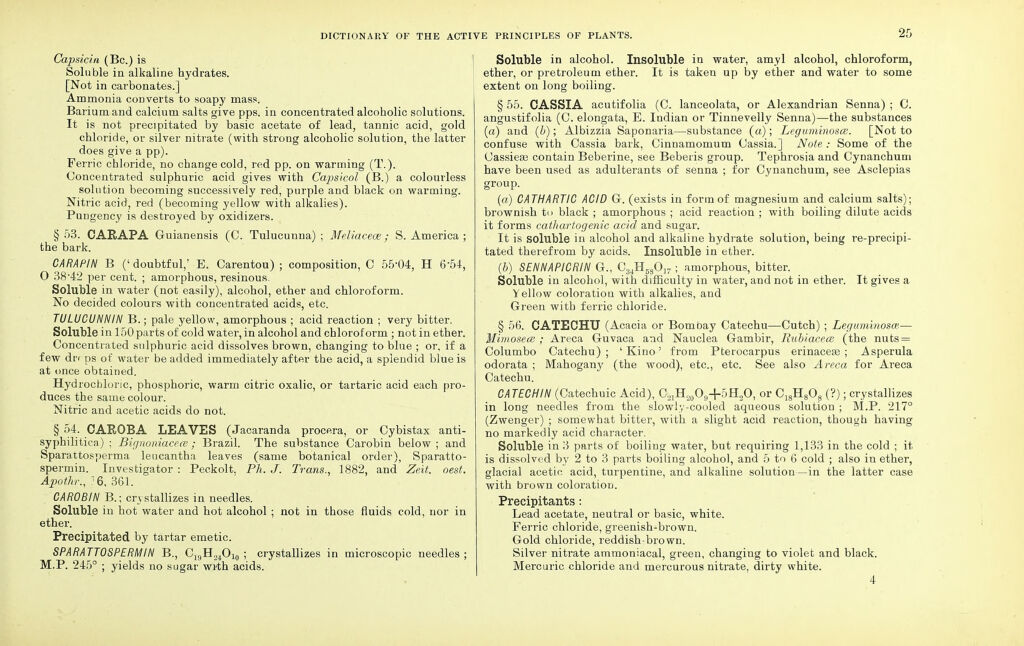
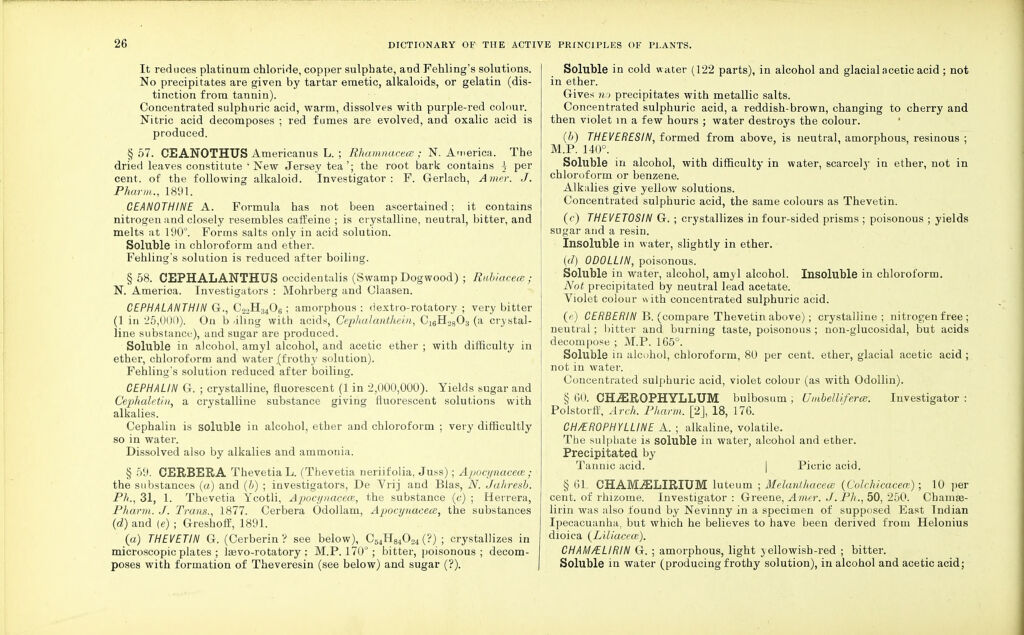
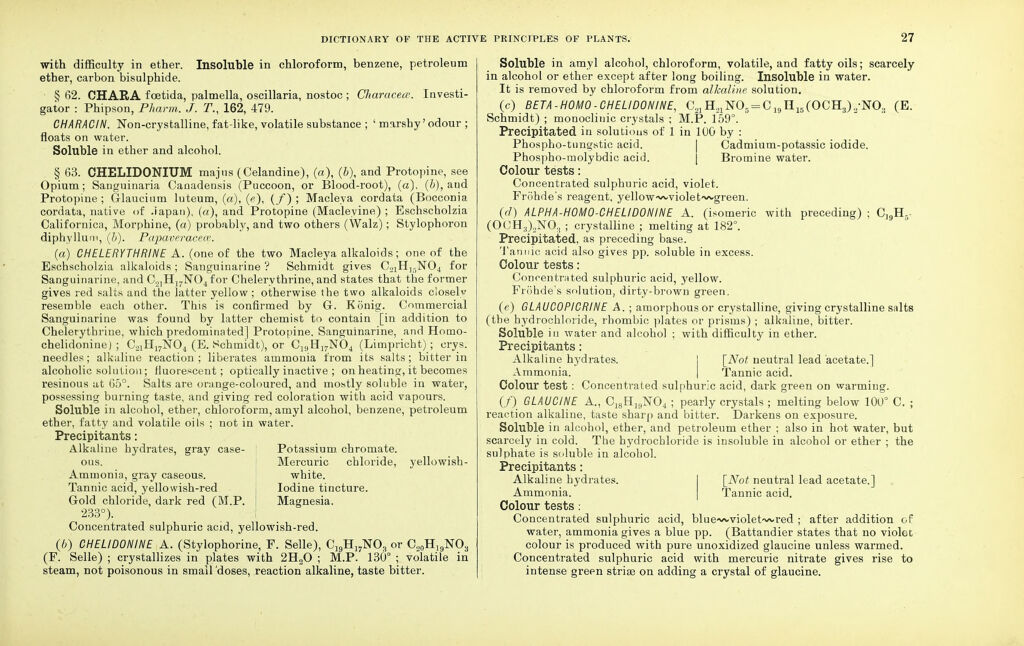
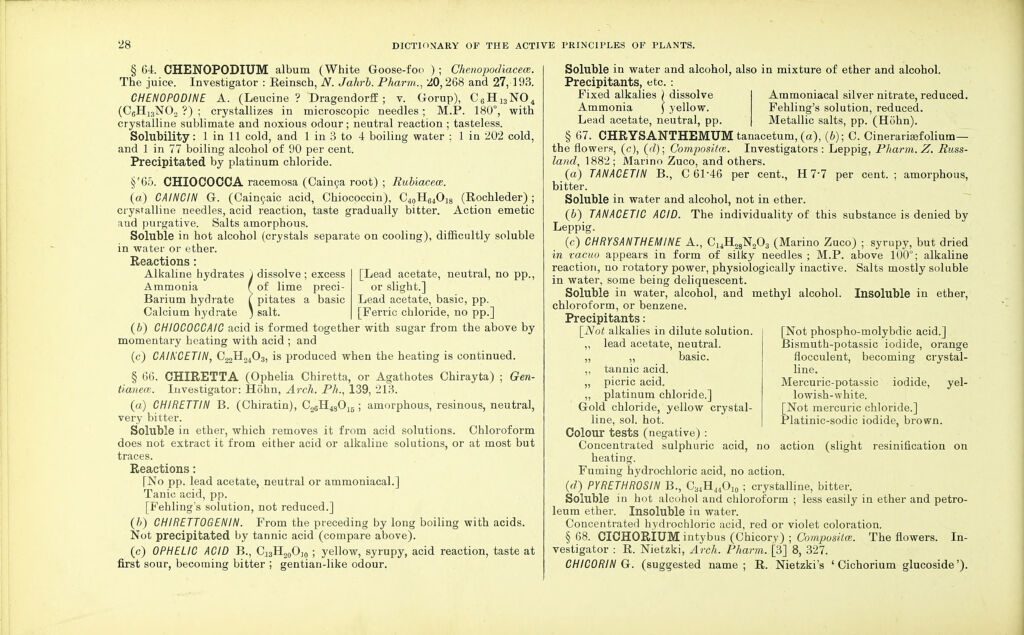
Dictionary of the active principles of plants: alkaloids : bitter principles; glucosides; their sources, nature, and chemical characteristics / with tabular summary, classification of reactions, and full botanical and general indexes. By Charles E. Sohn.
- Sohn, Charles E.
- Date:
- 1894
Licence: Public Domain Mark
Credit: Dictionary of the active principles of plants: alkaloids : bitter principles; glucosides; their sources, nature, and chemical characteristics / with tabular summary, classification of reactions, and full botanical and general indexes. By Charles E. Sohn. Source: Wellcome Collection.
Provider: This material has been provided by The University of Leeds Library. The original may be consulted at The University of Leeds Library.
42/210 page 30
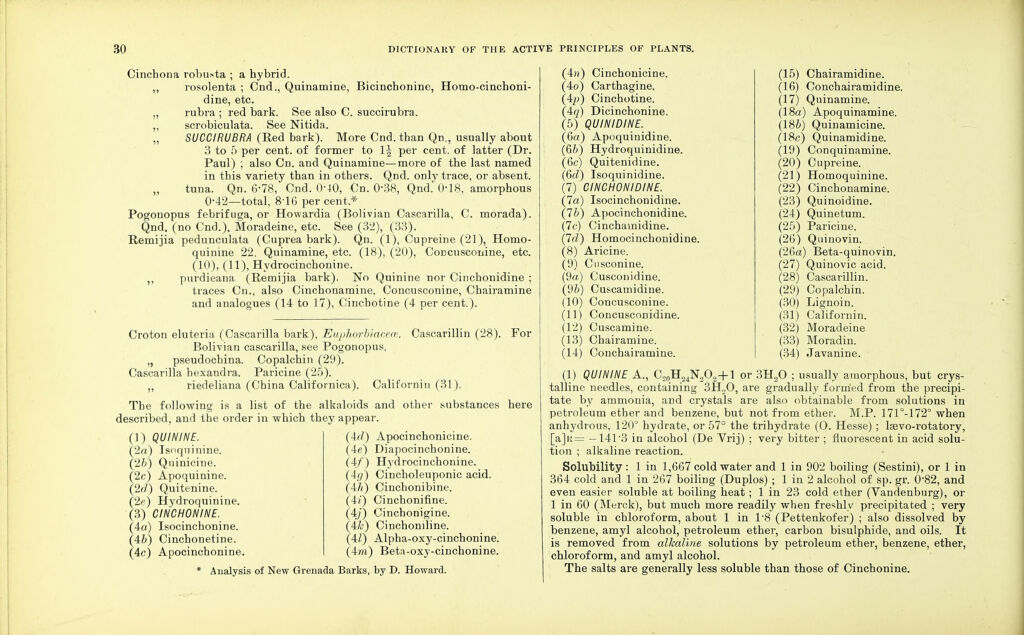
![Cinchona robusta ; a hybrid. ,, rosolenta ; Cnd., Quinamine, Bicinchonine, Homo-cinchoni- dirie, etc. rubra ; red bark. See also C. succirubra. ,, scrobiculata. See Nitida. „ SUCCIRUBRA (Red bark). More Cnd. than Qn., usually about 3 to 5 per cent, of former to 1| per cent, of latter (Dr. Paul) ; also Cn. and Quinamine—more of the last named in this variety than in others. Qnd. only trace, or absent. „ tuna. Qn. 6-78, Cnd. 0-40, Cn. 0-38, Qnd. 0-18, amorphous 0-42—total, 8-16 per cent* Pogonopus febrifuga, or Howardia (Bolivian Cascarilla, C. morada). Qnd. (no Cnd.), Moradeine, etc. See (32), (33). Remijia pedunculata (Cuprea bark). Qn. (1), Cupreine (21), Homo- quinine 22. Quinamine, etc. (18), (20), Concusconine, etc. (10), (11), Hydrocinchonine. ,, purdieana (Remijia bark). No Quinine nor Cinchonidine ; traces Cn., also Cinchonamine, Concusconine, Chairamine and analogues (14 to 17), Cinchotine (4 per cent.). Croton eluteria (Cascarilla bark), Eujpliorbiacece. Cascarillin (28). For Bolivian cascarilla, see Pogonopus. „ pseudochina. Copalchin (29). Cascarilla hexandra. Paricine (25). „ riedeliana (China Californica). Californin (31). The following is a list of the alkaloids and other substances here described, and the order in which they appear. (46) (1) QUININE. (2a) Tsoquinine. (26) Qninicine. (2c) Apoquinine. (2d) Quitenine. (2c) Hydroquinine. (3) CINCH0NINE. (4a) Isocinchonine. (46) Cinchonetine. (4c) Apocinchonine. * Analysis of New Grenada Barks, by D. Howard. Apocinchonicine. Diapocinchonine. (4/) Hydrocinchonine. (4,0) Cincholeuponic acid. (46) Cinchonibine. (4i) Cinchonifine. (4j) Cinchonigine. (Ak) Cinchoniline. (4^) Alpha-oxy-cinchonine. (4m) Beta-oxy-cinchonine. (in) Cinchonicine. (4o) Carthagine. (4^>) Cinchotine. (4a) Dicinchonine. (5) QUINIDINE. (6a) Apoquinidine. (66) Hydroquinidine. (6c) Quitenidine. (6d) Isoquinidine. (7) CINCHONIDINE. (la) Isocinchonidine. (76) Apocinchonidine. (7c) Cinchamidine. (Id) Homocinchonidine. (8) Aricine. (9) Cusconine. (9a) Cusconidine. (96) Cuscamidine. (10) Concusconine. (11) Concusconidine. (12) Cuscamiue. (13) Chairamine. (14) Conchairamine. (15) Chairamidine. (16) Conchairamidine. (17) Quinamine. (18a) Apoquinamine. (186) Quinamicine. (18c) Quinamidine. (19) Conquinamine. (20) Cupreine. (21) Homoquinine. (22) Cinchonamine. (23) Quinoidine. (24) Quinetum. (25) Paricine. (26) Quinovin. (26a) Beta-quinovin. (27) Quinovic acid. (28) Cascarillin. (29) Copalchin. (30) Lignoin. (31) Californin. (32) Moradeine (33) Moradin. (34) Javanine. (1) QUININE A., C.:nH„4N202+l or 3H20 ; usually amorphous, but crys- talline needles, containing 3H20, are gradually formed from the precipi- tate by ammonia, and crystals are also obtainable from solutions in petroleum ether and benzene, but not from ether. M.P. 171°-172° when anhydrous, 120° hydrate, or 57° the trihydrate (O. Hesse) ; laevo-rotatory, [a]R= -141'3 in alcohol (De Vrij) ; very bitter ; fluorescent in acid solu- tion ; alkaline reaction. Solubility : 1 in 1,667 cold water and 1 in 902 boiling (Sestini), or 1 in 364 cold and 1 in 267 boiling (Duplos) ; 1 in 2 alcohol of sp. gr. 082, and even easier soluble at boiling heat; 1 in 23 cold ether (Vandenburg), or 1 in 60 (Merck), but much more readily when freshly precipitated ; very soluble in chloroform, about 1 in T8 (Pettenkofer) ; also dissolved by benzene, amyl alcohol, petroleum ether, carbon bisulphide, and oils. It is removed from alkaline solutions by petroleum ether, benzene, ether, chloroform, and amyl alcohol. The salts are generally less soluble than those of Cinchonine.](https://iiif.wellcomecollection.org/image/b21503023_0042.jp2/full/800%2C/0/default.jpg)