Dictionary of the active principles of plants: alkaloids : bitter principles; glucosides; their sources, nature, and chemical characteristics / with tabular summary, classification of reactions, and full botanical and general indexes. By Charles E. Sohn.
- Sohn, Charles E.
- Date:
- 1894
Licence: Public Domain Mark
Credit: Dictionary of the active principles of plants: alkaloids : bitter principles; glucosides; their sources, nature, and chemical characteristics / with tabular summary, classification of reactions, and full botanical and general indexes. By Charles E. Sohn. Source: Wellcome Collection.
Provider: This material has been provided by The University of Leeds Library. The original may be consulted at The University of Leeds Library.
44/210 page 32
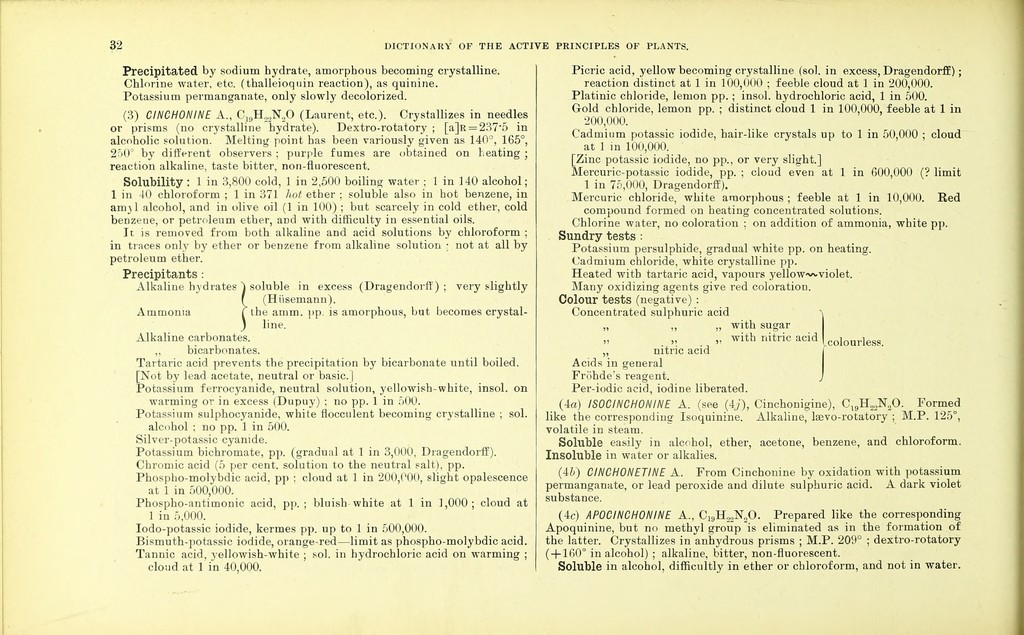
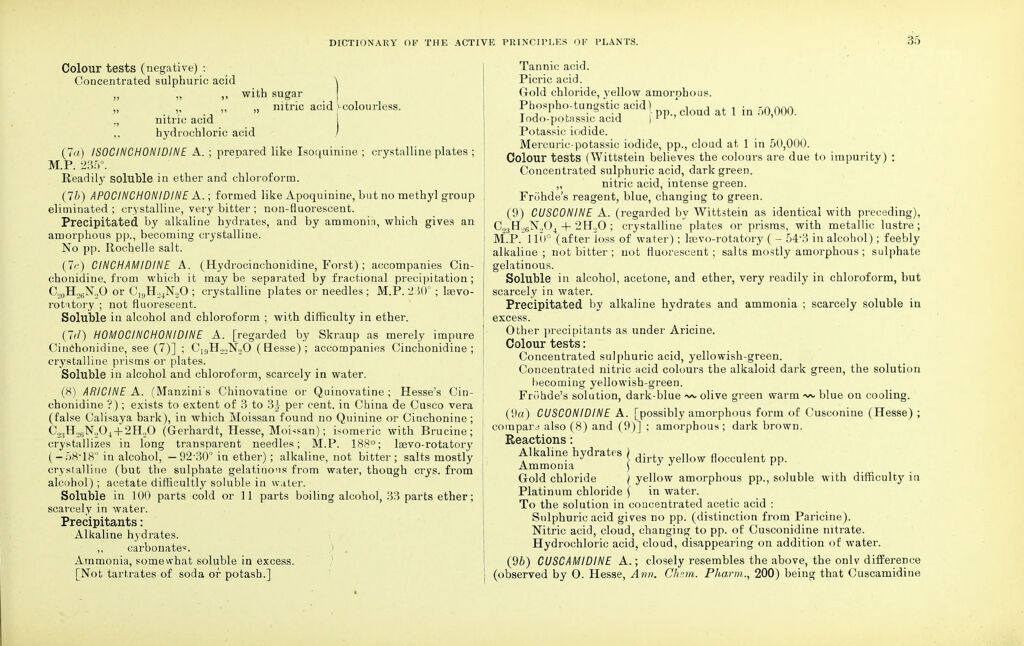
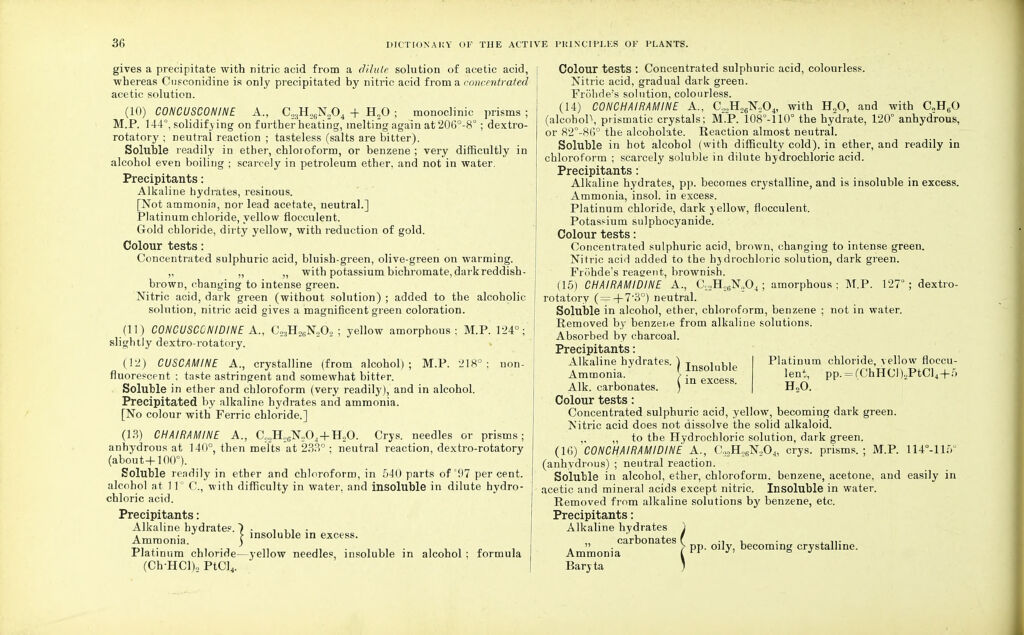
![Precipitated by sodium hydrate, amorphous becoming crystalline. Chlorine water, etc. (thalleioqnin reaction), as quinine. Potassium permanganate, only slowly decolorized. (3) CINCHONINE A., C19H22N20 (Laurent, etc.). Crystallizes in needles or prisms (no crystalline hydrate). Dextro-rotatory ; [a]R = 2375 in alcoholic solution. Melting point has been variously given as 140°, 165°, 250° by different observers ; purple fumes are obtained on heating ; reaction alkaline, taste bitter, non-fluorescent. Solubility : 1 in 3,800 cold, 1 in 2,500 boiling water ; 1 in 140 alcohol; 1 in 40 chloroform ; 1 in 371 hot ether ; soluble also in hot benzene, in amjl alcohol, and in olive oil (1 in 100) ; but scarcely in cold ether, cold benzeue, or petroleum ether, aDd with difficulty in essential oils. It is removed from both alkaline and acid solutions by chloroform ; in traces only by ether or benzene from alkaline solution ; not at all by petroleum ether. Precipitants : Alkaline hydrates } soluble in excess (Dragendorff) ; very slightly f (Hiisemann). Ammonia (the amm. pp. is amorphous, but becomes crystal- J line. Alkaline carbonates. ,, bicarbonates. Tartaric acid prevents the precipitation by bicarbonate until boiled. [Not by lead acetate, neutral or basic. | Potassium ferrocyanide, neutral solution, yellowish-white, insol. on warming or in excess (Dupuy) ; no pp. 1 in 500. Potassium sulphocyanide, white flocculent becoming crystalline ; sol. alcohol ; no pp. 1 in 500. Silver-potassic cyanide. Potassium bichromate, pp. (gradual at 1 in 3,000, Dragendorff). Chromic acid (5 per cent, solution to the neutral salt), pp. Phospho-molybdic acid, pp : cloud at 1 in 200,000, slight opalescence at 1 in 500,000. Phospho-antimonic acid, pp. ; bluish white at 1 in 1,000; cloud at 1 in 5,000. Iodo-potassic iodide, kermes pp. up to 1 in 500,000. Bismuth-potassic iodide, orange-red—limit as phospho-molybdic acid. Tannic acid, yellowish-white ; sol. in hydrochloric acid on warming ; cloud at 1 in 40,000. Picric acid, yellow becoming crystalline (sol. in excess, Dragendorff); reaction distinct at 1 in 100,000 ; feeble cloud at 1 in 200,000. Platinic chloride, lemon pp.; insol. hydrochloric acid, 1 in 500. Gold chloride, lemon pp. ; distinct cloud 1 in 100,000, feeble at 1 in 200,000. Cadmium potassic iodide, hair-like crystals up to 1 in 50,000 ; cloud at 1 in 100,000. [Zinc potassic iodide, no pp., or very slight.] Mercuric-potassic iodide, pp. ; cloud even at 1 in 600,000 (? limit 1 in 75,000, Dragendorff). Mercuric chloride, white amorphous ; feeble at 1 in 10,000. Red compound formed on heating concentrated solutions. Chlorine water, no coloration ; on addition of ammonia, white pp. Sundry tests : Potassium persulphide, gradual white pp. on heating. Cadmium chloride, white crystalline pp. Heated with tartaric acid, vapours yellow~vviolet. Many oxidizing agents give red coloration. Colour tests (negative) : Concentrated sulphuric acid „ ,, ,, with sugar ,, „ ,, yvith nitric acid „ nitric acid Acids in general Fronde's reagent. Per-iodic acid, iodine liberated. _ (4a) IS0CINCH0NINE A. (see (Aj), Cinchonigine), C19H22N20. Formed like the corresponding Isoquinine. Alkaline, lasvo-rotatory ; M.P. 125°, volatile in steam. Soluble easily in alcohol, ether, acetone, benzene, and chloroform. Insoluble in water or alkalies. (4b) CINCH0NETINE A. From Cinchonine by oxidation with potassium permanganate, or lead peroxide and dilute sulphuric acid. A dark violet substance. (4c) AP0CINCH0NINE A., C19H22N20. Prepared like the corresponding Apoquinine, but no methyl group is eliminated as in the formation of the latter. Crystallizes in anhydrous prisms ; M.P. 209° ; dextro-rotatory ( + lfi0° in alcohol) ; alkaline, bitter, non-fluorescent. Soluble in alcohol, difficultly in ether or chloroform, and not in water. .colourless.](https://iiif.wellcomecollection.org/image/b21503023_0044.jp2/full/800%2C/0/default.jpg)