Dictionary of the active principles of plants: alkaloids : bitter principles; glucosides; their sources, nature, and chemical characteristics / with tabular summary, classification of reactions, and full botanical and general indexes. By Charles E. Sohn.
- Sohn, Charles E.
- Date:
- 1894
Licence: Public Domain Mark
Credit: Dictionary of the active principles of plants: alkaloids : bitter principles; glucosides; their sources, nature, and chemical characteristics / with tabular summary, classification of reactions, and full botanical and general indexes. By Charles E. Sohn. Source: Wellcome Collection.
Provider: This material has been provided by The University of Leeds Library. The original may be consulted at The University of Leeds Library.
46/210 page 34
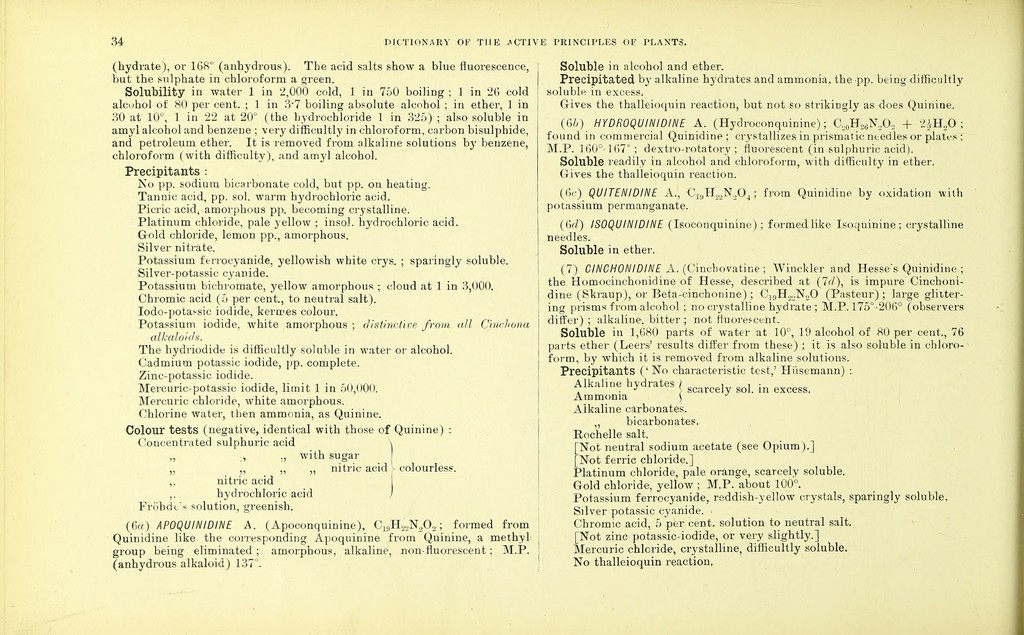
![(hydrate), or 168° (anhydrous). The acid salts show a blue fluorescence, but the sulphate in chloroform a green. Solubility in water 1 in 2,000 cold, 1 in 750 boiling ; 1 in 26 cold alcohol of 80 per cent. ; 1 in 37 boiling absolute alcohol ; in ether, 1 in 30 at 10°, 1 in 22 at 20° (the hydrochloride 1 in 325) ; also soluble in amyl alcohol and benzene ; very difficultly in chloroform, carbon bisulphide, and petroleum ether. It is removed from alkaline solutions by benzene, chloroform (with difficulty), and amyl alcohol. Precipitants : No pp. sodium bicarbonate cold, but pp. on heating. Tanuic acid, pp. sol. warm hydrochloric acid. Picric acid, amorphous pp. becoming crystalline. Platinum chloride, pale yellow ; insol. hydrochloric acid. Gold chloride, lemon pp., amorphous. Silver nitrate. Potassium ferrocyanide, yellowish white crys. ; sparingly soluble. Silver-potassic cyanide. Potassium bichromate, yellow amorphous ; cloud at 1 in 3,000. Chromic acid (o per cent., to neutral salt). Iodo-potassic iodide, kermes colour. Potassium iodide, white amorphous ; distinctive from all Cinchona alkaloids. The hydriodide is difficultly soluble in water or alcohol. Cadmium potassic iodide, pp. complete. Zinc-potassic iodide. Mercuric-potassic iodide, limit 1 in 50,000. Mercuric chloride, white amorphous. Chlorine water, then ammonia, as Quinine. Colour tests (negative, identical with those of Quinine) : Concentrated sulphuric acid \ „ , „ with sugar ,, ,, „ ,, nitric acid;- colourless. ,, nitric acid ,. hydrochloric acid Frobdb's solution, greenish. (6«) AP0QUINIDINE A. (Apoconquinine), CIBH.™N202; formed from Quinidine like the corresponding Apoquinine from Quinine, a methyl group being eliminated ; amorphous, alkaline, non-fluorescent; M.P. (anhydrous alkaloid) 137°. Soluble in alcohol and ether. Precipitated by alkaline hydrates and ammonia, the pp. being difficultly soluble in excess. Gives the thalleioquin reaction, but not so strikingly as does Quinine. (6&) HYDROQUINIDINE A. (Hydroconquinine); C,0H,6N,O., + 2£H20 ; found in commercial QuiDidine; crystallizes in prismatic needles or plates ; M.P. 160°-167°; dextro-rotatory; fluorescent (in sulphuric acid). Soluble readily in alcohol and chloroform, with difficulty in ether. Gives the thalleioquin reaction. (6c) QUITENIDINE A., C^H^O,,; from Quinidine by oxidation with potassium permanganate. (6rf) IS0QUINIDINE (Isoconquinine) ; formed like Isoquinine; crystalline needles. Soluble in ether. (7) CINCH0NIDINE A. (Cinchovatine ; Wiuckler and Hesse's Quinidine ; the Homocinchonidine of Hesse, described at (7^/), is impure Cinchoni- dine (Skraup), or Beta-cinchonine); Ci9H22N20 (Pasteur) ; large glitter- ing prisms from alcohol ; no crystalline hydrate ; M.P. 175°-206° (observers differ) ; alkaline, bitter ; not fluorescent. Soluble in 1,680 parts of water at 10°, 19 alcohol of 80 per cent., 76 parts ether (Leers' results differ from these) ; it is also soluble in chloro- form, by which it is removed from alkaline solutions. Precipitants ('No characteristic test,' Hi'isemann) : Alkaline hydrates I i i : , . J \ scarcely sol. in excess. Ammonia ) Alkaline carbonates. „ bicarbonates. Rochelle salt. [Not neutral sodium acetate (see Opium).] [Not ferric chloride.] Platinum chloride, pale orange, scarcely soluble. Gold chloride, yellow ; M.P. about 100°. Potassium ferrocyanide, reddish-yellow crystals, sparingly soluble. Silver potassic cyanide. ■ Chromic acid, 5 per cent, solution to neutral salt. [Not zinc potassic-iodide, or very slightly.] Mercuric chloride, crystalline, difficultly soluble. No thalleioquin reaction.](https://iiif.wellcomecollection.org/image/b21503023_0046.jp2/full/800%2C/0/default.jpg)