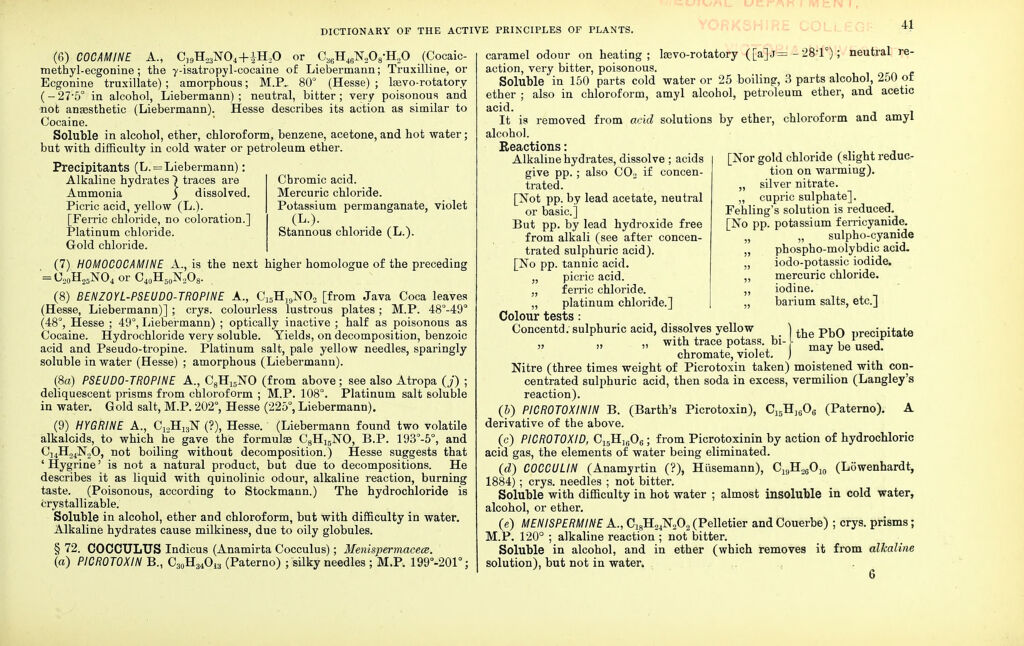
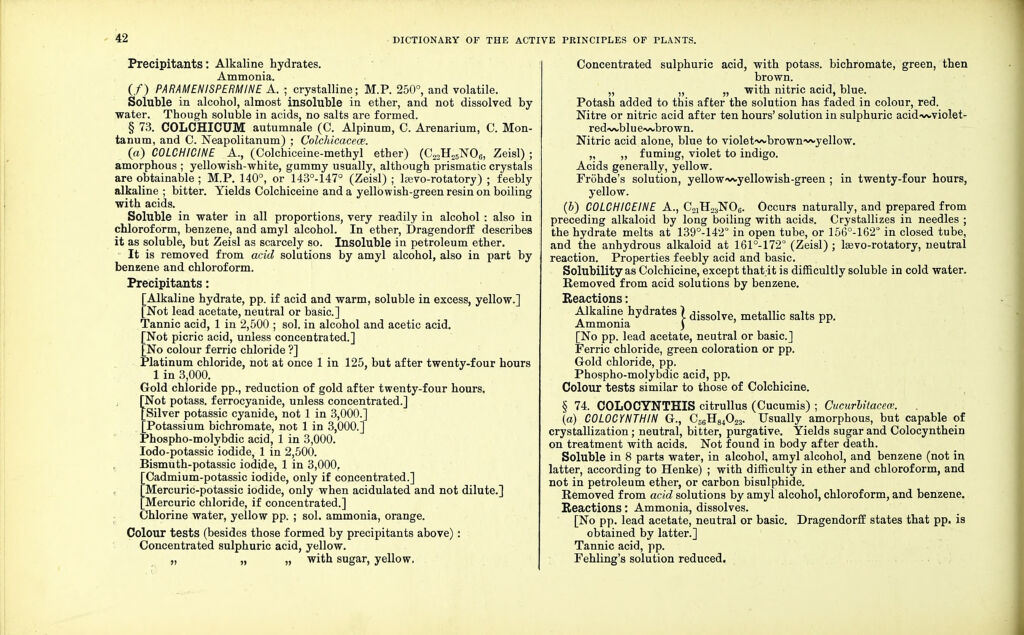
Dictionary of the active principles of plants: alkaloids : bitter principles; glucosides; their sources, nature, and chemical characteristics / with tabular summary, classification of reactions, and full botanical and general indexes. By Charles E. Sohn.
- Sohn, Charles E.
- Date:
- 1894
Licence: Public Domain Mark
Credit: Dictionary of the active principles of plants: alkaloids : bitter principles; glucosides; their sources, nature, and chemical characteristics / with tabular summary, classification of reactions, and full botanical and general indexes. By Charles E. Sohn. Source: Wellcome Collection.
Provider: This material has been provided by The University of Leeds Library. The original may be consulted at The University of Leeds Library.
49/210 page 37
![Colour tests : Concentrated sulphuric acid, intense green. Nitric acid, as Chairamidine (15) above. Frohde's reagent, intense green. (17) QUIN AMINE A., C19H24N202. Crystallizes in prisms (no crystalline hydrate; M.P. 172°; dextro-rotatory (-+-104-5°); tasteless, though salts are bitter ; non-fluorescent. Soluble in 1,516 parts water at 1(5° C, 105 alcohol at 20° C, 48 ether at 16° C, in chloroform, boiling benzene, and petroleum ether. Precipitated by gold chloride, pale yellow, changing to red with reduction of gold. (18a) APOQUINAMINE A. From the above by boiling with acids. (186) QUINAMICINE A., C^H.^NJX. Formed together with (18c) from Quinamine bv heating to 130° with hydrochloric acid in sealed tube. Crystalline ; M.P. 109°. Soluble in alcohol, ether, and chloroform. Precipitants: Alkaline hydrates ) ,, carbonates > insol. in excess. ., bicarbonates J Ammonia, amorphous, becoming crystalline ; insol. in excess. Gold chloride, amorphous ; yellow if pure, or purple if containing Quinamidine. Potassium iodide. Salicylate ammonia. Oxalate ,, Sodium chloride. Acids (hydrochloric, nitric, or sulphuric) also give precipitates. (18c) QUINAMIDINE A. Formed in the preparation of the above, from which it is distinguished by giving No pp. with bicarbonates of the alkalies. The gold chloride pp. is purple. (19) CONQUINAMINE A., C]9H24N202. Triclinic prisms; M.P. 121°; dextro-rotatory (+204°). Soluble in alcohol, ether, chloroform, benzene, carbon bisulphide, and with difficulty in water. Precipitate by gold cbloiide is yellow, becoming purple. (20) CUPREINE A., C,,H,,N2d2 and with 2H20. Crystallizes in prisms 37 from ether ; becomes anhydrous at 120°-125°, subsequently melting at 198° ; alkaline i-eaction, lgevo rotatory (= — 175°). Soluble in alcohol, but with difficulty in ether or chloroform. It is not removed from a 10 per cent, soda solution, but from ammoniacal liquids by immiscible solvents. Precipitants : Alkaline hydrate, soluble in excess. Ammonia, slightly soluble in excess. Ferric chloride, dark brown coloration. Platinum chloride, pp. difficultly soluble. The dry double salt becomes dark green on heating. Potassium sulphocyanide, cloud changing gradually to crys. pp. Chlorine water, etc. (thalleioquin reaction), as Quinine. (21) H0M0QUININE A. (Ultraquinine), C19H22N2O2-C20H24N2O2. A com- pound of Quinine and Cupreine in molecular proportions (Paul and Cownley). Pearly prismatic crystals in stellar groups ; M.P. 177° ; lasvo- rotatory [a] J= —221°; fluorescent (the acid salts) ; strongly alkaline. Soluble in alcohol and chloroform, but with difficulty in ether unless freshly precipitated. Reactions: Ammonia, dissolves. Rochelle salt, pp. with concentrated solutions. . [No pp. iodo-potassic iodide.] Concentrated sulphuric acid with potass, bichromate, deep green. Concentrated sulphuric acid alone ) , , -, > do not decompose. „ nitric „ ,, i e Gives the thalleioquin reaction (chlorine water, then ammonia). The soda hydrate pp. contains Quinine and Cupreine, only the former being removable on shaking with ether. (22) CINCH0NAMINE A., C19H24N20. Hexagonal prisms (no crystalline hydrate) ; M.P. 195°; dextro-rotatory (-f-121°) ; bitter, poisonous. Soluble in alcohol, ether, chloroform, benzene, and carbon bisulphide ; difficultly in water and petroleum ether. Hydrochloride sparingly soluble. Reactions: No colour with ferric chloride, nor thalleioquin test (chlorine water, etc.). (23) QUIN0IDINE and (24) QUINETUM are mixtures ; the former con- taining principally Quinicine (see 26) with Cinchonicine (see 4«) ; and the latter the alkaloids of red bark. (25) PARICINE A., Ca6H18N,0, from China Succirubra and Cascarilla](https://iiif.wellcomecollection.org/image/b21503023_0049.jp2/full/800%2C/0/default.jpg)