Dictionary of the active principles of plants: alkaloids : bitter principles; glucosides; their sources, nature, and chemical characteristics / with tabular summary, classification of reactions, and full botanical and general indexes. By Charles E. Sohn.
- Sohn, Charles E.
- Date:
- 1894
Licence: Public Domain Mark
Credit: Dictionary of the active principles of plants: alkaloids : bitter principles; glucosides; their sources, nature, and chemical characteristics / with tabular summary, classification of reactions, and full botanical and general indexes. By Charles E. Sohn. Source: Wellcome Collection.
Provider: This material has been provided by The University of Leeds Library. The original may be consulted at The University of Leeds Library.
51/210 page 39
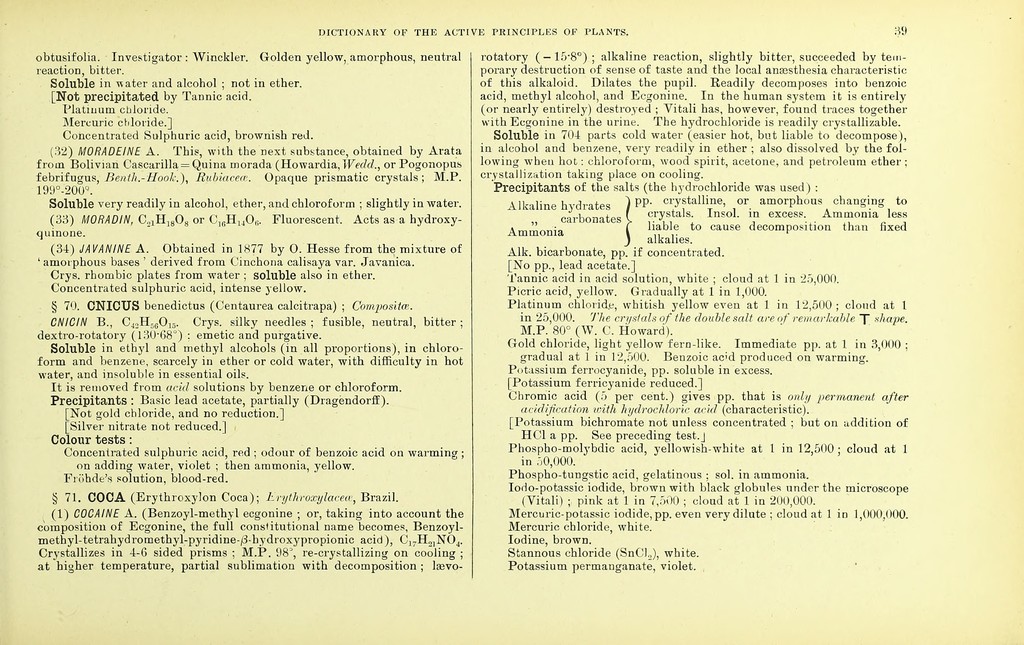
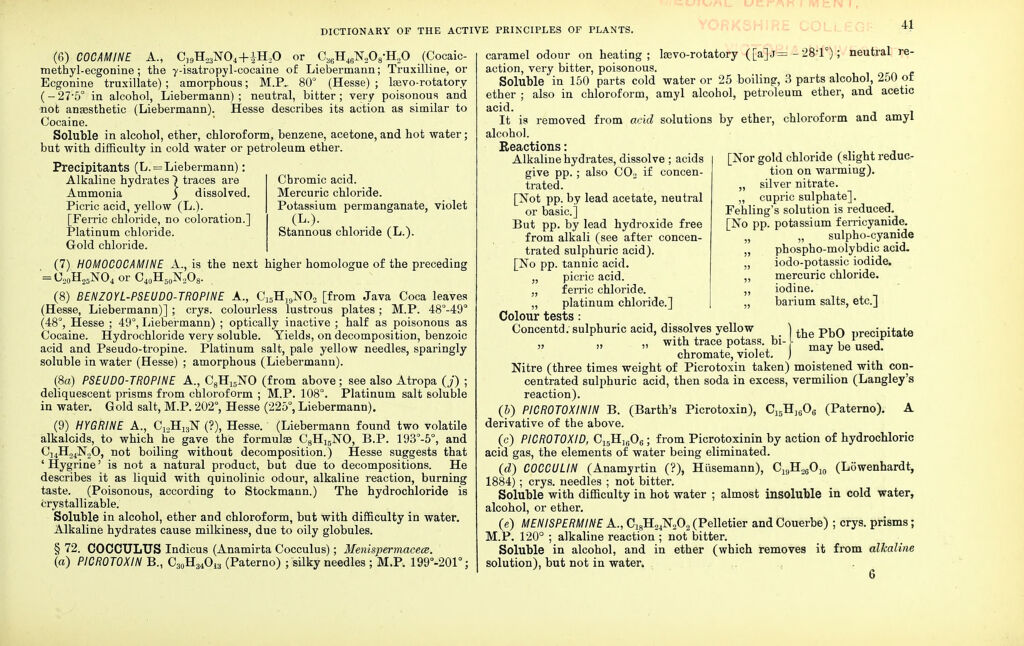
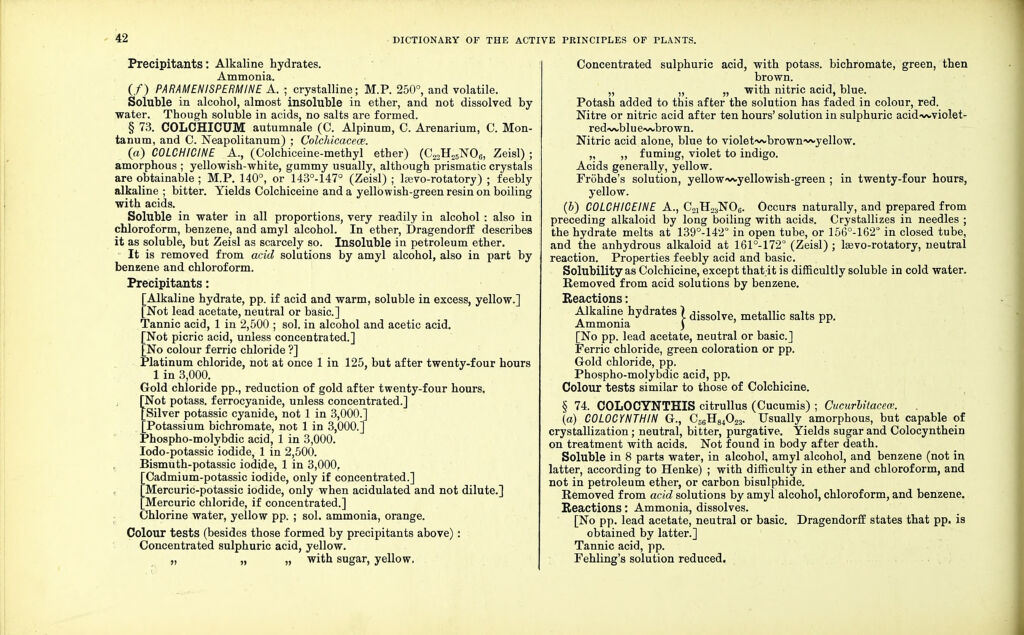
![obtusifolia. Investigator: Winckler. Golden yellow, amorphous, neutral reaction, bitter. Soluble in -water and alcohol ; not in ether. [Not precipitated by Tannic acid. Platinum cbloride. Mercuric chloride.] Concentrated Sulphuric acid, brownish red. (32) MORADEINE A. This, with the next substance, obtained by Arata from Bolivian Cascarilla = Quina morada (Howardia, Wedd., or Pogonopus febrifugus, Benth.-Hool,-,), Kubiaceas. Opaque prismatic crystals; M.P. 199°-200Q. Soluble very readily in alcohol, ether, and chloroform ; slightly in water. (33) MORADIN, C.2lHJg08 or C1(!H140(;. Fluorescent. Acts as a hydroxy- quinone. (34) JAVAMINE A. Obtained in 1877 by 0. Hesse from the mixture of ' amorphous bases ' derived from Cinchona calisaya var. Javanica. Crys. rhombic plates from water ; soluble also in ether. Concentrated sulphuric acid, intense yellow. § 70. CNICUS benedictus (Centaurea calcitrapa) ; Composite?. CNICIN B., C42H56015. Crys. silky needles ; fusible, neutral, bitter ; dextro-rotatory (13068°) : emetic and purgative. Soluble in ethyl and methyl alcohols (in all proportions), in chloro- form and benzene, scarcely in ether or cold water, with difficulty in hot water, and insoluble in essential oils. It is removed from acid solutions by benzene or chloroform. Precipitants : Basic lead acetate, partially (Dragendorff). [Not gold chloride, and no reduction.] [Silver nitrate not reduced.] Colour tests: Concentrated sulphuric acid, red ; odour of benzoic acid on warming ; on adding water, violet ; then ammonia, yellow. Frohde's solution, blood-red. § 71. COCA (Erythroxylon Coca); Erythroxylacea, Brazil. (1) COCAINE A. (Benzoyl-methyl ecgonine ; or, taking into account the composition of Ecgonine, the full constitutional name becomes, Benzoyl- methyl-tetrahydromethyl-pyridine-/3-hydroxypropionic acid), C]7H2]N04. Crystallizes in 4-6 sided prisms ; M.P. 98°, re-crystallizing on cooling ; at higher temperature, partial sublimation with decomposition ; lasvo- rotatory (—15'8°) ; alkaline reaction, slightly bitter, succeeded by tem- porary destruction of sense of taste and the local anassthesia characteristic of this alkaloid. Dilates the pupil. Readily decomposes into benzoic acid, methyl alcohol, and Ecgonine. In the human system it is entirely (or nearly entirely) destroyed ; Vitali has, however, found traces together with Ecgonine in the urine. The hydrochloride is readily crystallizable. Soluble in 704 parts cold water (easier hot, but liable to decompose), in alcohol and benzene, very readily in ether ; also dissolved by the fol- lowing wheu hot: chloroform, wood spirit, acetone, and petroleum ether; crystallization taking place on cooling. Precipitants of the salts (the hydrochloride was used) : Alkaline hydrates ) PP crystalline, or amorphous changing to carbonates \ CI7sta's- lnsol. in excess. Ammonia less Ammonia ' I ia'3'e *° cause decomposition than fixed J alkalies. Alk. bicarbonate, pp. if concentrated. [No pp., lead acetate.] Tannic acid in acid solution, white ; cloud at 1 in 25,000. Picric acid, yellow. Gradually at 1 in 1,000. Platinum chloride, whitish yellow even at 1 in 12,500 ; cloud at I in 25,000. The crystals of the double salt are of remarkable 7 shape. M.P. 80° (W. C. Howard). Gold chloride, light yellow fern-like. Immediate pp. at 1 in 3,000 ; gradual at 1 in 12,500. Benzoic ac'd produced on warming. Potassium ferrocyanide, pp. soluble in excess. [Potassium ferricyanide reduced.] Chromic acid (5 per cent.) gives pp. that is only permanent after acidification with hydrochloric acid (characteristic). [Potassium bichromate not unless concentrated ; but on addition of HC1 a pp. See preceding test.J Phospho-molybdic acid, yellowish-white at 1 in 12,500 ; cloud at 1 in 50,000. Phospho-tungstic acid, gelatinous : sol. in ammonia. Iodo-potassic iodide, brown with black globules under the microscope (Vitali) ; pink at 1 in 7,500 ; cloud at 1 in 200,000. Mercuric-potassic iodide, pp. even very dilute ; cloud at 1 in 1,(100,000. Mercuric chloride, white. Iodine, brown. Stannous chloride (SnClu), white. Potassium permanganate, violet.](https://iiif.wellcomecollection.org/image/b21503023_0051.jp2/full/800%2C/0/default.jpg)