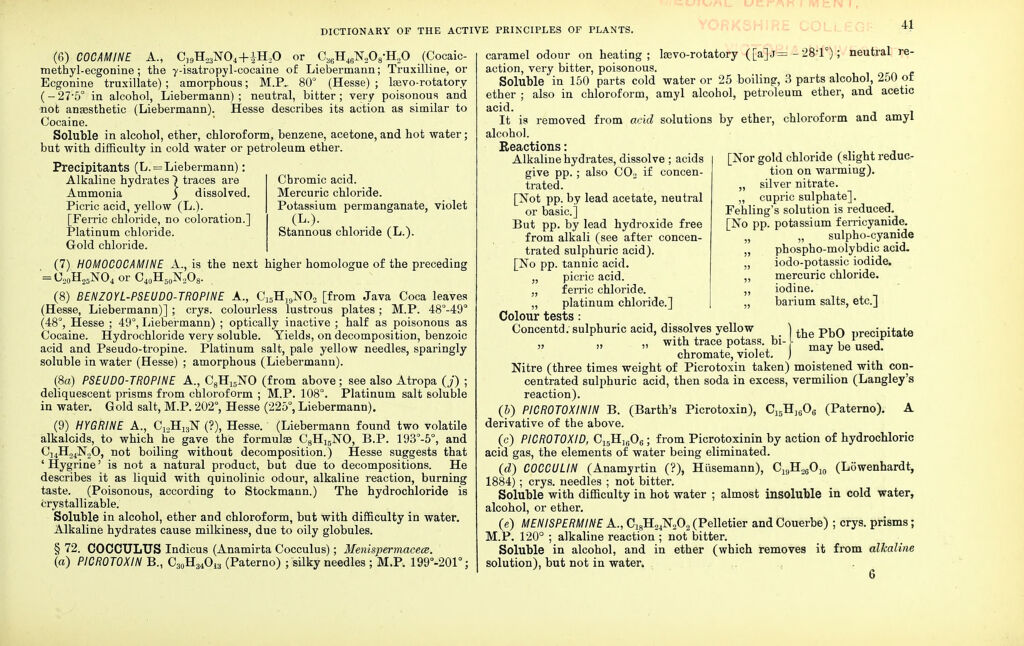
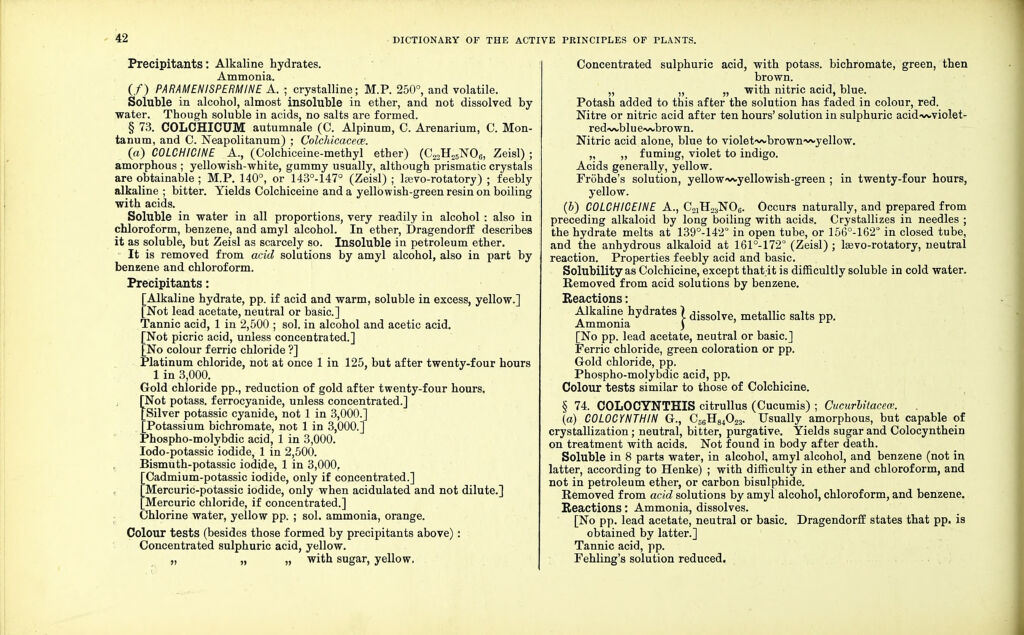
Dictionary of the active principles of plants: alkaloids : bitter principles; glucosides; their sources, nature, and chemical characteristics / with tabular summary, classification of reactions, and full botanical and general indexes. By Charles E. Sohn.
- Sohn, Charles E.
- Date:
- 1894
Licence: Public Domain Mark
Credit: Dictionary of the active principles of plants: alkaloids : bitter principles; glucosides; their sources, nature, and chemical characteristics / with tabular summary, classification of reactions, and full botanical and general indexes. By Charles E. Sohn. Source: Wellcome Collection.
Provider: This material has been provided by The University of Leeds Library. The original may be consulted at The University of Leeds Library.
52/210 page 40
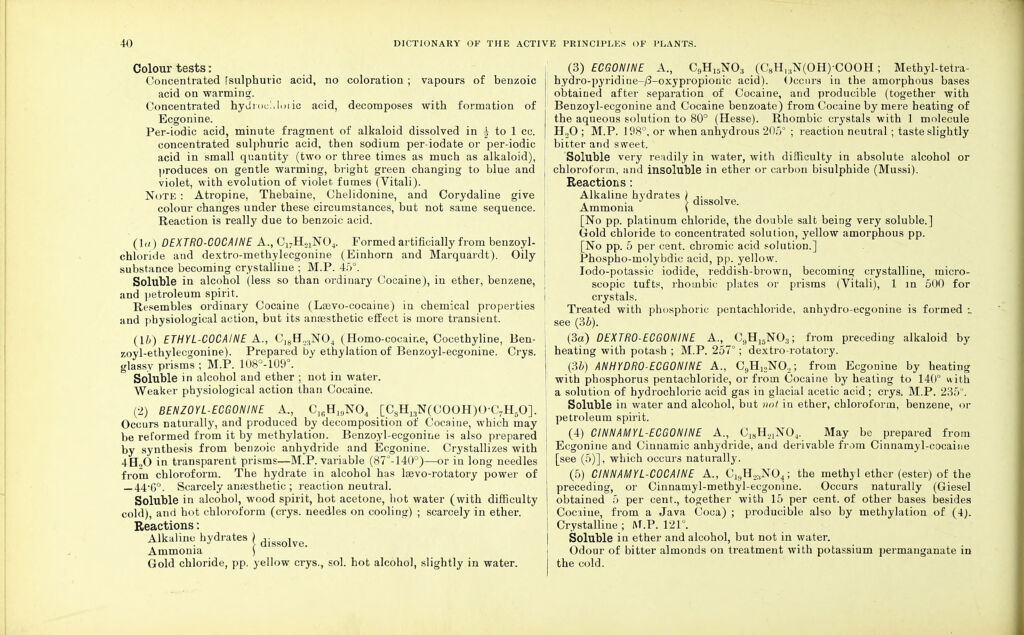
O-C7H5O]. Occurs naturally, and produced by decomposition of Cocaine, which may be reformed from it by methylation. Benzoyl-ecgonine is also prepared by synthesis from benzoic anhydride and Ecgonine. Crystallizes with 4ET.,0 in transparent prisms—M.P. variable (87°-140°)—or in long needles from chloroform. The hydrate in alcohol has lasvo-rotatory power of _44-G°. Scarcely anaesthetic ; reaction neutral. Soluble in alcohol, wood spirit, hot acetone, hot water (with difficulty cold), and hot chloroform (crys. needles on cooling) ; scarcely in ether. Reactions: Alkaline hydrates ) digsolve_ Ammonia ) Gold chloride, pp. yellow crys., sol. hot alcohol, slightly in water. (3) ECGONINE A., C9H15NO;i (C8H,.,N(OH)-COOH ; Methyl-tetra- hydro-pyridine-/3-oxypropionic acid). Occurs in the amorphous bases obtained after separation of Cocaine, and producible (together with Benzoyl-ecgonine and Cocaine benzoate) from Cocaine by mere heating of the aqueous solution to 80° (Hesse). Rhombic crystals with 1 molecule H„0 ; M.P. 198°. or when anhydrous 205° ; reaction neutral; taste slightly bitter and sweet. Soluble very readily in water, with difficulty in absolute alcohol or chloroform, and insoluble in ether or carbon bisulphide (Mussi). Reactions: Alkaline hydrates v , . . J } dissolve. Ammonia ( [No pp. platinum chloride, the double salt being very soluble.] Gold chloride to concentrated solution, yellow amorphous pp. [No pp. 5 per cent, chromic acid solution.] Phospho-molybdic acid, pp. yellow. Iodo-potassic iodide, reddish-brown, becoming crystalline, micro- scopic tufts, rhombic plates or prisms (Vitali), 1 in 500 for crystals. Treated with phosphoric pentachloride, anhydro-ecgonine is formed :. see (36). (3a) DEXTR0-ECG0NINE A., C,,H15N03; from preceding alkaloid by heating with potash ; M.P. 257°; dextro-rotatory. (36) ANHYDRO-ECGONINE A., C9H13N02; from Ecgonine by heating with phosphorus pentachloride, or from Cocaine by heating to 140° with a solution of hydrochloric acid gas in glacial acetic acid; crys. M.P. 235°. Soluble in water and alcohol, but not in ether, chloroform, benzene, or petroleum spirit. (4) CINNAMYL-ECGONINE A., C18H21N04. May be prepared from Ecgonine and Cinnamic anhydride, and derivable from Cinnamyl-cocaine [see (5)], which occurs naturally. (5) CINNAMYL-COCAINE A., C1,,Ho:,N04; the methyl ether (ester) of the preceding, or Cinnamyl-methyl-ecgonine. Occurs naturally (Giesel obtained 5 per cent., together with 15 per cent, of other bases besides Cocaine, from a Java Coca) ; producible also by methylation of (4). Crystalline ; M.P. 121°. Soluble in ether and alcohol, but not in water. Odour of bitter almonds on treatment with potassium permanganate in the cold.](https://iiif.wellcomecollection.org/image/b21503023_0052.jp2/full/800%2C/0/default.jpg)