Dictionary of the active principles of plants: alkaloids : bitter principles; glucosides; their sources, nature, and chemical characteristics / with tabular summary, classification of reactions, and full botanical and general indexes. By Charles E. Sohn.
- Sohn, Charles E.
- Date:
- 1894
Licence: Public Domain Mark
Credit: Dictionary of the active principles of plants: alkaloids : bitter principles; glucosides; their sources, nature, and chemical characteristics / with tabular summary, classification of reactions, and full botanical and general indexes. By Charles E. Sohn. Source: Wellcome Collection.
Provider: This material has been provided by The University of Leeds Library. The original may be consulted at The University of Leeds Library.
53/210 page 41
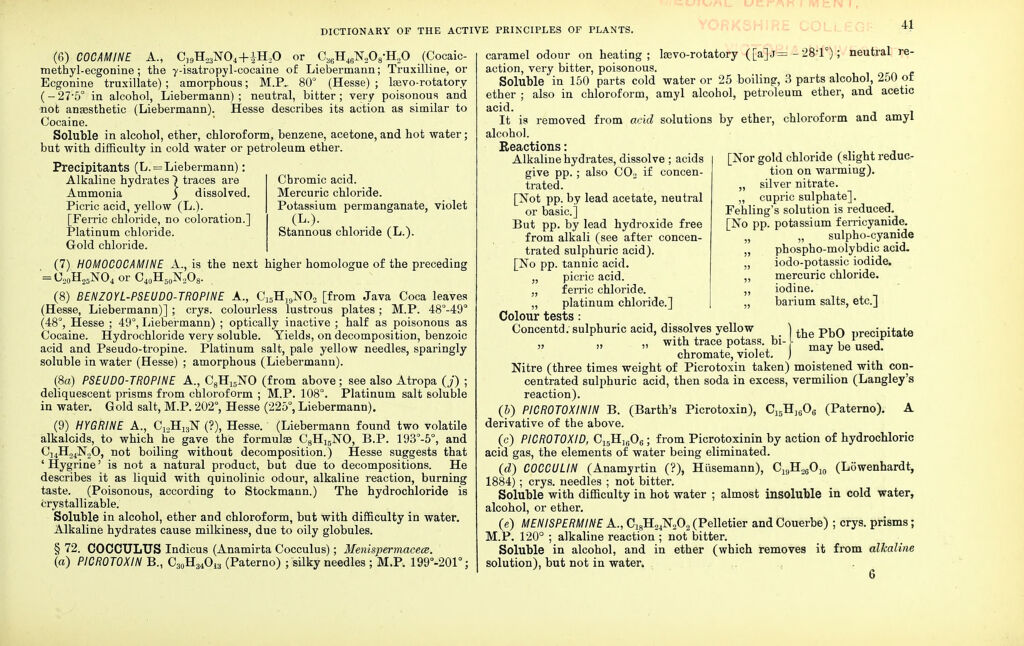
![(6) COCAMINE A., C]9H23N04+iH20 or C36H46N2OyH20 (Cocaic- methyl-ecgonine; the y-isatropyl-cocaine of Liebermann; Truxilline, or Ecgonine truxillate) ; amorphous; M.P.. 80° (Hesse) ; hevo-rotatory (- 27-5° in alcohol, Liebermann) ; neutral, bitter; very poisonous and not anaesthetic (Liebermann). Hesse describes its action as similar to Cocaine. Soluble in alcohol, ether, chloroform, benzene, acetone, and hot water; but with difficulty in cold water or petroleum ether. Precipitants (L. = Liebermann): Alkaline hydrates) traces are Ammonia ) dissolved. Picric acid, yellow (L.). [Ferric chloride, no coloration.] Platinum chloride. Gold chloride. Chromic acid. Mercuric chloride. Potassium permanganate, violet (L.). Stannous chloride (L.). (7) H0M0C0CAMINE A., is the next higher homologue of the preceding = U20H25NO4or C40H50N2O8. . (8) BENZ0YL-PSEUD0-TR0PINE A., C15HJ9NOa [from Java Coca leaves (Hesse, Liebermann)] ; crys. colourless lustrous plates; M.P. 48°-49° (48°, Hesse ; 49°, Liebermann) ; optically inactive ; half as poisonous as Cocaine. Hydrochloride very soluble. Yields, on decomposition, benzoic acid and Pseudo-tropine. Platinum salt, pale yellow needles, sparingly soluble in water (Hesse) ; amorphous (Liebermann). (8a) PSEUDO-TROPINE A., C8H15NO (from above; see also Atropa (j) ; deliquescent prisms from chloroform ; M.P. 108°. Platinum salt soluble in water. Gold salt, M.P. 202°, Hesse (225°, Liebermann). (9) HYGRINE A., C12H13N (?), Hesse.' (Liebermann found two volatile alkaloids, to which he gave the formulas CgHi5NO, B.P. 193°-5°, and C14H24N20, not boiling without decomposition.) Hesse suggests that 'Hygrine' is not a natural product, but due to decompositions. He describes it as liquid with quinolinic odour, alkaline reaction, burning taste. (Poisonous, according to Stockmann.) The hydrochloride is crystallizable. Soluble in alcohol, ether and chloroform, but with difficulty in water. Alkaline hydrates cause milkiness, due to oily globules. § 72. COCOULUS Indicus (Anamirta Cocculus); Menispermacece. (a) PICROTOXIN B., C30H34O13 (Paterno) ; silky needles ; M.P. 199°-201°; 41 [Nor gold chloride (slight reduc- tion on warming). „ silver nitrate. „ cupric sulphate]. Fehling's solution is reduced. [No pp. potassium ferricyanide. ?, „ sulpho-cyanide „ phospho-molybdic acid. „ iodo-potassic iodide. „ mercuric chloride. ,, iodine. „ barium salts, etc.] caramel odour on heating; Isevo-rotatory ([a]j= - 28*1°); neutral re- action, very bitter, poisonous. Soluble in 150 parts cold water or 25 boiling, 3 parts alcohol, 250 of ether ; also in chloroform, amyl alcohol, petroleum ether, and acetic acid. It is removed from acid solutions by ether, chloroform and amyl alcohol. Reactions: Alkaline hydrates, dissolve ; acids give pp.; also C02 if concen- trated. [Not pp. by lead acetate, neutral or basic] But pp. by lead hydroxide free from alkali (see after concen- trated sulphuric acid). [No pp. tannic acid. „ picric acid. „ ferric chloride. ,, platinum chloride.] Colour tests: Concentd. sulphuric acid, dissolves vellow ) the PbO precipitate „ with trace potass bi- be used: chromate, violet. J J Nitre (three times weight of Picrotoxin taken) moistened with con- centrated sulphuric acid, then soda in excess, vermilion (Langley's reaction). (b) PICR0T0XININ B. (Barth's Picrotoxin), Ci5H]606 (Paterno). A derivative of the above. (c) PICR0T0XID, C15Hig06; from Picrotoxinin by action of hydrochloric acid gas, the elements of water being eliminated. {d) C0CCULIN (Anamyrtin (?), Hiisemann), C19H26O10 (Lowenhardt, 1884); crys. needles ; not bitter. Soluble with difficulty in hot water ; almost insoluble in cold water, alcohol, or ether. (e) MEN I'SPERMINE A., C18H24N202 (Pelletier and Couerbe) ; crys. prisms; M.P. 120° ; alkaline reaction ; not bitter. Soluble in alcohol, and in ether (which removes it from alkaline solution), but not in water.](https://iiif.wellcomecollection.org/image/b21503023_0053.jp2/full/800%2C/0/default.jpg)